Find Out More

Find out more about Helena P. Schrader's Sparta novels at: https://www.helenapschrader.com/ancient-sparta.html

Saturday, June 9, 2012

Go Tell the Spartans....


Herodotus refers to three separate monuments erected before his time to commemorate the men who fought at Thermopylae. There was a collective monument which read: Four thousand here from Pelops’ land, Against a million once did stand. There was “a stone lion in memory of Leonidas,” and a special monument erected by the Spartans with a dedication that in one common translation ran: “Go tell the Spartans, stranger passing by, that here, in obedience to the laws, we lie.”

This simple epitaph has, I believe, been the source of much confusion about Sparta down the ages. It is widely interpreted to mean that the 300 Spartans who died at Thermopylae had no option of retreating. Allegedly, these men lay buried in the Pass at Thermopylae, so far from home, because Sparta’s “laws” forbade retreat regardless of the odds or the certainty of death.

But as I have pointed out elsewhere, Spartan forces both surrendered and retreated in a variety of other engagements over the centuries. The Spartans didn’t seem to think there was a “law” against retreat even under far less threatening and less hopeless situations than that presented to Leonidas at Thermopylae. Are we to believe Leonidas and his 300 were the only Spartans who lived and died by Sparta’s laws? Or could there be another explanation of the epitaph?

 The answer, I believe, can be found in the fact that there were, in fact, two Spartan monuments: the one to Leonidas and the one to the other Spartiates. If we separate the two, then we see the glimmer of an answer because it suggests that the “law” that the 300 obeyed may not have applied to Leonidas at all.

Leonidas had an option. Leonidas could have decided to pull-out of the Pass as soon as it became indefensible. Leonidas would not have broken any “law” if he had done so, because there was no law that required Spartans to “fight until death rather than retreat one step.”

But there was a law that required obedience to Sparta’s kings as long as they were beyond the borders of Lacedaemon in command of Sparta’s armies. This law is documented and was widely respected.  Sparta’s kings could be charged, tried and exiled once they were at home, but not during war, not abroad. As long as they were abroad on campaign, their troops were bound to obey them, and for the most part did. 

What this means is that once Leonidas decided to stay and die – as he no doubt believed was his destiny based on the oracle from Delphi – his body guard had no option but to stay with him. There is anecdotal evidence recorded by Plutarch that Leonidas tried to save some of his companions by asking them to deliver dispatches, but the “older men” saw through him and refused. This is consistent with a king determined to face his destiny, but distressed by the knowledge that his decision will drag three hundred of Sparta’s finest with him.

The erection of two separate monuments and the epitaph makes sense in this context as well. Leonidas was the lion, who decided to go down fighting defiantly rather than live to fight a second day. After he had made that courageous decision, however, his bodyguard had no choice and for them, therefore, they lay buried in a foreign pass not as particular heroes but simply “in obedience to the laws.” 

Friday, June 1, 2012

Sparta's Self Confident Citizens


The Spartan Assembly is often portrayed as a body of dumb, possibly illiterate, automatons, a rubber stamp for the decisions of the Kings, Gerousia and ephors.  This view of the Spartan Assembly is based on constitutional provisions that appear to have restricted debate, the absence of secret ballots, and the assumption that Sparta’s notoriously obedient soldiers would “take orders” in the Assembly just as they did on the battlefield. 

However, as any officer can tell you, the best soldiers are not automatons who wait for orders, but thinking, self-confident men who take the initiative and act without – or even against – orders if necessary.  Furthermore, the famous case of Amompharetus refusing to obey Pausanias’ orders on the eve of the Battle of Plataea is a dramatic case in point demonstrating that Spartans didn’t always obey orders – not even on the battlefield.  It further highlights the fact that commanders in the Spartan army did not command obedience:  Amompharetus was not, after all, summarily executed or even relieved of his command. Instead, Pausanias tried to reason with him and finally ordered the rest of the army to move out. Last but not least, Sparta had sufficient confidence in the judgment of its individual commanders to repeatedly send men of “ordinary” status out act as advisors to foreign powers, such as Gylippus in Syracus.

Second, the Assembly had real powers, officially more than the kings.  The Assembly elected the ephors every year and members of the Gerousia whenever vacancies occurred due to death. Hence men with political ambitions had to lobby and ensure a majority of votes against rivals. Also, according to most interpretations of the Great Rhetra, the Assembly had “the final say” on legislation.  The Assembly forced more than one king into exile (e.g. Cleomenes I, Leotychidas, Pleistoanax) and could condemn commanders who exceeded instructions such as Pausanius and Phoebidas.  Thus, despite the inability to introduce legislation and the public nature of the vote, the Spartan Assembly did exercise real power.

Most important, however, the Spartan Assembly was made up of her soldiers and her soldiers knew that they represented the might and power of Sparta. A body in which a large minority was composed of virile young men, in peak physical condition, who have been raised to think of themselves as the elite is unlikely to have been docile. The men who were to be officers and admirals, magistrates, governors, ambassadors and military advisors around the world rose through the ranks of the army – and all had a voice (and probably a following) in the Assembly. Even if some citizens were indifferent to politics and willing to do what others advised, in every generation there would have been ambitious young men willing to challenge existing authority.  Certainly the Assembly as a whole could be quite rowdy as the example of the Assembly (“the Spartans” – not the ephors or Gerousia) throwing the Persian emissaries of Darius down a well demonstrates.

What the above suggests is that Spartan citizens were anything but mindless automatons manipulated by their officers and political leaders, but self-confident citizens with a highly developed sense of their own power and confidence in their own capabilities and judgment.  Sparta’s citizens were not docile or mindless pawns, but thinking and responsible citizens – every bit as confident that their voice in politics mattered as were the citizens of Athens.  The differences between Athenian and Spartan democracy were many, and both were imperfect from the modern standpoint, but the Spartan citizen’s individual status within his polity should not be denigrated. 

Thursday, May 24, 2012

Leonidas the Diplomat


Fans of “300” may find it hard to think of Leonidas as a diplomat.  In the Hollywood cartoon, Leonidas is portrayed as the brutal antithesis of a diplomat: he personally throws a Persian ambassador down a well.  But there is no more historical evidence that Leonidas committed this crime than that Xerxes was a monster. The historical record, foggy and imprecise as it is, suggests that far from being a tactless brut, Leonidas was probably a very savvy diplomat. 

The evidence for Leonidas’ diplomatic talent is indirect rather than explicit. It is evident in what he did, rather than what is said about him.  Quite simply: During his brief reign, Leonidas managed to forge a coalition of Greek states willing to oppose the Persian invasion and to convince this loose coalition of independent and proud city-states to agree to a unified command and a joint strategy.  The significance of such an achievement can be measured by the fact that ten years earlier Athens didn’t place her army under the unified command of even a single Athenian; no less than ten generals shared command of the Athenian army at Marathon.  Equally notable, while Leonidas’ brother Cleomenes alienated Lacedaemon’s Peloponnesian allies to the point of provoking revolt, Leonidas won over new Allies such as Mycenae and Tiryns.  

As for the incident with the Persian ambassadors, Herodotus tells us that the Spartans shared the guilt for the murder of the ambassadors.  According to Herodotus, the entire city was threatened by ill-omens and the Spartan Assembly met repeatedly in order to find volunteers from among the citizens willing to appease the Gods by dying in atonement for the murdered Persian ambassadors.  If, as when Cleomenes’ burned the Sacred Wood near Argos, the crime had been committed by either of the Spartan kings, the Spartans would have expected/demanded that the king bear responsibility.  Whoever killed the Persian ambassadors, the entire Spartiate population felt collectively guilty about it – something that suggests the Persian emissaries had not been the victims of a spontaneous act of violence but rather condemned by the Spartan Assembly.  (Something which in turn suggests that Spartan Assemblies could be quite rowdy affairs, but that is a subject for another day….)


At last the real Sparta emerges!


Under the above title, Peter Spencer published the following review of "Leonidas of Sparta: A Boy of the Agoge." 

Helena Schrader has finally revealed Sparta and Spartan society as it most probably would have been. This is not the Sparta of many modern European writers, but Helena shows a society where literacy was an essential tool of all citizens (Spartan soldiers also travelled regularly as envoys and on diplomatic missions - makes it a bit hard if you are an ignorant illiterate doesn't it? Also Spartan women managed property - I wonder how they did the books and kept the good management they were famous for?), and the Agoge was more in line with a boarding school education now. Indeed even now, many Army officers I know went from an elite GPS boarding school to Royal Military College Duntroon, and then to their Regiments in a very similar progression to Spartan youth.


Now a retired Australian Army Officer, my military special study was Sparta, and it constantly annoyed me that many writers espoused a society that could not have produced either the successful and prosperous culture, or the military supremacy that Sparta had for hundreds of years. It should be remembered that for Spartan citizens, this was a genuine democracy, who the rest of Greece looked to for defence from tyrannical governments. Even Athens had sought their help here. Helena explores what the real Sparta probably was, through the eyes of a fairly modest kid, who proves to be very real and very 'normal' but who will become the only Spartan King to ever undergo the Agoge. Helena's portrayal of Leonidas as a developing personality fits perfectly with the man who will become one of the iconic 'heroes' of history.


Thank you Helena for the real Sparta, and the real Leonidas.


I can barely wait to begin book 2.


Thank you, Peter! I hope you have enjoyed "A Peerless Peer." Meanwhile, the final book in the trilogy has gone to the publisher. We're still on track to release it in September of this year.

Saturday, May 5, 2012

Sparta (Sparti) in Spring


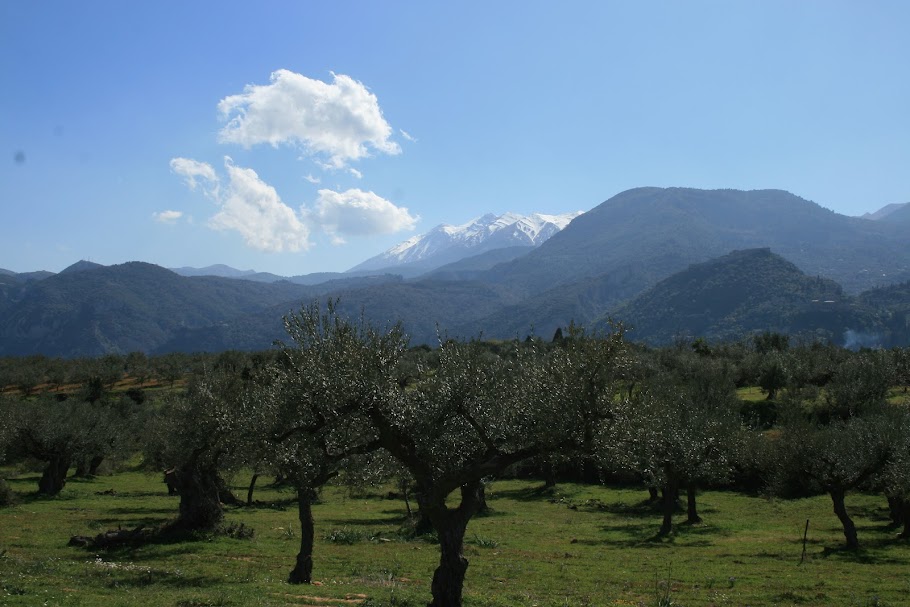
Returning from Kythera, my husband and I spent a night in Sparta (“Sparti,” as the modern town is designated on most maps and signs nowadays, is Ionian; I prefer to use Doric, which shows up now and again on local signs).  The modern city, full of students, traffic clogging the main street and disco music filling the night air, is not always the best place to evoke ancient Sparta, but it has charm of its own. The palms of the main avenue remind one of the more trendy cities on the Riviera, but the backdrop of snowy Taygetos is more beautiful. There are good restaurants, good hotels, a pretty square with a monument to the Three Hundred, and a charming little museum with some excellent pieces of Lacedaemonian sculpture. The ancient acropolis is far enough away from the heart of the modern town to allow a stroll in contemplative silence, and I am always pleased to see the Leonidas standing guard in front of the soccer stadium.  In short, I always enjoy a stop in Sparta on our way to or from Kythera.

Particularly interesting this trip was that the Eurotas was running black. Usually, when I have been in Sparta, it has been muddy and lazy. This trip is was running fast and deep. This suggests that in ancient Sparta as well the river ran deep and fast at least some of the time. Indeed, I’ve heard theories that the climate of Greece was generally cooler and wetter in the archaic and classical periods. Certainly, the population density was lower and so the consumption of water less. Less water consumption nearer the source of the Eurotas would have meant greater volumes of water flushing down through Sparta. Certainly, it looked more inviting this time around, and I could easily imagine the boys of the agoge cavorting around in it and young citizens plunging in to refresh themselves after drill.

Since pictures are worth a thousand words, however, I think I’ll stop writing here and just upload some of the pictures I took this year. I end with a picture of me at Leonidas feet.


If you look hard you can read the “Μολαν Λαβε” on the base of the statue.

In other news, I submitted the manuscript for the third book of the Leonidas Trilogy, Leonidas of Sparta: A Heroic King  to the publisher today. If all goes well, the book will be released on schedule in early September.

Saturday, April 14, 2012

The Female Factor in Sparta's Power Projection

The importance of women to an economy has been increasingly recognized and acknowledged over the last quarter century. Raising female literacy has become an important goal of international aid organizations, because no factor is more important in decreasing both infant mortality and birthrates than female literacy. Indeed, various studies demonstrate a strong inverse relationship between levels of female education and poverty. More recently, development and aid programs have shifted their focus from grants to governments and male dominated organizations to micro-credits to women.

When applied to Ancient Greece, of course, the modern approach to development appears fatally flawed. No one can seriously argue that Athens was “under-developed” or that it was poor – by the standards of its time. To be sure, by modern standards based on factors such as literacy, infant mortality, and longevity, not to mention per capita income and income distribution, Athens would have been rated an undeveloped or “less developed” country. Yet by ancient measures of wealth, Athens was comparatively well off – even if, as Thucydides argued, the monuments it built with tribute money from its subject cities created the impression of a city twice as rich and powerful as it “really” was. On this point, however, I take issue with Thucydides: any city that can force other cities to pay for a monumental building program in a distant metropolis deserves to be seen as a great power. Thucydides was, however, trying to make another point: that monuments alone do not constitute power -- a point he underlined by saying later generations would underestimate Spartan power, if they judged it on the basis of its monuments.

And it is when we look at Spartan power that we need to reconsider the importance of women to ancient economies. Sparta, like Athens, was a recognized power in the ancient world. From at least the 6th century to the early 4th century BC, it was one of Greece’s “leading” states. It had a large alliance system and eventually broke the back of Athens’ empire, and it briefly dominated the Greek world. Based on the amount territory controlled, Lacedaemon had a strong economic base from which to develop its power. It had sufficient rainfall, fertile river valleys, and several natural harbors. It had natural resources, though neither gold nor silver, and it had timber for building ships, marble for monuments, and a benign climate. In short, it had all the objective criteria necessary for becoming a powerful state – except manpower.

That is to say, if we consider only the Spartiates, then Lacedaemon reached its pinnacle of projected power (not necessarily its greatest moment!) at a period of time when the Spartiate population was tiny – less than two thousand men. And if we accept the prevailing view that the Spartiates were unpopular oppressors of their own population and their allies, much less their enemies, then this is an even more remarkable achievement. How could 2,000 men – regardless of how well drilled and physically fit – control a hostile domestic population more than ten times as strong, and all the allies in the Peloponnesian League – and still manage to defeat a great empire like Athens'?

Obviously, one answer is that Sparta’s subject classes, perioikoi and helot, and Sparta’s allies were not as hostile to Spartan leadership as is popularly assumed. (A thesis readers of this blog will find familiar!) Another answer is that Spartan women played a significant role in the Spartan economy, effectively doubling the size of the ruling class. Both, I believe, are true, but today I want to focus on the role of Spartan women.

The ideal Athenian woman “knew as little as possible” and was neither seen nor heard. Her job was to go a virgin bride of 12 or 13 to the house of a citizen and then (despite being still a child) produce as many children as her husband wanted (but let him kill as many of her children as he wanted) until she died. Oh, and she was allowed to rule over the slaves and her husband’s concubines as long as she didn’t set foot outside the house, show her face even in the doorway, and never expressed an opinion on anything. Xenophon, a liberal strongly influenced by contact with Sparta, thought it was advantageous for women to learn to read and calculate a little so they could manage their husband’s household better, but the more common opinion was expressed by Meander that teaching women to read was like giving more poison to an already horrible snake. As Aristotle makes clear, many leading Athenian men would have been much happier, if there had been no need for women at all. Women being the source of all evil, only a society without any women at all could be a real utopia.

Real Athenian society and real Athenian woman obviously did not live up to this ideal. Poorer women had to work just to survive and to help their husbands in their shops and workshops. Not all Athenian women had the “privilege” of being locked up in the dark, stuffy, cramped rooms at the back of an Athenian house for their entire life. Women did step outside their house – at least for weddings, funerals and religious festivals. They probably even opened their mouths and said things, though that is hard to prove. But whichever way one looks at it, Athenian women made no contribution to Athenian economic, intellectual or military power.

In Sparta, in contrast, women were from birth onwards better treated than their sisters in Athens. They were fed the same food as their brothers, attended the public school, and engaged in sport so that they grew up strong and healthy. Most important, they were not forced into marriage when still immature, and so not subjected to the trauma of childbirth until they were 18 or older, something modern medicine considers vital to female health. In consequence, Spartan women would have been healthier throughout their lives and lived longer than Athenian women. This would have had the important and often overlooked consequence that there must have been many more grandmothers in Sparta than in Athens!

This is more than anecdotally significant. Recent studies suggest that older, infertile females play a significant role in the survival of young in very primitive societies. We should not dismiss the notion that in Ancient Greece too they could have played a significant role in child-rearing and household management – if they had been there. In fact, however, there probably weren’t very many grandmothers in Greek cities other than Sparta because girls married and died very young.

Equally important is the fact that, Spartan women were educated in the public agoge. We have no historical record of what they learned there and if you assume even Spartan males received little training in literacy, than neither did the girls. But the notion that Spartiates were largely or only marginally literate has been effectively debunked by various scholars (see particularly Ellen Millender, “Spartan Literacy Revisited, Classical Antiquity, Vol. 20 ) and it is more reasonable to assume that Spartan girls, like their brothers, left the agoge with functional literacy and numeracy.

This is where modern evidence from the developing world suggests that such women were much more competent in the economy than women who lacked literacy and numeracy. In short, Spartan women were in a position to actually conduct economic transactions for their husbands. Allegedly, Spartiate women dominated the agora (where bachelors were not supposed to be seen at all), and this again reinforces the image of women who were cable of conducting business.

Could such economically savvy women have contributed to Sparta’s ability to project its power? Could, for example, Sparta afford to send harmosts, generals and admirals overseas because they had competent administrators in their women? Did female management of Spartiate kleros and other estates ensure that Spartiates had the economic resources necessary to remain professional soldiers and provide administrators for an imperial power? Did Spartiate women not only manage kleros, but administer tax collection, customs and other economic functions inside Lacedaemon? Probably not, or Aristotle would have mentioned it. Nevertheless, in light of modern experience, we need to reassess the role of Sparta’s better educated, healthier and longer-living women. We should ask whether they didn’t contribute much more to Sparta’s power and status than just the soldiers they bore in childbed.

NOTE: I will be on holiday in Kythera the rest of this month, and the next blog entry will be posted in early May. Καλη Εβδομαδα!


Saturday, April 7, 2012

“Helen of Troy” by Bettany Hughes – A Review

Hughes bills her book as “The Story Behind the Most Beautiful Woman in the World” – which is certainly ambitious. She devotes 312 pages to the main text followed by 130 pages of appendices. The book contains roughly 30 colored illustrations and even more black and white images -- altogether a very impressive and comprehensive treatment of the topic. Hughes furthermore sets out not only to try to discover the historical reality behind the story of Helen of Troy, but to describe the Bronze Age in which she allegedly lived, and then to describe how the story of Helen of Troy was handled in literature and art down the ages from Homer onwards.
 
Although at times I found the narrative long-winded and had the feeling Hughes was trying to justify what must have been a significant investment in time and money by dragging out some commentary unnecessarily and belaboring some points to the point of exhaustion, the book nevertheless provides some very useful information. Particularly impressive was the amount of information she collected on life in the Bronze Age, something I knew little about.

One of her principle thesis is that Helen (or the Helen Pro-type) was a Bronze Age aristocrat (princess and Queen) – and every subsequent treatment of Helen tells us more about the age in which the work of art depicting her was created than about Helen herself. Less successfully, Hughes tries to analyze why the story of Helen of Troy should have fascinated artists and audiences for three thousand years.
 
Perhaps due to my ignorance of the Bronze Age, I found Hughes descriptions of recent archeological discoveries about this period particularly exciting and informative. She succeeded in convincing me that the Bronze Age civilizations were very sophisticated and international, with significant trade across the Mediterranean. A recent trip to Egypt helped me visualize just how rich and yet familiar such ancient societies could be. The art of Minoa and Egypt, with which I am more familiar, provided collateral, flanking evidence, to Hughes’ thesis about a Bronze Age Helen, who was more powerful and independent than the women in ancient Greece.  In short, Hughes succeeded in making me change my own views of Helen, by enabling me to see her as a figure from a pre-archaic society with significantly different social structures and traditions.
 
Almost as fascinating was the way in which the character and role of Helen changed depending on the values of the society re-telling the story. For example, the fact that Helen received a comparatively positive treatment in the 12th Century AD due to Eleanor of Aquitaine's the patronage of Benoit de Sainte-Maure, author of the Roman de Troie. As Hughes perceptively points out, Eleanor, like Helen, had been the bride of one king, but effectively – if less surreptitiously -- ran away with his arch-rival and became the Queen of the empire that most threatened her first husband’s realm. Eleanor had good reason to see Helen as a positive role model and not some tawdry whore or instrument of the devil.
 
After reading Hughes, I admit, I am more sympathetic to Helen than I was before reading Hughes. When she described a 1974-5 staging of Christopher Marlowe’s The Tragical History of Dr. Faustus in which Helen is portrayed as “a marionette with blond wig, a mask and a chiffon nightie.” (Hughes, p. 307), I found myself feeling indignant. How could a director show so little respect for Helen? Would a dumb blond in a negligee really have been worth fighting for? For ten years? And worth recovering? Reinstating as Queen? In short, Hughes achieved her presumed of objective of making me see Helen as more than “just a pretty face.”

As such, despite its stylistic faults, I think Hughes work makes a significant contribution to our understanding both of the historical and the literary Helen.