Find Out More

Find out more about Helena P. Schrader's Sparta novels at: https://www.helenapschrader.com/ancient-sparta.html

Wednesday, January 1, 2014

Sparta Lost and Found

Unlike Athens, that remained inhabited from the archaic period to the present day without interruption, Sparta was not only defeated and humiliated, it was destroyed by earthquakes, flooding and ultimately abandoned. When the Franks and the Ottomans came, there was not even a village to mark the site of Ancient Sparta.

Equally devastating was the lack of a Spartan literary tradition. A society that placed value on silence and brevity did not produce historians or play writes, and while Spartan philosophers were admired throughout the rest of the ancient world, they preferred an oral to a written tradition.

The combination of these factors, a lack of a written record, the dispersal of any inhabitants that might have kept an oral tradition alive and the physical destruction of the city, left subsequent generations with an image of Sparta that derives entirely from the accounts of outsiders. Many commentators on Sparta, even in ancient times, had never been there – or at most visited briefly. Some, like Xenophon, knew Sparta relatively well, but remained fundamentally Athenian. Trying to understand Sparta on the basis of the accounts of Athenians and Romans is like trying to understand Africa from the reports of Victorian explorers.  It won’t get you very far.

Our images of Sparta, the city, are dominated to this day by what we have been told about Sparta and Spartans by these visitors from a different culture. Even someone who has never studied Sparta or read a single book about it has images of Sparta that have been transmitted through our language alone.  “Spartan” is an adjective used to denote “severe,” “plain,” and “austere.” Laconic speech is “terse,” “concise” and “economical.” The most rudimentary and fleeting brush with Sparta in literature will not be without reference to rigid discipline, disdain for luxury, self-sacrifice and endurance of hardship.

The more a novice looks into Spartan society, the quicker he/she is confronted by references to a childhood of deprivation in which one had to steal to get enough to eat and was allowed only one garment per year. The boys, we learn, had to cut down the river reeds with their bare hands or the help of a tool which is dismissed as practically worthless, and then sleep upon these instead of real beds. Worse, they had to live practically in the wild, exposed to the elements without shelter or proper clothes.  Books like Gates of Fire describe horrendous beatings to which Spartan boys were apparently subjected for any tiny infraction of the rigid rules of acceptable behavior.

Nor are youths the only Spartans whom, we are led to believe, suffered deprivation. This was a society, according to most sources, where women were prohibited from wearing jewelry or even taking pride in their weaving. Indeed, all gold and silver was banned, and so could adorn nothing - not even the temples of the Gods.  The houses, we are told, were not painted (as else where in the Ancient world), and if one believes the oft quoted “sayings of Spartan kings” they did not even hew their house beams into regular square posts, but left them raw and untreated – one imagines crude timber as in a log cabin. Meanwhile, the young men lived in barracks (notoriously grim places in any society!) and for their entire lives ate their meals at men’s clubs where the cuisine, we soon learn, was infamous throughout the ancient world for its lack of sophistication and variety.

Such a society is most readily imagined in an austere, plain, indeed barren, landscape.  After all, a society characterized by deprivation of food, clothes, decoration and fine cuisine sounds like a desperately poor society, a society barely surviving in a hostile environment, a society which has made a virtue out of necessity. It is logical to assume that the underlying – if unspoken – root cause of Sparta’s obsession with self-discipline and self-denial for the good of the community, the City, was a fundamental lack of resources that required such a rigid regime.

This assumption is reflected in modern literature about Sparta. In his best-selling novel Gates of Fire Stephen Pressfield calls Sparta “a village” adding: “The whole stinking place would fit, with room to spare, within His Majesty’s [Xerxes of Persia’s] strolling garden at Persepolis. It is … a pile of stones. It contains no temples or treasures of note, no gold; it is a barnyard of leeks and onions, with soil so thin a man may kick through it with one strike of the foot.”[i]

But there is a problem here.

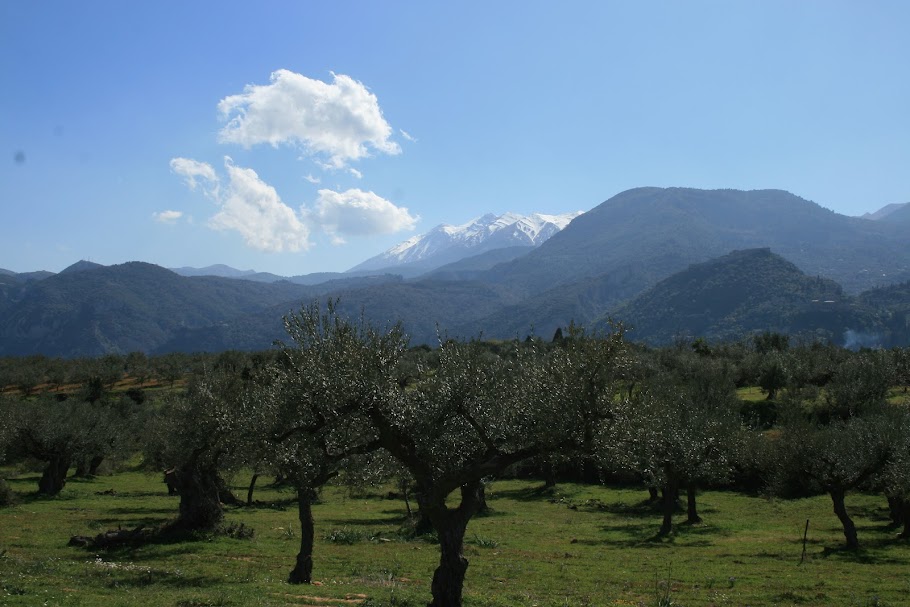
If you drive down the modern road from Tripoli (or Tegea as I prefer to think of it) toward Sparti (Sparta) there is a moment when coming around a bend you catch the first glimpse of Taygetos. I will never forget the first time I encountered that view: it took my breath away.  I could hardly concentrate on the winding road for straining to get another glimpse of those spectacular, snow-capped mountains. And when the valley of the Eurotas was spread out before me it was like revelation. My image of Sparta – Ancient Sparta and all that Sparta implied – was transformed in a single instant.

The valley of the Eurotas is anything but barren! It is quite the reverse. It is green and fertile and stunningly beautiful - like riches cupped in the hands of the gods. From the blooming oleander to the wild iris, the valley is a garden. The orange orchards stretch as far as the eye can see, brazenly advertising not only the abundance of soil and sun but water as well. Most spectacular of all, the Eurotas valley is one of those few places on earth that offers the sensually stimulating sight of palm trees waving against a back-drop of snow-capped mountains.

Has Laconia perhaps changed dramatically in the last 2,500 years? Was it poor when the harsh, economical, self-disciplined Spartan society took root in its – then – sparse and almost barren soil?  Does it bloom now artificially because of modern fertilizers and irrigation?

If we are to believe the ancient historians, no. Herodotus speaks of Sparta’s “good soil”[ii] or Thucydides describes the entire Peloponnese (with the exception of Arcadia) as the “richest part of Hellas.”[iii] It is when speaking of Athens, that Thucydides draws attention to “the poverty of her soil.”[iv]

So the fertility and abundance of the valley has not changed since Ancient times any more than the shape of Taygetos beyond. But if this rich valley was the seat of Sparta, then Spartan austerity and deprivation did not come from necessity! Sparta’s land was rich, fertile and productive enough to enable the highest standard of living available in the ancient world – at least to the always modest number of elite Spartiates. In short, if Sparta was as austere a society as it is depicted in modern times, then that austerity was self-imposed.

But is it reasonable to imagine that a people raised in the midst of wealth and beauty had no appreciation for either? Or is the very austerity of Spartan society as mythical as the thin soil of Pressfield’s Sparta?
Maybe our images of a rigid, harsh and brutally disciplined society is also a distortion? A fractured image? A misunderstanding based on ignorant, or prejudiced foreign reporting? Imagine what American society looks like through the eyes of the Taliban!

It's because I firmly believe that modern images of Sparta a largely based on inadequate, hostile and sometimes purely fanciful source material that I have dedicated this blog and my website “Sparta Reconsidered” to questioning common assumptions and misconceptions about Sparta.


[i] Pressfield, p. 188
[ii] Herodotus, Book I.66, p.26.
[iii] Thucydides, Book I.2, p.36.
[iv] Ibid.
[v] Nicastro, p. 67
[vi] Pausanias, III.10. p. 37.

Sunday, December 1, 2013

Spartan Piety - Reflections on the Relgion of the Spartans

In the ancient world, Sparta was famous for its piety.  Individual Spartans could be granted leave even from a campaign to take part in a religious festival, and on two famous occasions recorded in Herodotus the entire Spartan army delayed deployment in an emergency because of the need to “honor the gods.” (The deployment to Marathon and Thermopylae).
But just what did “piety” or “honoring the gods” entail in Ancient Greece? I admit, I find it difficult to understand this concept of “honoring” fickle, unpredictable, immoral (as well as immortal) gods. And how could one ever please all the different gods of the Greek pantheon when they were so often at odds with one another?  In a polytheist world, honoring one god might offend another.
Yet in trying to understand Spartan society better, I discovered some very interesting aspects of Spartan religion.  First, Sparta’s patron was not, as I expected, Ares, but rather Athena.  On reflection, this made sense since Sparta was not, as modern commentators would like us to believe, a society obsessed exclusively with war, but a society which placed as high a value on training the intellect as the body. (See the excellent article by w. Lindsay Wheeler, “Doric Crete and Sparta, the home of Greek Philosophy,” in Sparta: Journal of Ancient Spartan and Greek History, Vol. 3, # 2). So giving pride of place to Athena was understandable. 
Even more fascinating was to discover how multi-faceted Spartan religious beliefs were, and what an important place gods with positive connotations – Apollo, Asclepius, Helios and even Aphrodite – played in Spartan society. Nikolaos Kouloumpis in his article “The Worship and the role of Religion in the formation of the Spartan state,” (Sparta: Journal of Ancient Spartan and Greek History, Vol. 6, #1) lists cults to Asclepius, Achilles, Hercules, Alexandra/Cassandra, Agamemnon, Castor and Pollux/ Polydeukes and Helios. And, of course, Sparta’s most important festivals, the Karneia and Hyacinthia, were dedicated to Apollo.  Even the Gymnopaedia, arguably the most famous of Sparta’s annual festivals, was dedicated to Apollo and Artemis, Dionysus and Leto, while the more infamous than famous festival of Artemis Orthia was, as the name implied, dedicated entirely to Artemis.  However, the cult of Menelaus and Helen was only slightly less important, although we do not know how the Eleneia was celebrated.
Turning from festivals to sanctuaries, Pausanias, in his detailed guide to the “significant” sites of Sparta, records ten temples/shrines to Athena, six to Zeus, and five to Aphrodite.  The Devine Twins, Castor and Polydeukes, Apollo, Artemis, and Poseidon and Asklepios all have four temples each.  In contrast, there are only three temples out of more than 150 temples, sanctuaries and shrines mentioned by Pausanias that are dedicated to Ares. Two are notably located outside of Sparta proper, one in Amyclae and the other even farther away in Geronthrai.  The only temple to Ares in Sparta itself is one in which the God of War is shown in chains, according to Pausanias because “in Lakonia they think the god of war will never desert them if they keep him in chains; [just as] in Athens they believe Victory will stay with them forever because she has no wings.” (Pausanisus, Book III, 15:6). 
While the large number of sanctuaries dedicated to Athena and Zeus hardly need an explanation given their power and prominence in the ancient Greek pantheon, it does seem odd that Aphrodite, Poseidon and Asklepios should receive comparatively more honors than the god of war in land-locked, warlike Sparta.  Poseidon might be explained in that he was also called the “Earth Shaker” and, given impact earthquakes had on Lacedaemon, the Earth Shaker was clearly a god to be appeased.  Notably one of Sparta’s temples to Poseidon is to the “Horse-Breeding” Posiedon, and so a reflection of Sparta’s interest and success in equestrian sports.
But why do Aphrodite and Asclepius place ahead of Ares in terms of the number of sites dedicated to them? One possible explanation would be the association of Aphrodite with Kythera, which was part of Lacedaemon for the better part of 500 years.  Allegedly, the worship of Aphrodite originated on Kythera, and conceivably the cult spread from there to the mainland of Lacedaemon.  However, it is notable that to date the only temple from the Classical period to have been identified on Kythera was dedicated not to Aphrodite but to Asclepius. (Again!)  Possibly the worship of the God of Healing also moved from Kythera to Sparta.  Alternatively, the need to treat battle injuries fostered a particular reverence for Asclepius. Such an interpretation and the fact that there appear to have been more temples to Asclepius than Ares suggests the Spartan’s trusted more to their own skills to win wars, than survive the aftermath.
In short, Sparta was filled with sanctuaries and temples to a great diversity of gods, demi-gods and heroes. By no means was Spartan worship narrowly focused upon the god of war, or even warrior heroes such as Achilles. Instead, the heroes Heracles, Castor and Polydeukes, whose greatest deeds were performed outside the context of war, receive more attention.  This plethora of religious/cult focus in turn suggests that Spartan society was far less narrow-minded and obsessed with things military than most modern commentators imply. 
Yet the essence of Spartan piety and how the Spartans related to these various gods still eludes me.  The very diversity of god and demigods suggests, however, that there was no one Spartan religion or one Spartan way of worship.  On the contrary, I suspect that each Spartiate chose the god or gods he felt closest to and developed a highly individualistic and private relationship with these deities.  At the same time, Spartans publicly took part in the seasonal rituals celebrated by the city for each of the gods in turn -- just as many people do today.

Friday, November 1, 2013

Suffering at Symposiums - Or a major difference between Sparta and Athens

In modern usage, the word symposium has come to mean “a conference organized for the discussion of some particular subject,” “a collection of opinions, especially a published group of essays,” or “any meeting or social gathering at which ideas are freely exchanged.”  The ancient Greek roots of the word have misled many into imagining that ancient symposiums resembled modern symposiums and were also primarily intellectual events.
 
Little could be farther from the truth. Ancient symposiums resembled drunken stag parties more than a modern symposium.  As a rule, large quantities of wine were consumed, maybe a few poems were recited (more likely dirty little ditties making fun of one’s elders, opponents or rivals), politics might be discussed (not necessarily at a niveau above that of a modern pub) and then there was a lot of drunken singing, or the participants competed in such “elevated” activities as seeing who could throw their wine farthest, while being entertained and/or serviced by prostitutes and the ancient equivalent of strip-tease dancers, before staggering home too drunk to see straight and requiring (sober) slaves to ensure a safe arrival. 
It was not uncommon for drunken bands of youth from rival symposiums to end up brawling in the streets, and the even a leading statesman such as Alcibiades could be accused of committing large-scale sacrilege with his friends after a symposium.  In short, ideas and politics might have been discussed occasionally at some of symposiums, but a symposium was primarily about male indulgence in excessive drink and sex -- not intellectual exchange.
Anyone familiar with Spartan society will understand why the Spartans disdained such activities and why Spartan authorities instituted laws (like not being allowed to light a torch at night) to prevent their young men from being seduced into such activities. But there is another feature of Athenian symposiums which was equally un-Spartan: the exploitation of women.
As James Davidson makes clear in his seminal work on Athenian society Courtesans and Fishcakes, a good Athenian host boasted about the “beautiful girls” and “babes” he would offer his guests. Since no respectable woman (wife, mother or daughter) was allowed to show her face or set foot in a symposium, all the women present were sexual objects, and almost all were slaves. Yes, there were the occasional so-called “hetaere” that like Japanese geishas were trained to cater to a more sophisticated clientele by having a smattering of education and skills such as playing instruments or singing, but very few of these women were free.  They too had to surrender all or some of their earnings to their owner (pimp). And hetaere were the “privileged” prostitutes, the “admired” prostitutes – what we might call “call girls” today or “courtesans” in the 17th and 18th century. But it only went downhill from here – to flute girl, household slave and “sex-worker” in a brothel.
 
As Anton Powell notes in Athens and Sparta: Constructing Greek Political and Social History from 478 BC (London: 1988), prostitution was widespread, taxed, and consorting with prostitutes was considered perfectly normal and in no way reprehensible, even for youth of the upper-classes -- in Athens.  The only social restriction on male intercourse with prostitutes was that it was considered bad taste for a married man to bring a prostitute into the house where his wife lived, or to spend the money he received from his wife’s dowry on expensive prostitutes.  Powell also notes, however, that it was common for men to maintain concubines under the same roof as their legal wives, and that sex with slave girls did not even count as infidelity in the Athenian courts. Clearly, Athens was a paradise for the sexually active male.
The “pleasures” of Athenian society, and especially of symposiums, were restricted – as was democracy, intellectual achievement, and artistic creativity – to that half of Athens’ population that was male. Respectable women were excluded from the symposium, just as they were excluded from drinking wine, eating fish or meat, exercise, education and political rights.  As for the women allowed to participate in symposium, with very few exceptions, they were slaves with no choice in where they went, who they serviced, or what they were asked to do.  They did not even receive compensation for their services, since the high prices paid by the customers went to their male owners, enriching him, not them. For the women of ancient Athens, symposiums were torture chambers. 
 
It is to Sparta's credit that no such abuse -- much less the glorification of the abuse of women and children as these symposiums represented -- was sanctioned or recorded in Spartan society.

Friday, October 4, 2013

Leonidas Trilogy: Five New Reviews

S. Walters reviewed Leonidas of Sparta: A Heroic King
*****Excellent read August 16, 2013

I love reading about Sparta. This is a fiction book supported by historical fact. The author is extremely knowledgeable, and I plan to get the other two books in the trilogy.


****An excellent dramatization July 24, 2013

I found this entire series, of which is the final installment to be both entertaining and educational. Though a fictional dramatization of an non-fictional character, the story makes an excellent case for understanding the possibility of how things actually happened. Worth the read for the entire series for those who have an interest in Leonidas and Sparta.

 
R. Duenow "gciking" reviewed Leonidas of Sparta: A Boy of the Agoge
*****Putting a Human Face on Sparta June 8, 2013

One of best histories I've read on ancient Greece, rivaling Gates of Fire by Steven Pressfield. Most other histories tell only the story of Sparta and its heroes, but Helena Schrader's trilogy permits us to see more than just the people and politics of the time; it also permits us to see the human side of its leaders. She weaves a beautiful story based upon her extensive knowledge and exhaustive research which allows us to...Read More One of best histories I've read on ancient Greece, rivaling Gates of Fire by Steven Pressfield. Most other histories tell only the story of Sparta and its heroes, but Helena Schrader's trilogy permits us to see more than just the people and politics of the time; it also permits us to see the human side of its leaders. She weaves a beautiful story based upon her extensive knowledge and exhaustive research which allows us to understand and appreciate the Sparta Culture and leaders of the age.

The trilogy follows the life of Leonidas from boyhood, through adulthood and finally, his unlikely rise to become one of Sparta's two Kings. Her stories describe Sparta at the height of its power and their relationship to other Greek city states and the other dwellers in Lacedaemonia, the Perioikoi and the Helots, which I never fully understood before.

She also elaborates and provides the details of the Spartiate citizens and women who were far more liberated than any other women of the ancient world, including Athens.

All in all, Schrader's trilogy was thoroughly enjoyable and a must read for history lovers of the ancient world.

 
natasha reviewed Leonidas of Sparta: A Boy of the Agoge
*****Great book May 18, 2013

This book gives you a detail look into the young Leonidas. It explains the many ways he was made into such a great king.

 
Pulser "Books with heart & mind" reviewed Leonidas of Sparta: A Boy of the Agoge
*****Sparta brought back to life! April 25, 2013

I really enjoyed this book in more ways than one. The story was compelling and interesting, the characters were multidimensional and believable,the pace was exciting, and the history lessons and finally the truth about the real Sparta abundant!
The author does a wonderful job creating the character of young Leonidas and following him as he develops into a young man is very entertaining. I highly recommend this to those...Read More
I really enjoyed this book in more ways than one. The story was compelling and interesting, the characters were multidimensional and believable, the pace was exciting, and the history lessons and finally the truth about the real Sparta abundant!

The author does a wonderful job creating the character of young Leonidas and following him as he develops into a young man is very entertaining. I highly recommend this to those who enjoy historical fiction with real historical information of the highest quality. I will be ordering the rest of the series shortly.

The only improvement that I felt was needed, was in the description of the topography. It is obvious that the author knows the area very well and can describe it in minute details. However, for someone who has never been there a map would have been very helpful. With so many names of areas and rivers and mountains, my mind couldn't envision it all-but of course that could be my own personal shortcoming.

Saturday, August 31, 2013

Spartan Ethos:

Liberty, Equality and Fraternity among the Philosopher Warriors


What set Sparta apart from other Greek city-states was not language, religion, or even laws – all of which were shared in broad terms with the rest of the ancient Hellenic world – but a unique ethos that permeated all aspects of life.  While Spartan philosophy valued silence over empty words, simplicity over decoration and precision over expansiveness, Sparta placed the liberty, equality and fraternity at the center of their ethical system.  Love of liberty was shared by all the ancient Greek democracies, but the emphasis on equality and fraternity set Sparta apart. 


There is no clear explanation for the roots of Sparta's unique emphasis on silence, simplicity, and precision, although it probably had Doric roots. Doric architecture, for example, is the simplest of the three Greek architectural orders. Nevertheless, there is little doubt that by the 5th century BC, Sparta had cultivated a tradition that put conscious emphasis on silence and simplicity over eloquence and decoration.
What is often overlooked by modern commentators is that the silence cultivated in Sparta was not the silence of dumb animals, but of thinking men, who recognize that it is wise to think before speaking and to speak only when they have something worth saying. This is the essence of Spartan rhetoric and the reason it was so highly prized by philosophers such as Socrates and Plato. If one is looking for a more modern parallel, the example of the Quakers might be appropriate.

Simplicity in dress, architecture, and art was a natural expression of this fundamental philosophy that "less is more" and precision preferable to ambiguity and ambivalence. To say that Spartan dress and architecture were simpler than that of contemporary cities is not to say it was primitive, only that it was more precise and made more use of natural elements. The focus on the functional and the essential need not be associated with a disdain for beauty. Most modern observers admire the Parthenon in Athens today for the perfection of its proportions and would be irritated and distracted to see it painted brightly, as it was in ancient times. Likewise, modern architecture and design has rediscovered the Spartan love of the pure beauty of form and material.


The Spartan land reform (described in the essay on the Spartan government and constitution) made all Spartan citizens equals, or Peers; and they not only described themselves as such, but reinforced the notion of equality by discouraging anything that would set one citizen apart or above another. Sparta was the first city-state to introduce a uniform for its army: scarlet chitons and cloaks, and indeed uniform shields, all bearing the lambda, or L, for Lacedaemon. Spartans also wore their hair in the same fashion: the boys of the agoge going about shaved, the young men with short hair, and the men over the age of thirty growing out their hair and often wearing it braided. Not until the second half of the 5th century do artistic depictions of Spartans indicate that the neat appearance of the archaic period had given way to an unkempt, almost barbaric fashion.

All adult male citizens were, furthermore, bound together through three distinct and separate institutions. First, the sons of citizens were required to attend the public school system, the agoge, from the age of seven through the age of twenty. Second, all male citizens between and including the ages of 21 and 60 had to serve in the army. A distinction was made between the first 10 age cohorts, who were required to live in barracks and were in effect on active service, and the elder age cohorts, who lived at home but could be called up at any time, similar to reserve status today. Third, all male citizens were required to join a syssitia, or dining club, and to eat at this club every night (unless excused), providing set amounts of food from their estates to support the common meals. Although every citizen had to belong to a syssitia (also known as phiditia), each citizen chose which club he wanted to join and the existing members voted to admit the new applicant – or not. One veto from an existing member was sufficient to prevent a new member from joining. Unexcused absence from the mess incurred a fine – something not even the kings were exempt from. However, Spartiates (Spartan citizens) could be excused for a variety of reasons, from war to hunting and the Olympic Games.

The bonds of school, military, and club were designed to keep the society closely knit and not divided along family and clan lines. They did not, however, replace family ties, as some modern observers assume.
Attending the agoge, the public school, from the age of 7 did not sever family ties any more than sending children to school today does. There is no evidence that the small children slept in barracks – they may well have slept at home – but even if they slept in dormitories on school nights, they would still have gone home for holidays. Sparta had many holidays, and some were so important that observance of them was more important than going to war – even in an emergency. School children would have spent probably as much as one-third of any year away from school, much as they do today. Furthermore, Spartan girls went to the same schools and gymnasiums as their brothers – and future husbands. Spartan youth therefore had far more contact with the opposite sex than did their contemporaries in other Greek cities, which in turn meant that the bonds between the sexes were also stronger than elsewhere. Shared memories of a common schooling would have strengthened Spartan marriages, and parents would have been careful to pass on their experiences of the agoge to their offspring in order to help them survive this critical prerequisite of citizenship.
The military duties of Spartan men were likewise less onerous than modern military service in distant theaters of war, which can keep men away from their families for years on end. Until the Peloponnesian War, ancient warfare consisted of marching out, meeting the enemy on a flat, open plain, fighting a single battle, and then returning home – victorious or defeated – within a few weeks. Most campaigns lasted no more than a month or two, and they usually took place after the harvest was in. Sparta was not continuously at war until the second half of the 5th century. Before that, Spartan men would not have been away at war for more than a few months at a time, and by no means every year. Some men might have been absent at war no more than a month or two in their entire lives.
Finally, the fact that men ate their evening meal away from their families need not have been more disruptive of good marital or family life than the fact that most modern couples eat their midday meal apart. On the contrary, the rhythm of Spartan life might actually have fostered good family relations, because men and women probably would have shared the middle of the day together, when other activities were not possible because of the heat.

Saturday, August 3, 2013

Spartan Dress and Spartan Dandies

Spartan dress and decoration differed from that of the rest of the Greek world sufficiently to provoke comment among ancient observers.  At the same time, Spartan dress remained essentially Hellenic.  The Spartans did not wear clothing fundamentally different from other Greeks, they were simply more conservative in the adoption of new styles, meaning that they retained archaic fashions, such as the peplos and long hair for men, long after Greeks from other cities had adopted new fashions.  When one considers the fact that new fashions were introduced primarily from Persia and Macedonia, than it is fair to say that Spartan dress was more purely “Greek” or “Doric” than the fashions of Athens.


The most obvious example of the conservative character of Spartan dress was the preference of Spartan women for the old-fashioned peplos, even after Greek women elsewhere had adopted the long chiton.  The peplos is the robe worn by almost all archaic kore, and these archeological models refute modern allegations that Spartan women went around in short skirts like Amazons. The ancient complaint that Spartan women were “thigh-throwers” did not refer to skirts or chitons so short they revealed a woman’s thigh, but rather to the fact that a woman wearing a peplos was very restricted in her movements – unless the side seam was opened to above the knee. Thus, while Athenian women in their looser cut long chitons could walk vigorously without revealing their legs, their Spartan sisters always showed some leg when they walked.  The characteristic Spartan bronzes that show a girl in a short skirt running or dancing do not depict mature Spartan women but rather girls; the most likely interpretation is that they depict girls in the agoge, and as such girls before puberty.


Another typical Spartan fashion that dated back to at least the archaic age was for men to wear their hair long. However, modern depictions of Spartans as shaggy, unkempt men with scrawny, chest-long beards and wild, tangled hair hanging to their shoulders (alà Richard Hook’s illustrations in Osprey’s The Spartan Army) are not supported by ancient sources. A statue fragment found in the heart of Sparta and dating from the early fifth century (commonly – or affectionately – referred to as Leonidas) shows a man with a clipped beard and neat hair. Earlier archaic artwork unanimously shows men with short beards and long, but very neat, “locks” of hair. (Note, for example the hoplites on the magnificent frieze of the Siphnian Treasure at Delphi dating from Leonidas’ lifetime, the Krater of Vix and other figures of known Laconian origin displayed now in the Museum of Ancient History in Berlin or pictured in Conrad Stibbe’s Das Andere Sparta.)


Likewise, I reject emphatically descriptions such as those of Otto Lendle, who describes Spartans as stinking, filthy and slovenly. These images likewise contradict the historical record and existing archeological evidence. Herodotus makes a great point of how the Spartans groomed themselves before Thermopylae, for example, and no one would be tempted to stress the beauty of Spartans  -- as Plutarch explicitly does -- if they had been repugnant for their lack of grooming and cleaning. Plutarch also claims Spartan men took particular care of their hair especially in the face of danger, and refers to an alleged quote from Lycurgus that long hair was preferred because it rendered a handsome man better looking, and an ugly one more frightening. 
The later quote suggests, of course, that while a handsome man might have groomed his hair assiduously, an ugly man might have consciously ratted his, but this hardly makes sense if one considers the need for a man to wear a helmet, as all Spartans did until they had reached the age of 61.  It is more likely to refer to the fact that hair braided back from the forehead tends to give the face greater prominence than a crown of curls such as other Greeks wore in the classical period.  Thus, while both a handsome and an ugly Spartan wore their hair neatly braided from the forehead, the effect was to highlight the good features of the former and the bad features of the latter. I would note further, that anyone familiar with African hair braiding knows that a great deal of variety, and so different effects, can be achieved without breaking the fundamental concept of long hair, neatly braided from the forehead. I like to imagine that Spartan dandies shocked and irritated their conservative elders by obeying the letter of the law (long, neatly groomed hair) while nevertheless developing individual styles.


I would also like to note that no ancient source claims that Spartan women did not adorn themselves.  On the contrary, in Euripides’ plays and Aristotle’s political commentary both, Spartan women are despised and castigated for being exceptionally vain, luxury loving and self-indulgent. Thus, while Spartan men are portrayed as (stupidly) restrained and austere, Spartan women are loathed for being even more fond of self-adornment than Athenian women, who are themselves viewed as excessively fond of cosmetics, perfumes and jewels.
This suggests that even if, as some argue, Spartan laws prohibited not only the use of gold and silver currency but also gold and silver objects d’art, than Spartan women found other means of adorning themselves. One option would have been to make jewelry from other materials – ivory, copper, bronze, lapis lazuli, jade, coral, amber etc. etc.  In addition, the garments could have been decorated with bright colored embroidery or borders with beads of bronze, copper, ivory etc. Alternatively, the peplos themselves might have been made of brightly colored fabrics.  The most precious purple dye was produced from muscles found in the Gulf of Laconia, and Lacedaemon undoubtedly exported this dye and or fabric stained with it.  Other important dyes, such as indigo, were also produced in Lacedaemon. 


Anthropology, archeology and art history show us that there is almost nothing as universal as human vanity. Throughout history and throughout the world, men and women have been astonishingly inventive in developing ways to adorn themselves and make themselves appealing to one another.  Sparta, a society far closer to our own than many others the world has known, was certainly no exception.

Friday, June 28, 2013

Spartan Architecture


Acropolis of Athens, 2012, Photo by author.
The ancient Athenian historian Thucydides made a prediction in his History of the Pelopponnesian War that has come true with a vengeance.  He wrote that “…[if] Sparta were to become deserted and only the temples and foundations of buildings remained, I think that future generations would, as time passed, find it very difficult to believe that the place had really been as powerful as it was represented to be. Yet the Spartans occupy two-fifths of the Peloponnese and stand at the head not only of the whole Peloponnese itself but also of numerous allies beyond its frontiers. Since, however, the city is not regularly planned and contains no temples or monuments of great magnificence, but is simply a collection of villages, in the ancient Hellenic way, its appearance would not come up to expectation. If, on the other hand, the same thing were to happen to Athens, one would conjecture from what met the eye that the city had been twice as powerful as in fact it is.” (Thucydides, History of the Peloponnesian War, Book I, 10, 2.)


This statement was as much a criticism of Athens’ building program under Pericles (that had diverted contributions from the Delian League, intended for defense against the Persians, to building extravagant temples in Athens) as a critique of Sparta.  Yet it has misled modern scholars and novelists to portray Sparta as if it were a primitive village of dirt and mud. 


For example, in his best-selling novel Gates of Fire, Stephen Pressfield calls Sparta “a village” adding: “The whole stinking place would fit, with room to spare, within His Majesty’s [Xerxes of Persia’s] strolling garden at Persepolis. It is … a pile of stones. It contains no temples or treasures of note, no gold; it is a barnyard of leeks and onions, with soil so thin a man may kick through it with one strike of the foot.” (p.188). Nicolas Nicastro is only willing to concede the dominant superpower of Greece was “an agglomeration of sleepy villages.”


These and other modern writers are guilty of both a too hasty reading of Thucydides, and a failure to consider other evidence.  Thucydides complains that Sparta “is not regularly planned” – but then nor is London. And he says it is “simply a collection of villages, in the ancient Hellenic way.”  This is not the same thing as saying Sparta was not a cosmopolitan city, it only means that Sparta had no plan and no walls and hence grew haphazardly -- as all major European cities did after their confining medieval walls were torn down. No one today would call Paris, Berlin or Rome “a collection of villages” simply because they are in fact many villages which have grown into a single metropolis after the need for fortifications disappeared and economic growth fueled urbanization. Why should we assume that just because Sparta was made up of five distinct villages in pre-Archaic times that it was not – in its years of glory – a cohesive, dynamic city?   


Sparta, April 2016, Photo by Author


Likewise, when Thucydides writes Sparta “contains no temples or monuments of great magnificence” he is not denying the existence of temples and monuments, only ones “of great magnificence” – such as Pericles built with stolen funds from Athens satellite states without their consent. In short, Thucydides never claimed that Sparta was not a major, metropolitan city, nor did he deny it had notable monuments, he was only making the astute statement that, judged by its buildings alone, future generations would over-estimate the power of Athens and under-estimate that of Sparta.

The assessment of Sparta's architecture has been aggravated for modern observers by the fact that today we cannot see what Thucydides did. Sparta was destroyed by earthquakes many times over the centuries. It was flooded by the Eurotas. It was abandoned. Nothing destroys architectural monuments so completely as abandonment.  Nor should it be forgotten that Sparta has not been systematically subjected to archeological excavation in almost a century. 


The Spartan Amphitheater, 2012, Photo by Author
Nevertheless, what has come to light demonstrates definitively that far from being a place full of primitive, mud structures, Spartan architecture was substantial, monumental (not the same as “magnificent”!), and very, very typical of Doric architecture throughout the ancient world. Sparta was, in fact, the ultimate Doric power. It attained it greatest artistic flourishing in the 6th rather than the 5th century BC, and consequently its greatest monuments were archaic not classical or Hellenistic. But they existed! We can still see some of the foundations and remnants to this day. Sparta was not just a heap of peasant hits, as Pressfield and Nicastro would like us to believe. 

For anyone whose imagination is too weak to mentally reconstruct a great city from the remnants left in Sparta today, we have the meticulous record of an ancient travel guide. Pausanias traveled to Greece in the 2nd Century AD, long after Sparta’s decline from prominence and more than half a century after its “golden era” in the 6th Century BC.  Yet he needs 26 sections and more than 60 pages to describe the city! And that, although he claims he has not described everything but rather has selected and discussed only “the really memorable things.” (Pausanias, III.10. p. 37)

I would also like to point out that no Spartan has left a written description of his/her city that has survived to our time. Would a Spartan have found the Acropolis in Athens “magnificent” or simply “distant, intellectual and arrogant”? Would a Spartan necessarily have admired the altar at Pergamom?  Or found it “gaudy” and “busy”-- as many people see rococo architecture today?  Sparta was different from other cities of its age, particularly Athens. Does that necessarily mean it was less attractive?
Let me be heretical. We know that in ancient Greece most statues and temples were painted vivid colors and the statues of the gods were dressed in robes, ivory, gold and jewels. What if Spartan austerity indeed extended to temples, statues and monuments and these were adorned only with natural beauty – i.e. naked stone and marble sculptures set amidst flowering trees and running water? Isn’t that what we find strikingly beautiful in Greek architecture and sculpture today? The perfection of proportion, symmetry and form in beautiful natural settings? Isn’t it the lifelike poses, gestures and expressions that appeal to us? Would we rather see Venus de Milo painted in flesh tones with red lips and blond hair? Would we admire the Parthenon in Athens as much if it was dressed in bright paint?

Ancient Nemea Today, Photo by Author
What if Spartan homes were indeed devoid of elaborate interior paintings because, unlike their Athenian counterparts, they were not crammed into an over-crowded city and surrounded by high-walls that blocked out almost all daylight? Spartan houses could be built on a generous plan because the city had no plan. They could incorporate interior courtyards planted with fruit trees and herbs, they could surround themselves with gardens and orchards, they could sparkle not with gold and silver but the glinting of sunlight on water in internal fountains. Spartan homes could have windows that let in the light and they might have decorated their homes, as they did themselves, with things of nature: cut flowers, bowls of fruits, running water. Such things are transient; they rarely leave an archeological record.

Spartan homes would have had views like this from the windows. Who needs wall paintings? Photo by Auhthor

Sparta, far from being a “stinking village” full of pigsties and mud-huts as modern novelists portray it, was a city – as Pausanias describes -- full of marble monuments, pure Doric temples, sun-soaked theaters and imposing stoas. It was a city with large villas set in blooming gardens. And it was a city where the barracks and civic buildings were interspersed between sunny open spaces set aside for running, ball-games and horse-racing. It was a city decorated with fountains and flowering trees. In short, it was a city much as we would plan one today.


This Sparta is the setting of my novels about Leonidas:


Buy "A Boy of the Agoge" Now!

Buy "A Peerless Peer" Now!
Buy "A Heroic King" Now!