Find Out More

Find out more about Helena P. Schrader's Sparta novels at: https://www.helenapschrader.com/ancient-sparta.html

Monday, January 15, 2018

Military Appointments: An Excerpt from "A Peerless Peer"

Last entry talked about the various ways in which Spartan officers may have been elected/appointed. In this excerpt I describe a concrete case of a lochogos (divisional commander) selecting his deputy with an eye toward influencing the already mad Agiad king Cleomenes.


Kyranios' head was was killing him. He felt as if one of the Titans had clamped his hand around his skull and as pressing inward. Kyranios could picture the plates of his skull fracturing like an egg pinched between the Titan's thumb and forefinger. He put his fingertips to his temples and tried to rub the pain away.

Kyranios did not believe the authenticity of the oracle Cleomens claimed to have received from Delphi. He as not alone in his doubts. King Demaratus had openly scoffed at it, asking Cleomenes what it had cost him.  This, however, had only led to a violent verbal exchange between the two kings that had demeaned and discredited them both.  Leotychidas, however, sensing a new opportunity to discredit Demaratus, had done all he could to ensure a majority in favor of war when the proposal came to the vote in the Assembly.

Had they all gone mad? Kyranios asked, closing his eyes to the pain and fear that was starting to unman him. No, not all. It had been a close vote, repeated three times, but the young men, like young men always, were full of themselves, cocky, spoiling for a fight...

A knocking on the door made Kyranios lift his head, drop his hands, and square his shoulders firmly. "Come in!" he barked, while his quartermaster and clerk looked briefly over their shoulders toward the door.

Leonidas entered, his helmet in the crook of his elbow, his leather corselet gleaming with oil, and his chiton fresh and clean -- as was proper when a junior officer reported to his superior. "You sent for me, sir?"

Kyranios nodded and signaled Leonidas to come forward, but did not stand. He was afraid that getting to his feet would make him dizzy and that Leonidas might notice he was off balance. "I have bad news for you," he announced, watching Leonidas' expression.

Leonidas, he calculated, was thirty-five -- exactly the age he'd been when he'd taken over the lochos. Leonidas admittedly had less experience as a company commander -- just three years -- but he had handled his company, and before that his task force during the expedition with the Corinthian grain fleet, splendidly. And Leonidas was an Agiad. Kyranios felt he had to take a chance on him.

Kyranios drew a deep breath. "You aren't going to like this," he told Leonidas bluntly, "but I have decided to appoint you my deputy; my current deputy will take over your pentekostus."

Leonidas started visibly and then asked simply, "Why?"

"I need you. That will have to be reason enough for you. Now, as my deputy, come with me to the Agiad Palace." Kyranios pushed his chair back and dragged himself to his feet, closing his eyes briefly a the room spun around him.  When he opened his eyes again, Leonidas was holding out to him the white-crested helmet denoting his rank as lochagos and watching him keenly, but he said nothing.

They walked in silence down the long corridor and out onto the porch of the lochogos headquarters.  Kyranios kept waiting for Leonidas to say something. He knew Leonidas enjoyed command -- just as he had. He was sure he did not want the position of deputy, which was a position without direct command authority, a position more like an advisor. 

...

[The five lochagoi and their deputies] left the palace and dispersed in the direction of their respective headquarters. Kyranios and Leonidas again walked side-by-side in silence, until Kyranios asked, "You understand what needs to be done, don't you?"

"You want me to keep my brother in check."

"Yes, I do."

"I'm not sure it will work. He doesn't respect my opinion -- as you saw this afternoon."

"What I saw was that you made him stop and think for a very long time. That's a good start. Not many men can do even that anymore."

Leonidas sighed and nodded.

BUY NOW!


Monday, January 1, 2018

Captains and Commanders -- the Spartan Way


Given the importance of the Spartan army in Spartan society and history it is surprising how little is known about the selection of officers. Stephen Hodkinson, in “Social Order and the Conflict of Values in Classical Sparta" (Whitby, Michael. Sparta. Routledge, 2002, pp. 104-130.) rightly stresses the fact that patronage and family background appears to have been at least as important as outstanding ability and success. However, he fails to put his discussion in context or to provide key information about the promotion of junior and mid-level officers.

The issue of context is particularly irritating. Hodkinson’s article criticizes Sparta for failing to promote purely on the basis of merit. Hodkinson sees nefarious influences at work and cites command appointments as evidence that Spartan society was not truly egalitarian. Yet, it should not surprise anyone that in every society -- even those with a goal of creating equality among members such as Communist China or Soviet Russia – there are always some members who are “more equal than others.”

The relevant question is how did Sparta’s system of promotion and appointment to command compare to the systems used by contemporary societies? Weren’t Persia’s armies commanded by her kings and noblemen? Even in democratic Athens, it was only those wealthy enough to finance ship-building, who commanded triremes. Furthermore, even the nominally elected generals were all from the so-called “better families.” Can anyone explain to me why no one appears to think Athens less democratic just because the opulently wealthy Miltiades or Alkibiades were also commanders, but the presence of wealth in Sparta or the appointment of commanders with connections to the royal families is treated as scandalous, dangerous and offensive?

It would also be useful to remember that even in today’s modern Western societies promotion to senior positions whether in the army, politics or business is not a matter of pure objective advancement by merit. As they saying goes, “it’s not what you know, but who you know.” The Germans speak of the importance of “Vitamin B” for Beziehungen (contacts). Americans talk of “networking” and “mentoring.” Why should we attach so much approbation to Spartans seeking to capitalize on relationships when we do it ourselves?

Turning to the issue of promotion in the lower ranks, I believe this topic deserves a great deal more attention because promotion to these ranks was probably an essential prerequisite to promotion to higher ranks. To my knowledge, however, no one has attempted to explain how it occurred, which has led me to speculate on possible procedures.

For example, boys in the agoge elected their herd leader so it is not completely unimaginable that they elected their enomotarch. Since an enomotia was a relatively small, close-knit unit similar in many ways to a herd of boys in the agoge, such an arrangement might even have helped solidify cohesion and discipline. 

The same, however, cannot be said for the election of pentekonteres and lochagoi. In these larger units, it would have been difficult for all members to know the qualities of the others and far more difficult to find consensus. Elections and competition for the position of commander would, therefore, have undermined discipline rather than reinforced it. Nevertheless, it is possible that a modified election procedure was used for these more senior ranks in which only the enomotarchs elected the pentekonteres and only the later elected the lochgoi. 

Yet, while the election of officers is not inconceivable, in the absence of positive evidence to support it, the thesis seems a bit radical. After all, the hippeis were appointed by the hippagretai, who first had been appointed by the ephors. This suggests a top-down approach more consistent with military experience the world-over up to the present time.

Assuming that officers were appointed rather than elected, we are left with the issue of who did the appointing. The kings, of course, took precedence in war and commanded Sparta’s armies, but they were often at loggerheads with one another and for all their vaunted influence, there is to my knowledge no evidence that they could simply appoint officers. Furthermore, as noted above, the ephors appointed the hippagreta, and as Hodkinson outlines they also  played a role in extraordinary appointments such as nauarchos, harmosts and polemarchs.  It would appear that at some level the promotion system entailed a formal process involving the ephors. Yet especially for these more senior posts, it is hardly likely that the ephors acted on their own. The ephors were essentially executives, operating -- except under exceptional circumstances -- on the guidance given by the Gerousia and/or Assembly.

The involvement of the Assembly in the promotions of nauarchos, harmosts and polemarchs is particularly plausible. The Assembly was involved in the declaration of war or peace. It could demand the exile or recall even the kings themselves. It does not seem a stretch to picture the Spartan Assembly at least approving senior appointments or selecting a candidate among a short-list presented by the Gerousia/ephors (as Hodkinson suggests for harmosts and nauarchos) for polemarchs and lochagoi as well. But how practicable would it have been to put forward to the Assembly the names of each candidate for an enomotai? I think this unlikely.

Nor does it seem likely that the Gerousia was the body responsible for appointing junior and mid-level officers. By definition it was composed primarily of old men and their familiarity with the age-cohorts suitable for more junior levels of command would have been limited.

Given the example of the hippagretai, I think it most likely that polemarchs and lochagoi were selected by a combination of Gerousia/ephors making a recommendation that then had to be ratified by the Assembly similar to the procedure used for nauarchos and harmosts, but that they then appointed their pentekoneres, who in turn appointed the enomotarchs. I would suggest further that given the professionalism of the Spartan army and organization of the entire society along age lines, that only men with a set amount of experience would be eligible for each rank.

It would be most logical, as in other military organizations over the centuries, that advancement to a senior rank was only possible after serving in the next lower rank. Thus no man could be a pentekontes without first being an enomotarch, and no one could become a lochagos without first serving as a pentekontes. If this is hypothesized, then the number of men eligible for senior positions would be reduced to a number that would be manageable – the short list that the Gerousia/ephors would present to the Assembly for a final vote. It would also mean that promotion depended heavily on winning the favor of those above you in the chain of command -- a system that can be stifling to the advancement of outsiders, individualists and radical thinkers!

While this procedure seems logical and appears consistent with what we do know, I admit it is almost pure speculation. I’d appreciate your comments on this thesis.

Promotion in the Spartan army plays a role in my novel "A Peerless Peer."

BUY NOW!


Friday, December 15, 2017

The Feast of the Dioskouroi - An Excerpt from "A Heroic King"

We know very little about Spartan religious festivals -- except that they were taken seriously. We also know they were marked by choral and dance performances, by sports contests including chariot racing in which women drivers could participate, and sacrifices to the gods. 
In the following excerpt from "A heroic King" I have tried to construct a Spartan festival based on these fragments of information. In the novel this festival is being celebrated after a devastating epidemic has killed hundreds of school children and the city is only slowly recovering as the epidemic has burned itself out.


The Feast of the Dioskouria, in honor of the Divine Twins was one of Sparta's most sacred holidays. However, because it fell after the autumn equinox, when travel was uncertain, it was not well-known outside of Lacedaemon and rarely attended by strangers.  In consequence, it was more a domestic festival than the Hyacinthia, the Karneia, and the Gymnpaedia, but no less important in Spartan eyes. 

The Dioskouria traditionally followed the end of the Phouxir, and was an opportunity to celbrate the successful graduation of a class of little boys to the status of youths. It also anticipated the winter solstice, when a class of eirenes would graduate to citizen status. The five day holiday celebrated the important deeds of the Divine Twins and culminated in a torchlight sacrifice at Kastor's Tomb, conducted by the reigning kings. Events included singing and dancing to mark the birth of the twins and their sister Helen, equestrian events in honor of Kastor, boxing to honor Polydeukes, and a day-long boar hunt culminating in an outdoor feast on the banks of the Eurotas. Throughout the holiday, special pear pastries and pear cider were consumed in large quantities. All in all, the Dioskouria was one of the Sparta's most pleasant festivals.

...

The third day of the Dioskouria commemorated the participation of the Dioskouroi in Herakles' hunt of the dangerous Kalydonian boar. The central event was a boar hunt led by the kings and guard, in which (theoretically) every able-bodied Spartan male participated. As citizen numbers had grown over the years, however, such a hunting party became unwieldy. Nowadays, many citizens, particularly the older men who felt they couldn't keep up with the Guard, went off in small groups to hunt on their own. The objective was to bring in as much game as possible to lay on the altar of the Divine Twins.  After the hearts and livers of the game had been given to the Divine Twins, what was left of the carcasses was taken down to the Eurotas and the meat roasted over open fires for a collective feast.

...

The equestrian events on the fourth day of the Dioskouria included horse and chariot racing. One of the favorite events was a two-horse chariot race in which Spartan maidens drove light chariots in competition. Over the years it had become customary for the sweethearts of the maiden charioteers to gallop alongside their favorite's team, cheering and urging on the horses. Gorgo had hated the event because she didn't have a sweetheart, and though she was sure she could have won the race itself, she was ashamed to advertise her lack of popularity by competing.

...

The [final] choral performance struck a chord with the audience in a rare way. Somehow Euryleon had put together a program that acknowledged and honored the dead, but at the same time focused on new life. The story of Kastor was well suited to that, of course, and yet not every choral master could have pulled it off.  The audience was given a chance to mourn, and Leonidas heard more than one person sobbing in the darkness behind him. Even Gorgo clutched his hand more tightly and dabbed at her eyes with her other.  But then the maiden chorus came down the aisles of the amphitheater, singing lyrics about Helen guided home from Troy by the stars of her brothers in the night sky. Each girl was carrying an oil lamp and when they met in the center of the stage, they joined their lamps together to light a larger fire. They formed a circle and started to dance around it, soon joined by young men. The song was joyous, and the dancers, followed by the audience, started to clap in time. At the end, the audience broke out into thunderous applause.

Gorgo leaned to her husband to shout in his ear over the cheering, "Do you think they really have anything in Athens that can beat that?"


Friday, December 1, 2017

The Impact of Spartan Piety on the Spartan Army


According to Herodotus, in 490 BC Sparta agreed to send troops to assist Athens repel the Persian forces at Marathon, but said they “could not take the field until the moon was full.” Since the Spartans did respond vigorously when the time came, historians have puzzled for millennia about why exactly the Spartans “could not take the field.” 

There have been persistent attempts to find evidence of a helot revolt, for example, and W. P. Wallace (“Kleomenes, Marathon, the Helots, and Arkadia,” The Journal of Hellenic Studies, Vol. 74 (1954), pp. 32-35) came up with a theory of Arkadian discontent and intrigues. I myself have suggested a command crisis, which I explained in detail in my blog entry on Sparta and Marathon. Yet the bottom line is that all these theories are essentially the product of dissatisfaction with the notion of a religious festival. 


However, we ought to admit to ourselves that we know very little about Spartan religious festivals. Most especially, we do not how they affected the readiness of the Spartan army. The assumption that a religious festival might delay departure of the army simply because of pious scruples may be entirely wrong.

What if, for example, the Spartan Army was given leave during religious festivals, or reduced to a skeleton of “duty officers” for each unit? Such a procedure would be perfectly normal in most societies because religious festivals, in all cultures over all times, are fundamentally family occasions. Why should Sparta have been any different? The very fact that there is no mention of how “odd” the Spartans were in this regard suggests that their behavior conformed to that of other Greeks and so elicited no comment.

If, as elsewhere, religious holidays in Sparta were celebrated in the family, then most likely the young men were exempt from sleeping in barracks and all men exempt from dining at their messes. Again, the fact that this is not explicitly mentioned is no evidence that it was not the case. There is no mention of men being exempt from duty and collective dining to participate in the Olympic Games either, but Spartan athletes were very prominent at the Olympics and they had to train in Elis for a month before the events just like all the other competitors. Likewise, Spartan spectators at the Games could not be eating and sleeping in Sparta while they were at Olympia. In short, the rules about living in barracks and eating at the messes were for “ordinary” days. The Olympics, war, and, arguably, religious festivals were “extraordinary” or “exceptional” days.

We know, further, that Spartans all had at least a state kleros, while wealthier Spartans had more extensive estates. Without knowing the yield of an acre of land using contemporary agricultural methods, I have no way of estimating just how large a kleros would have been, and without know how large each kleros was, I cannot estimate how many could have been located within easy walking/riding distance of Sparta’s barracks and messes. However, I think it is fair to say that not all 8,000 – 9,000 kleroi could have been within easy reach of the heart of Sparta. It is far more likely, that many kleroi were more than a half-day away from Sparta. Some may even have been located in Messenia, on the far side of Taygetos, or on Kythera. Reaching these estates to check up on things and to collect rents would have taken Spartans away from Sparta for days on end.

The requirement to be present in Sparta most of the time, meant that most of the time the estates were left in the hands of helots, perioikoi overseers or wives. Yet the fact that Spartiates were absent from their estates most of the time only reinforces the need for them to be present some of the time. Particularly if Spartiate/Helot relations were as bad as most commentators suggest, no Spartan would have risked leaving his kleros entirely in the hands of his helots or even perioikoi overseers. It would have been essential for every Spartiate to periodically check up on things at his kleros or risk having it so mismanaged that he could not meet his syssitia (and, if he had sons, agoge) fees. If a kleros was left to a wife, the desire to visit periodically would have been even greater, particularly if she had the couple’s young children with her.

In short, Spariates would have periodically traveled to their distant kleroi and while doing so they would have been excused both from their military duties and exempted from eating at their syssitia. Probably, any man could apply for leave to go to his estates whenever he felt it necessary. Possibly, it was traditional for men to go to their estates during holidays, when men were given leave to be with their families in any case.

For the wealthier Spartiates from the so-called “better” families, the 400-500 families that made up Sparta’s elite, the need to visit estates would have been even more acute than for the poorest with only one kleros. The elite would have had multiple estates to look after, not to mention horse-farms, kennels, orchards etc. They would have needed to be away from Sparta more often than the others as a result. And it was this elite that, at least in the later years of the 5th century BC, occupied most of the positions of authority and power in the Spartan state.

So if I am right and many citizens spent major (particularly long) holidays like the Karneia at their estates, then Pheidippides may have arrived in a Sparta when the army was dispersed and the commanders scattered about Lacedaemon on their distant estates. The ephors would have needed to recall at least the members of the Gerousia and the officers of the army as well as cancel leave for those units they wanted to send to Athens. The ephors could, I suspect, calculate pretty accurately how long it would take messengers to reach the lochagoi and other senior officers, and how long they would need to call up their troops and get them ready to march. That time frame alone – and nothing so impenetrable as piousness, helot revolts, foreign policy considerations, or even command uncertainties – might have determined the earliest possible day on which the Spartan army was able to march out for Marathon. 

In my novel, A Heroic King, I hypothesize an different reason for the delay, also plausible. 

Wednesday, November 15, 2017

A Day at the Olympics -- An Excerpt from "A Peerless Peer"

At the start of the month I talked about Sparta's very successful athletes and Sparta's many victories in the Olympics. In this excerpt from "A Peerless Peer," Leonidas and his friends attend the Olympic games -- as spectators.


The boxing was scheduled for immediately after the dolichos, the long-distance race in which the runners had to run twenty-four lengths of the stadium. It was always hard to guess how long the dolichos would last, and since it was a rather boring event, many spectators skipped it to secure better seats for the boxing. The bulk of the Spartan spectators chose this option, because they had no strong entrant in the dolichos but were hoping Cleombrotus would give them a victory in the boxing. Leonidas, however, declared his intention to go to the dolichos.

"But if we go there, we'll never get a good seat for the boxing!" Sperchias protested.

"Why should I fight half of Greece for a place from which to watch my brother beat someone up? I can see that in Sparta without any trouble any day of the week." 

Sperchias opened his mouth three times to find an answer, and finally settled on, "But the dolichos is so boring."

"Not really. You go ahead to the boxing, if  you like."

Sperchias and Euryleon wordlessly followed Leonidas. They joined a small contingent of other Spartans, friends of the one Spartan competitor, Oliantus. No one really thought the young man, who was in the age-cohort ahead of Leonidas, had much of a changce against the Corinthian Aristeas or the Athenians, who were rumored to have not one but two outstanding runners, Pheidippides and Eukles.

Leonidas and his friends made themselves comfortable partway down the slope beside the stadium.  These were not the best seats, but their interest was only moderate. Below them was a large crowd of rowdy Athenians, who at the moment were divided into two factions that were shouting insults at one another. It was hard to hear exactly what was being said, but it sounded as if some of the men invented little rhyming ditties that made rude remarks about their rival. These brought roars of approving laughter from their own faction and counter-insults from the other faction.

There was also a large Corinthian contingent, but this was more orderly, and the front-row seats near the finish line had been cordoned off. Only just before the start of the race did the men for whom these seats were reserved arrive in a small group, escorted by slaves. One man was even carried in on a litter, which the slaves set down so he could sit. The slaves then stood and held an awning over the spectators so they were shaded from the hot sun. Refreshments had evidently been brought as well.

...

The cheers around them grew in intensity. The runners were on their twenty-second lap. Just two more turns. The Spartan seemed to be gaining on the leaders, and the Spartan spectators were standing and cheering him by name. "Oliantus! Oliantus!" Leonidas was gald for him. He was a quiet, rather ugly man who hardly ever drew attention to himself. A conscientious soldier, Leonidas knew, who had been passed over for promotion every year. He felt it would only be fair if Oliantus won a surprise victory here -- and it served the rest of his countrymen right for preferring to secure seats for Brotus' fight rather than support the underdog. 


Sunday, October 15, 2017

Graduation: An Excerpt from "A Peerless Peer"

Spartan life was marked by rituals of transition -- from boy to youth, from youth to manhood and military service, and from active service to "retirement." When men joined the reserves they were just 31 years old, however, and -- as I pointed out in the entry at the start of this month -- they had many options for pursuing a career in the administration of the Spartan state. 
In this excerpt from "A Peerless Peer," Leonidas and his friends have just turned over their shields to graduating eirenes, thereby symbolizing that they have left the active army, the life in the barracks, for the life of a "full-citizen," living on their estates and serving Sparta in other ways.


The names were being read out. Gorgo watched her uncles turn over a shield to an eirene one after the other, still wishing she were out there in the square rather than wandering around on the fringes of the crowd feeling superfluous. She was so on the edge, in fact, that she did not even notice when the last name was read out.

Suddenly everyone was cheering, and then the whole crowd burst out into the Ode to Kastor. Gorgo noted that an old man nearby was weeping openly, though she couldn't know why. Memories of his own youth? Joy for a son or grandson? Or mourning for a youth who hadn't made it? There were always one or two of those: boys who were killed in accidents, youths who committed serious breaches of the rules and were forced to repeat a year, and -- increasingly -- young men whose families could not pay their agoge fees and so were forced to drop out. 

The crowd was breaking up, dispersing. Younger boys were running to join their families, swept into the arms of mothers and sisters. Youths were going off in groups  or swaggering proudly in front of younger siblings and admiring sisters. Young couples were disappearing around the corners into the darkness. Gorgo felt like going back to the palace and curling up in the straw beside her mare and hound, as she had done when she was a little girl.

"Gorgo! What are you doing? Come here!" The voice cut through her misery, and she looked up to see her Uncle Leo waving to her. He was with his friends, of course, and he was smiling, even though his tone was admonishing. As she joined his little group, he put his arm around her and drew her into his circle, asking in a low voice, "Is something wrong? You look so unhappy?"

"I'm just jealous," Gorgo admitted. "I wish girls got to go through the agoge and graduate like that in public."

One of Leo's friends laughed outright, and another shook his head and remarked, "Believe me, it's not as fun as it looks!"

But Uncle Leo seemed to understand.  He said, "You're right. At least in other Greek cities girls are the center of attention at their weddings, but we don't ever celebrate you, do we?"

"Better less celebration and more freedom," one of the women in the little crowd noted rather sharply.

"Of course," the other woman agreed, then smiled at Gorgo and added, "but what would be wrong with both? I'm Hilaira, by the way," she introduced herself to Gorgo, and the others introduced themselves as well. Gorgo noted the names of Leonidas' friends Alkander and Sperchias and Euryleon.  The latter suggested they go to the banks of the Eurotas, where the cattle had been roasting for hours, and join the feast. Since the other men were with their wives and Leo had none, Gorgo naturally fell in beside him. He chatted with her, asking about Jason and Shadow as if she were still a little girl, but that was better than being left out.

She asked him, "What are you going to do now that you're in the reserves?"

"I'm going to work in the agoge," Leo announced.

"Leo! You can't do that to us!" Euryleon protested, stopping dead in his tracks and gaping at his enomotarch.

"I can and I have. I informed Diodoros this morning."

"Leo! You're mad!" Sperchias exclaimed.

"Why? You want a career in civil administration or diplomacy, not the army! Why is wrong form me to want something similar?"

"Because you're a good officer, Leo -- and an Agiad."

"What does that have to do with anything? Kyranios himself said that war was the failure of diplomacy. You do a good job as a diplomat, Chi, an we won't need a strong army."

"I'm not a diplomat yet, and the minute we lose the capacity to fight better than anyone else, the Messenians and Argives will crush us."

"We'll have a strong army whether I'm in it or not. Now let's enjoy the food," Leonidas ordered, and the others knew better than to try to argue with him when he was in one of his mulish moods, as he obviously was.

Gorgo wasn't sure what to think, except that she wanted her uncle to be happy. Maybe he was right and he would be happier outside the army, but only, she thought, if he could do good for Lacedaemon.  Uncle Leo was more  like her father than he -- or her father -- liked to admit.  Behind his facade of humility, he was actually very ambitious. What was  more, she realized with a kind of awed surprise -- even more than her father, he cared about Sparta, not just himself. 

 Buy Now!


Friday, September 15, 2017

Sparta Through Persian Eyes - An Excerpt from "A Heroic King"

At the start of the month I speculated on the way Sparta might have looked in Leonidas' time. This is another way of looking at Sparta, this time through the eyes of a Persian interpreter, used to the great, walled cities, magnificent palaces and planned gardens of the Persian empire.


"And this is it?" The Persian interpreter Zopyrus asked incredulously. "This is Sparta?" He looked around, baffled, as his chariot drew up in front of a modest, whitewashed building with a sober portico on a pleasant, but far from grandiose, square."

...

Traveling in easy stages, it had taken four months to reach their destination, and Zorypus had been looking forward to staying in one place for a month or more.  Now that he was here, however, he found Sparta so disappointing that he was no longer certain he wanted to stay for long.

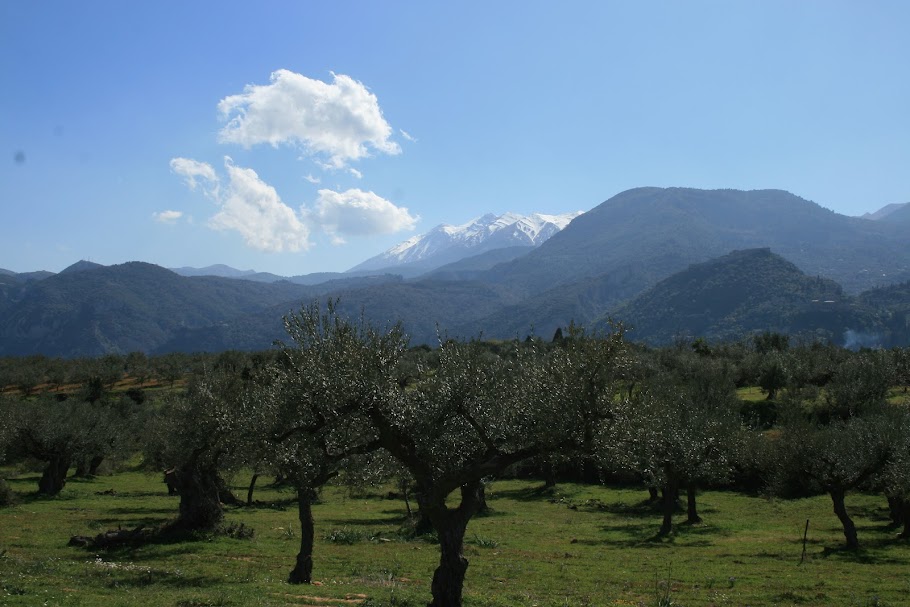
There was no denying that the capital of Lacedaemon lay in beautiful surroundings. It sat cupped in the hands of a fertile valley enclosed on three sides by mountains. The majestic peaks of Taygetos rose up to the west, and the Parnon range provided protection to the east. The two ranges met in the north so that as the Persian convoy worked its way up from the port of Gytheon on the Gulf of Laconia toward the city, the valley narrowed more and more.

But Sparta itself made no sense to Zopyrus. Throughout the rest of the known world, cities were surrounded by massive walls. In the more primitive countries, these might be little more than mounds of earth surrounded by ditches, but in the more civilized parts of the world, the walls were of quarried stone and fired brick. Major cities often had walls twenty yards thick and fifty yards high, strengthened with towers that stood even higher, and many walls nowadays were faced with polished stone or glazed tiles.  While more prosperous cities spread beyond their walls, so that dwellings, stalls, shops and other semi-urban structures cluttered the surrounding countryside in ever greater density, all the important civic buildings and palaces of every metropolis Zopryus had seen up to now lay behind defensible walls with ramparts and fortified gates manned by soldiers.

Sparta was different. It had hundreds of temples, shrines, monuments and public buildings. It had fountains, broad avenues, gynasiums and palaestra, stoas and baths, and an amphitheater below the acropolis. It was undoubtedly urban, but because it had no walls, it seemed to sprawl across the plain as if some giant had spilled a basket full of buildings. It was haphazard. There was no urban planning. There was no gridwork of streets running at right angles to one another, and there was no logical organization into quarters for administration, trade, worship, finance and dwelling. There wasn't even any separation of rich and poor.

Furthermore, the royal palaces were primitive. Rather than sitting above the city surrounded by gardens fed by streams and encased in high, glistening walls, they were located right in the heart of the city, crowded by other buildings that had grown up around them over time.  They were too cramped to be comfortable or have pretty grounds, and they were completely indefensible.