Find Out More

Find out more about Helena P. Schrader's Sparta novels at: https://www.helenapschrader.com/ancient-sparta.html

Friday, March 25, 2011

Merciless Exploiters of Their Neighbors?

In his introduction to Persian Fire Tom Holland argues that “Sparta’s greatness…rested upon the merciless exploitation of her neighbors.” The sentence made me stumble. Is Holland truly unaware that the Peloponnesian League at this point in history gave every city-state an equal vote in the League Council? Is Holland unaware that some city-states in the League chose to march north with Sparta to fight the Persians at Thermopylae and Plataea?

Since Holland goes on to contend that “to people who had suffered under Spartan oppression for generations, Xerxes rule might almost have felt like liberty,” I gather that Holland is really talking about the helots. He apparently believes that the helots and perioikoi and other Peloponnesians, who fought with the Spartans at Plataea, were all “mercilessly oppressed” Spartan slaves fighting against their own best interests. One wonders how 5,000 Spartans managed to keep 40,000 oppressed slaves under control and prevented them from defecting to their Persian liberators, while simultaneous defeating the Persians on the battlefield? Spartans must have been truly superhuman indeed to succeed at such a feat!

It is a particularly notable feat when one considers that the mere proximity of a potential liberator induced 20,000 Athenian slaves to defect in 413. The freedom loving, benevolent and ever democratic Athenians apparently didn’t treat their slaves as well as the “merciless oppressors” of Sparta or 20,000 Athenian slaves would not have “voted with their feet” by abandoning Athens for Sparta.

It also seems incredible that Sparta would have been elected to supreme command of the Greek forces opposing the Persian invasion – including Athens, if at that time it was widely perceived as a brutal oppressor of its neighbors. Would the United States at any time in its history have elected Nazi Germany the leader of a joint coalition? Would we have asked the Soviet Union to assume command of joint NATO and Warsaw Pact forces to fight a joint enemy? It tries my imagination.

Whatever else one says about Sparta’s treatment of helots (and firmly believe they were far better off than chattel slaves in the rest of Greece, not to mention Persian), to suggest that Sparta “mercilessly oppressed” its neighbors is a gross distortion of the historical record. It is sad that such sweeping allegations are still standard fare in modern treatments of the ancient world.

Friday, March 18, 2011

From Choral Masters to Quartermasters: Sparta’s Invisible Professions

As everyone with even a cursory knowledge of Sparta knows, Spartan citizens were professional soldiers. Spartiates trained for war in the agoge, they spent the first ten years of their adult lives (ages 21-30) on what amounted to “active duty,” and the next thirty years of their lives in the ancient equivalent of the reserves. Not only this, but, we are told, Spartiates were prohibited from learning and pursing other professions and so there were no potters and no carpenters, no shipwrights and no smiths among Spartan citizens. These undisputed facts have led most people to see Spartan citizens as soldiers only, ignoring the fact that despite their life-long service in the military, Spartan citizens could in fact be much more than soldiers. They were also the administrators of a large, prosperous and exceptionally complex state.

Lacedaemon stretched from the Ionian to the Aegean Sea and had an estimated population of 60,000 or more. It had at least three classes of inhabitants (helots, perioikoi and Spartiates). It had a public school – unlike any other city of its age. It had a great number of public festivals with complex rituals involving choral, dance and athletic competitions. It successfully competed in the pan-hellenic games. It pursued extensive diplomacy throughout the then known world. And all this in addition to pursuing a brutal war that dragged out over generations in the second half of the fifth and early fourth century. In short, Sparta was a highly sophisticated society, which could not have been managed by two bickering kings, 28 men in their dotage and five amateurs elected for a single year. Sparta’s centuries of pre-eminence in the ancient world, and its reputation for good governance and order, can only be explained by hypothesizing a well-functioning administration that kept Sparta’s institutions operating.

This logical conclusion is supported by various sources which make oblique reference to various, often ill-defined, dignitaries that apparently supported the operation of the Spartan state. For example, the Paidonomos and his assistants, priests, magistrates, and heralds. While there is no explicit evidence (except with respect to the Paidonomos) that these positions were filled by Spartiates, it is unlikely that the Spartans would have entrusted the education of their children, their relationship with the Gods, communication with the enemy or the enforcement of their laws to helots or perioikoi. In short, there were many things beyond soldiering that almost certainly must have been performed by Spartiate full-citizens after they had been released from active duty.

Let’s start with the agoge. Although Xenophon and others speak only of “the” Paidagogos, as if one man alone controlled the entire agoge, such a notion illogical. We know that effective education requires low ratios of instructors to pupils, and even taking into account an age cohort of eirenes providing a degree of internal discipline each year, it is not credible that there were no other agoge officials. It is far more likely, given the size and importance of the agoge to Spartan society, that there were a relatively large college of instructors, or at least Deputy and Assistant Paidagogoi, maybe the Mastigophoroi usually portrayed as a bunch of whip-wielding thugs, but more likely responsible and respected educators.

Descriptions of Spartan life suggest a variety of other activities that would also have been performed by Spartan citizens if not “professionally” then, nevertheless, with the conscientiousness expected of full or part-time public service. For example, Sparta was famous for its choruses and dance performances. Anyone who has engaged in either knows that large groups of people cannot be brought to perform harmoniously together without someone choreographing, directing, or conducting. Sparta undoubtedly had chorus masters, and it is seems highly unlikely that for performances during Sparta’s sacred festivals that choral and dance masters would have been drawn from the ranks of the helots or perioikoi. Just as with the agoge instructors, it is far more probable that these were full citizens.

We also know that the Spartan kings kept records and maintained archives. Control of such delicate material as oracles from Delphi, communication between the kings and their permanent representatives, correspondence between the ephors and commanders in the field or ambassadors to foreign capitals would hardly have been entrusted to anyone but Spartiates. In all probability, therefore, there was at least one “archivist” for each royal house, and this position was probably filled by a Spartiate, who was either appointed or elected.
Then there is the issue of taxation. Taxation was particularly important in Sparta because citizenship itself depended on paying two kinds of tax: the agoge fees when immature, and the syssitia fees after attaining citizenship. Someone had to keep track of who paid how much, and they had to do that each and every month. Maybe each syssitia had a part time “treasurer” too keep track of fees, but the agoge was large and would have required at least one (and probably more) full-time “treasurers.” It is not credible that perioikoi would have been entrusted with control of records that revealed (and in part determined) the strength of the citizen body and so the army in future generations. Finally, taxes also had to be collected from the helots and perioikoi. Spartiates who collected too much from their helots were subject to sanctions, so someone – and it had to be one of their peers – must have been keeping track of how much was due and how much collected.

Even if not explicit, it is also fair to assume that the perioikoi were subject to taxation, just as metics in Athens. Again, an institutionalized means of assessing and collecting those taxes would have been necessary to ensure everything functioned properly, and at least until Sparta’s population decline became critical, such an apparatus would have been headed by Spartiates. Given the size and expanse of Lacedaemon, my guess is there would have been many more than one citizen engaged in tax collection!

Once taxes were collected, they had to be put to work, so we come next to the realm of financial management. Sparta would have needed some mechanism to allocate funding to various state expenditures. Money was needed for the army, of course, but also for the fleet, and for public works like roads and fountains and drainage systems and for public buildings from temples to theaters, monuments and barracks. Managing such projects requires full-time public servants committed to ensuring that the intentions of the state (as expressed, one assumes, by the Assembly via the ephors) are fulfilled and that funds are not misallocated.

And finally there was the Spartan army. Friend and foe alike admired the Spartan army not only for its relatively good performance on the battlefield but also for its organization and professionalism. Yet as most soldiers will tell you, an army’s effectiveness is not simply a matter of fighting capacity. A good army is well fed, well equipped, and well-supplied. It has effective command-and-control mechanisms, efficient lines of communication, and adequate, flexible transport. A good army has a medical corps and in centuries past good veterinaries as well. In short, there is a great deal more to creating an effective fighting force than drill with weapons. Sparta’s army must have had not just good soldiers and officers, but good quartermasters as well.

While all these various positions were “honorary” in the sense that they were without remuneration, they were nevertheless jobs requiring considerable time, energy, dedication and skill. Spartiates may not have earned a living from these jobs, since they all had their estates, but they probably viewed their performance in such jobs as honorable public service. Whether elected or appointed, ambitious Spartiates would undoubtedly have competed for these positions and performance would have contributed to a man’s reputation and prestige. I suspect that men who did well in these public function were most likely to be elected ephor, but whether they attained that honor or not, men in these positions would in turn have been influential.. They would have been part of the complex network of “leading” citizens that helped shape Spartan policy behind the scenes. There is nothing sinister about this. It happens in every society – including our own.
Friday, March 11, 2011

Women in the West: Sparta's Contribution

International Women’s Day, March 8, is celebrated here by parties, newspaper articles, speeches – and red roses. I was invited to give the keynote address at an event, but while, as expected, I outlined the major milestones of the women’s movement in the U.S.A., I couldn’t leave it there. The condition and position of women in many parts of the world is so incomparably worse than in the “West” that I felt an International Women’s Day should not focus exclusively on the demands of rich and successful Western women for more, but on the need for solidarity with the truly oppressed and misused.

The statistics are truly appalling. A woman dies in childbed every single minute. Two million female infants are either aborted or killed before they reach their first birthday. Five to six thousand women are murdered each year because their fathers or brothers think they did not behave “modestly.” Ten times as many women are trafficked across international borders each year in the 21st Century than Africans were transported across the Atlantic during the height of the African slave trade. A million children each year are forced into prostitution, and ten million children are currently sex-slaves, the bulk of these are girls. Women are not only denied education, access to medical treatment and excluded from economic and political power, they are tormented, enslaved, humiliated, neglected, and murdered – simply because they are women. In many societies, the position of women can only be described as systematic subjugation based on contempt, scorn, loathing and palpable hate.

What does all this have to do with Sparta? Maybe nothing at all, but it did strike me that women in “the West” have status, respect, and legal protection to a degree that is exponentially higher than women in other parts of the world. Furthermore, women in “the West” have enjoyed status, respect and legal protection for literally thousands of years. No, women were not “equal” to men in ancient Rome or in the Middle Ages, but the status of women in Rome and in Medieval England, France and Scandinavia, for example, was significantly higher than in many parts of the world today. Respect for women (not equality) is an integral part of “Western” civilization.

But what is “Western” civilization? It is not just Christianity (although that is an important component!). The “West” also claims the traditions of pre-Christian, ancient Greece as part of its heritage. That is the reason Marathon, Salamis and Thermopylae are often portrayed as the defense of “the West” against the Orient.

But we have a slight problem here. Women in Athens – that favored example of all things “golden” in the ancient world – were treated pretty much like women under the Taliban today. They were denied a healthy diet and exercise, and confined to the cramped, dark “women’s quarters” – just like women in Afghanistan today. They were kept illiterate, and married off at 12 or 13 to die in droves like the child-brides of Africa and Asia today because their immature bodies could not cope with childbirth. They could not inherit or even control property worth more than a bushel of grain.  If they were raped, their husbands were compelled to discard them or lose their own citizenship. They had no part of Athens famed culture. They did not even attend the symposiums unless they were sex-slaves. As Pericles put it, the less one talked about or saw Athenian women, the better. In short, they were an embarrassment that Athenian men would rather have done without – how the Taliban would have understood and applauded Pericles! If Athens is the source of our “Western” traditions with respect to women, than Christianity alone is the source of the higher status of women in the West. Possible.

But Sparta had a very different tradition with respect to women. In fact, the status of women in Sparta was notoriously high. Spartan women certainly had economic power – hence Aristotle’s diatribes against them and Sparta itself. They were educated. They received the same food as their brothers and engaged in sport. They were not married until they were sexually mature and had a better chance of surviving the rigors of childbirth.

In the contrast between the Athenian and Spartan treatment of women, we have a microcosm of the modern world -- with Athens firmly located in the regions in which women are most exploited and despised. If ancient Greece had any impact on modern Western attitudes toward women, then we are following – quite unconsciously in most cases – the example of Sparta. In short, Sparta’s influence on Western civilization may be greater than most people – raised on adoration of Athens’ intellectual and artistic accomplishments – realize.


Friday, March 4, 2011

Appeal for a Photo of the Pass at Thermopylae

The covers of the books in my Leonidas trilogy are composed of photos showing Greek landscapes combined with images that evoke ancient Greece. My aim is to remind the reader that ancient Greece was blessed with the same magnificent landscape as modern Greece and to hint at the fact that these books, while set in the ancient world, are an attempt to bring the ancient world to life. 

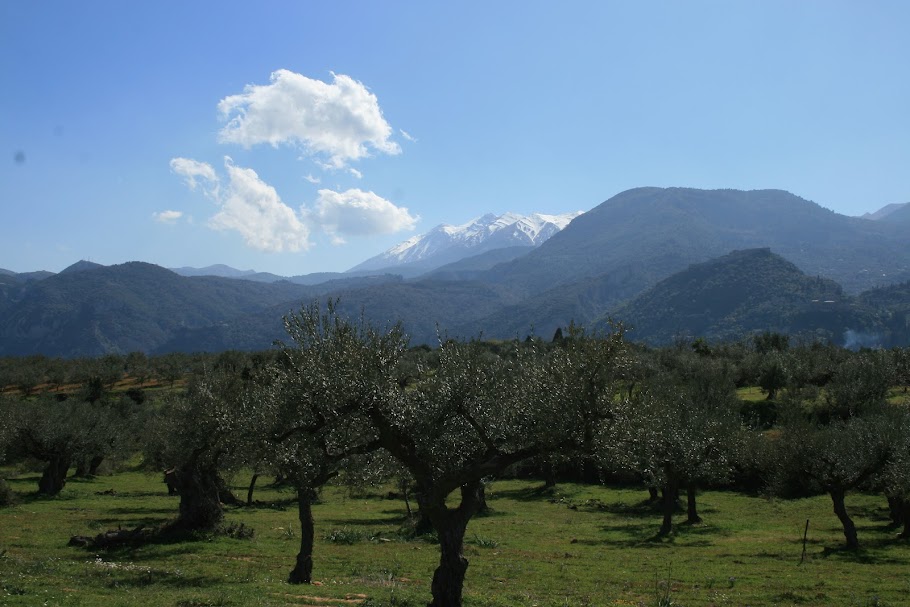
Leonidas of Sparta: A Boy of the AgogeThe image on the cover of A Boy of the Agoge shows the view from the Eurotas to Taygetos from Sparta -- a view Leonidas would have seen daily when growing up in the agoge.   

The image in the background of the cover of A Peerless Peer shows a white-washed wall on a shed on Kythera.  I chose this because I wanted to suggest that this was a book focused more on domestic issues -- hence an orchard and a shed and a family scene. Thanks to all, who helped select the latter!

For Book III, A Disposable King, I would like to have an image of the Pass at Thermopylae in the background.  I had hoped to take the photo myself, as I did the photos for Books I and II. Unfortunately, I will not be able to make it to Thermopylae in time.

So, I am requesting your help.

If you, or anyone you know, has a color photo of Thermopylae and like the idea of having your photo on the cover of a book, please send me a file with the photo to hps_books@yahoo.com, along with written permission to use the photo for this purpose.  I will give full credit for the photo in the acknowledgements of the book.

I look forward to seeing your photo!

Thank you!


Friday, February 25, 2011

A Nation of Theives?

Every scholar of Sparta knows Xenophon’s descriptions of how Spartan youths and boys were kept hungry so they would learn how to steal, and were punished only for being caught rather than for theft itself. Credible as Xenophon generally is, his commentary on this aspect of Spartan society is very questionable. Aside from the fact that thieves in any society can only be punished when caught, and many robbers undoubtedly view punishment as the price of poor performance rather than theft itself, the greater problem with this common depiction of Sparta is the notion that Sparta’s youth was continually stealing just to keep alive.

Admittedly, a nation of thieves may well fit Athenian views about their enemy. The French referred to the English as “perfidious.” Americans and Soviets routinely attributed treachery to each other throughout the Cold War. The Israelis and Arabs have no end of adjectives to describe the deceitful character of the other side. Rather like calling your enemy’s men “fags” and their women “whores,” attributing sly dishonesty and immorality to the enemy is standard fare in propaganda wars regardless of culture or century.

A nation of thieves does not, however, fit well with a society that even her enemies considered remarkably stable and orderly. How do you keep a society orderly, if the entire male population between the ages of 7 and 20 are actively encouraged to steal? More important, how do you keep an economy functioning at the high levels of efficiency needed to finance a brutal, 30 year war, if every farm, shop, house, workshop and warehouse must be locked and guarded against hoards of desperate, half-starved youth? There are thieves in every society, but high levels of crime are one of the most destructive factors to social stability and political credibility.

Admittedly, the theft of food alone might not be so devastating to an economy as the theft of all goods, but the accounts usually cited, supplemented with details such as the absurd story of a youth caught stealing a fox (which is not on anyone’s menu), suggest that theft as such was encouraged. It is this picture of Spartan youth which dominates modern portrayals of Sparta.

To his credit, Anton Powell, in his article “Dining Groups, Marriage, Homosexuality,” in Michael Whitby’s Sparta, notes that “theft offended against two ideals of Spartan society: obedience and respect for elders.” (Sparta, p. 102). However, rather than questioning if Xenophon’s account is accurate or complete, Powell tries to argue that the military benefits of teaching youth stealth and deceit outweighed the disadvantages of corrupting their morals. The problem with this argument is that such skills were conspicuously not necessary to the phalanx warfare at which Sparta was so good. Powell attempts to make a connection between guerrilla warfare and the custom of theft despite the fact that Thucydides states explicitly that prior to the Pylos campaign the Spartans had little experience of brigandage. Unable to square such a statement with his own image of Sparta, Powell hypothesizes a long history of (completely unrecorded!) helot revolts in which the Spartans learned guerrilla warfare – and so needed training in theft and stealth, but which Thucydides and Herodot knew absolutely nothing about.

Admittedly, the kryptea was an organization in which the skills of deceit and theft would have been useful, but we are told that only selected Spartan youth ever served in it, not all of them. Furthermore , as Dr. Nic Fields so significantly pointed out, Sparta probably did not have that repulsive institution unit until after the helot revolt of 465. There is, in fact, no credible indication whatsoever that Sparta had to deal with helot revolts of any kind prior to 465 – unless one counts the Second Messenian War as a major “helot” uprising. It is far more likely that both helots and perioikoi prospered throughout the archaic period.

Rather than inventing unrecorded wars, I think it makes more sense to examine the presumption that Spartan youth were encouraged to steal. It is far more likely, as Nigel Kennel argues in The Gymnasium of Virtue, that if Spartan youth were encouraged to learn stealth and theft at all, it was only in a very limited and restricted context, and/or only after the degeneration of Spartan society had set in in the mid-fifth century BC.


Wednesday, February 16, 2011

Two New Reviews of The Olympic Charioteer

Jennifer Walker of SharedReviews (http://sharedreviews.com/) wrote:


The Olympic Charioteer:


The Olympic CharioteerSoon after politician and chariot horse breeder Antyllus buys the slave Phillip from the quarry, it becomes clear that his new purchase is not just any slave. Phillip possesses a remarkable level of pride for his station; but more than that, he has a death wish. He nearly manages to achieve that goal when Antyllus purchases him just in time to prevent a horrifying end. Antyllus soon learns just how unusual Phillip is. For one thing, despite his insolence and liberal sarcasm, Phillip has apparently been trained in rhetoric and deportment. For another, his ability to handle horses rivals that of anyone Antyllus has ever met.

Antyllus hopes for an Olympic victory with the team of horses he bred, but he needs a skilled driver to give him the best chance. He teaches Phillip to drive them and assist in training sessions, and Phillip learns so quickly that he soon surpasses Antyllus in skill. Antyllus decides that he has found his Olympic charioteer, but when Phillip surprisingly refuses, the mystery of the slave's background is finally solved.

The Olympic Charioteer transported me back to ancient Greece and plunged me into a world of politics and intrigue. Author Helena P. Schrader deftly paints a picture of social and political life in Tegea and Sparta of the times, which I found fascinating. Schrader’s story is fictional, but she obviously has an intense level of knowledge of the time period, which brings the story to life in a very authentic way. She explores in this story the conflicts between these two city-states--a conflict that eventually led to the formation of the Peloponnesian League through a series of non-aggression pacts.

I found Helena P. Schrader’s The Olympic Charioteer to be a brilliant tapestry of Ancient Greece, with robust, lifelike characters and scenery. This story has a little something for everyone: it is a realistic historical fiction for those readers, with a sweet romance for those fans. There is even mystery, action and drama. It was a brilliant and fascinating read that I truly enjoyed. This book retails for $22.95 and is 416 pages. It is available at Amazon and other online retailers.

Overall Rating: 5.0
Acquired by: It was a gift
Category: Fiction Books
Published: Jan 31, 2011

Feature Ratings:
Genre: 5.0
Author / Illustrator: 5.0
Length: 5.0
Content: 5.0

Review Author: Jennifer Walker


ALSO, April Renn of http://mybookaddictionandmore.worldpress.com/ wrote:

THE OLYMPIC CHARIOTEER by Helena P. Schrader is an interesting historical fiction set in Archaic Greece. It is well written with depth and details. It is a tale of one slave,two men with Olympic ambitions, two cities at war and the finest charioteer in Greece. It has tragedy, olympic triumph, romance, slavery, intrigue, alliances, struggles, Archaic Spartan society, love won and lost.  It is about the struggle of one slave who will become the greatest Olympic charioteer of all and his sacrifices, triumphs and the first non-aggression pact: the Peloponnesian League. This is a very intense story with many faceted characters. It expands on the Spartan culture and shows much research was done in order to write this story. It is packed full of action, adventure, tragedy, and is fast paced. If you enjoy learning more on the Spartan culture, their trials, triumphs, slavery and be transported to a different time and place this is the book for you. It is a great read and is fast paced. This book was received for the purpose of review from AME Virtual Author Tours and details can be found on amazon.com.

RATING: 4

REVIEWED BY: April Renn

Monday, February 7, 2011

Sparta's far from Insignificant Fleet

The Peloponnesian War is often seen as a conflict between a great sea-power (Athens) and a great land-power (Sparta), and in many history books disparaging remarks about Sparta’s “inability” to grasp the importance of sea-power can be found. Generally, there are dismissive references to its “insignificant” fleet – despite the fact that Sparta ultimately defeated Athens at sea rather than on land. Clearly, Sparta’s pride was her army, not her navy, and clearly the Athenians were the “lords of the sea” throughout the Classical period, but I think it worth noting that the clichés about Sparta’s lack of maritime power are overdrawn.
Sparta, unlike Athens, was not dependent on the sea for its very existence. Because it was self-sustaining in food and other necessities from ore to wood, Sparta did not need to trade and because it was not dependent on trade it did not need to control the trade routes. It did need to control its bread-basket Messenia, but that could be done with its army. Thus, far from being negligent or backward (as some commentators suggest), the relative unimportance of Sparta's fleet was a logical consequence of her geo-political position.  In fact, the ability of Sparta to deploy a fleet at all is rather surprising.

Furthermore, based on Herodotus, it is arguable that Sparta had a credible fleet before Athens did. Sparta’s first attempt to depose Hippias entailed, we are told, sending an army by sea (5:63). Sparta would hardly have sent its own modest fleet, if it had been facing a major sea-power, and significantly the force dispatched was defeated on land by Thessalian cavalry. This is an important early example of Sparta's vulnerability to cavalry, but equally importantly means that Sparta successfully landed troops in Attica, something that seems astonishing if the Athenians had truly had command of the sea at the time.

When Aristagoras convinced the Athenians to aid his rebellion against Persia, we are told the Athenians sent 20 triremes. That is respectable, but not overwhelming considering islands like Chias and Naxos could deploy fleets a hundred strong. Obviously, Athens might have consciously chosen not to send too many ships, yet it seems odd they would risk the wrath of Persia with only a token force. Twenty triremes probably represented a sizable portion of their available fleet.

More to the point, Themistocles is credited with having convinced the Athenians to build a navy. He would hardly have earned the reputation as “father” of the Athenian navy if Athens already had a substantial fleet. If the Athenian navy was indeed built up from a modest, auxiliary component of Athens’ military forces to her pride and primary arm in the ten years between 490 and 480 BC, then it is less surprising than usually assumed that a Spartan, Eurybiades, was nominally in command of the combined Greek fleets opposing Persia in 480.

On the contrary, it is arguable that at the time of Eurybiades’ appointment, Athens' new fleet and most of her crews were completely untested. Sparta’s fleet may have been smaller and not notably successful, but apparently the allies felt it was more experienced than Athens.’ In fact, it is less odd that Sparta was given precedence over Athens than that Sparta was given precedence over Corinth. Corinth had a substantially larger fighting fleet and is credited by naval historians with having evolved the trireme – not Athens.

Once Athens had won the battle of Salamis, however, Athens’ domination of the seas began. The navy was an instrument well suited to Athens radical democracy because it gave poorer citizens a means of contributing directly to Athens military power. Radical democracy in turn gave Athens the manpower to man her fleet. Middle class Athenians could remain hoplites and the sons of the wealthy could form the cavalry, while the great magnates financed the construction and commanded the fleet. But it was Athens citizen crews that made her fleet so good. No trireme manned by slaves or mercenaries could be depended upon to row so fast or fight so hard.

And Sparta’s fleet? We know that Spartiates were appointed to command the fleet as navarchos. Beyond that, to my knowledge, the names of no Spartan who served at sea has been recorded. The assumption is that Spartiates were required to serve in the army and did not man the fleet. This means that the Spartan fleet must have been manned by either perioikoi or helots or both.

Helot crews would, of course, have been similar to slave crews – highly problematic since disloyalty or mere disinterest could cost a battle. Does this explain the lackluster performance of the Spartan navy throughout most of the Peloponnesian War?

Yet, helots would hardly have been capable of building and paying for the ships nor is it likely they would have been capable or entrusted with command aboard them. This suggests perioikoi most likely financed and commanded Sparta’s fleet. This is yet another area in which the role of the perioikoi has been seriously overlooked. The fascination of ancient and modern observers with the unique live-style of the Spartiates themselves, and to a lesser extent their relationship with the helots has resulted in serious academic neglect of an essential component of Lacedaemon’s success: the perioikoi.