Find Out More

Find out more about Helena P. Schrader's Sparta novels at: https://www.helenapschrader.com/ancient-sparta.html

Saturday, August 6, 2011

Looking for Sparta

The ancient city of Sparta was destroyed by earthquakes more than once. The valley was flooded and the site completely abandoned for more than a thousand years. Today, what few ruins remain date predominantly from the Hellenistic or Roman periods, and an modern town has grown over the ancient site, so naturally
 
So naturally our images of the ancient city-state have been shaped by what we have been told about Spartan society. Spartan society was characterized by rigid discipline, a disdain for luxury, and endurance of hardship. We are told that the boys suffered a childhood of deprivation in which they had to steal to get enough to eat and were allowed only one garment per year. Allegedly the women were prohibited from wearing jewelry or taking pride in their weaving. Indeed, gold and silver was banned entirely, and so could not adorn even the temples of the Gods. The houses, we are told, were not painted (as else where in the Ancient world), and the cuisine was infamous for its lack of sophistication and variety. (See my blog entry from July 10 "The Secrets of Spartan Cuisine" for more thoughts on Spartan cooking.)

It is understandable if one imagines that such a society could only have developed in an austere, plain, indeed barren, landscape. After all, a society deprived of food and clothes, and lacking all forms of decoration and fine cuisine sounds like a desperately poor society. It is easy to assume that Spartan society evolved to make a virtue out of necessity.

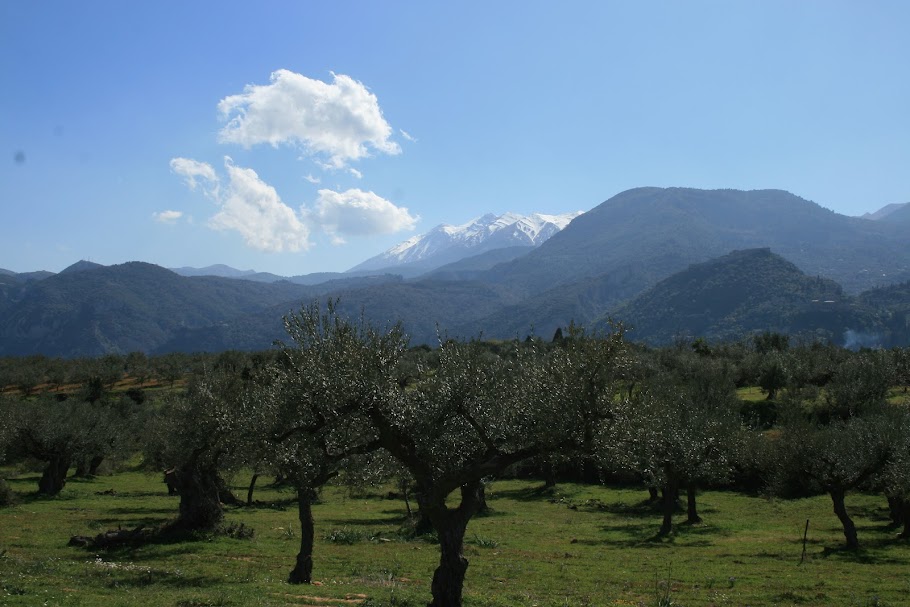
But the valley of the Eurotas River, the heart of ancient Lacedaemon, is anything but barren! It is green and fertile and stunningly beautiful - like riches cupped in the hands of the gods. From the blooming oleander to the wild iris, the valley is a garden. Orange orchards stretch as far as the eye can see, brazenly advertising the abundance of soil and sun and water. Most spectacular of all, the Eurotas valley is one of those few places on earth that offers the sensually stimulating sight of palm trees waving against a back-drop of snow-capped mountains.

Nor is this richness a product of modern fertilizers and irrigation. The ancient historians also speak of Sparta’s agricultural wealth. Sparta’s hinterland produced in abundance every staple of ancient Greek agriculture from grain to grapes, and from citrus fruits to olives. Furthermore, ancient Laceademon was famous for its forests and pastureland. The former provided exportable timber and abundant game to enrich the Spartan diet, while the latter nourished sheep, cattle, goats and fine horses. Finally, Lacedaemon had exploitable mineral resources such as lead, tin, copper and marble.

Sparta took full advantage of these natural blessings. The fact that the ruling class, Sparta’s full citizens or Spartiates, were prohibited from engaging in any profession other than arms, has led many modern observers to imagine Lacedaemon was devoid of industry, trade and commerce. Nothing could be farther from the truth. Sparta’s tiny elite of professional soldiers had the luxury to devote themselves to perfecting their skill at arms precisely because Lacedaemon had a large population of helots and perioikoi who ensured the economic prosperity of the Lacedaemonian state.

Both helots and perioikoi are believed to be the descendents of the peoples who inhabited Lacedaemon before the Doric invasion. While the helots had a status similar to medieval serfs and enjoyed only limited freedom, the perioikoi were fully free men. The perioikoi had abdicated control of foreign policy to Sparta, but they otherwise governed their own affairs by their own customs and laws. They were not bound by the Spartan Constitution attributed to Lycurgus regarding dress, diet, profession or the possession of gold and silver. Among the perioikoi there were artisans and architects, merchants and bankers, tradesmen and shipbuilders – just as in any other Greek city. The perioikoi produced everything from mundane domestic articles to exportable quality works of art in bronze, ivory and stone, and they traded from a variety of ports with direct access to the Aegean and Ionian Seas. (See my blog entry from April 9: "Shopkeepers and Shipmasters.")

In short, Leonidas’ Sparta was not poor, but the center of the powerful city-state of Lacedaemon. It was the administrative hub of large territory with an abundance of natural resources and agricultural produce, good lines of communication, and an active commercial and trading community. It was also the leading nation of the Peloponnesian League, a powerful defensive alliance of independent city-states – the NATO of its age. Last but not least, it was the site of annual vocal and dance festivals that attracted mass tourism from around the ancient world. It was most decidedly not a provincial back-water lost in a barren and inaccessible landscape.

Modern writers, however, have often been misled by the disparaging remarks made by Athenian observers about their hated rival. Nicolas Nicastro in his The Isle of Stone (p.67), for example, describes the capital of the dominant superpower of Greece as no more than “an agglomeration of sleepy villages.” Jon Edward Martin, an author whose research is on the whole very sound, writes in The Headlong God of War (p. 83) that “large buildings were few” and depicts the city as having only “a small collection of civic buildings clustered to the southeast of the acropolis.” Steven Pressfield in his best-selling novel Gates of Fire (p. 188) has one of his characters describe Sparta as “… a pile of stones,” and go on to claim: “It contains no temples or treasures of note, no gold….”

Yet Pausanias, whose travel guide to Greece was written in the 2nd Century AD – long after Sparta’s decline from prominence under Leonidas – needed 26 sections and more than 60 pages to describe only the noteworthy architectural sites of the ancient city! Far from being a backwater, Sparta was a large, prosperous and important city in the lifetime of Leonidas. But, as the Athenian commentary suggests, it was also very different from other Greek cities.

Visitors to Leonidas’ Sparta would have come expecting the capital of this rich and powerful state to be like other power-centers of the civilized world. Whether tourists, coming for the dancing and singing at the annual festivals, or diplomats, coming to plead for Spartan troops to support some distant conflict, foreign visitors would have compared Sparta to Susa, Babylon and Memphis no less than Athens or Corinth. These foreigners came expecting a city enclosed by walls whose strength matched Sparta’s military reputation. They expected to pass through imposing gates into a city crammed with brightly painted, colorfully tiled and elaborately decorated public buildings. They expected to find temples laden with gold crushed between pompous civic buildings. They expected to find a confusing maze of residential streets crammed with humanity humming incessantly with activity. They expected – as in other crowded cities – these back streets to be clothed in the perpetual shadows cast by the tall walls which shielded the private spheres and women of the inhabitants from public view. They expected a commercial capital as well as an administrative one. It is hardly surprising that they were disappointed with what they found at Sparta.

Sparta was different from other Greek cities, but it was not necessarily without its unique charms. For example, we know that in ancient Greece most statues and temples were painted vivid colors and the statues of the gods were dressed in robes, ivory, gold and jewels. Spartan temples were not. But isn’t it precisely that simplicity of white stone structures of flawless proportions and life-like naked marble statues that we find striking in ancient Greek architecture and sculpture today? Would we admire the Parthenon in Athens as much if it was dressed – as it was in the age of Leonidas - in vivid paint? Would we prefer to see Venus de Milo painted in flesh tones with red lips and blond hair?

Sparta’s ethos and aesthetics were different from other Greek cities, but that doesn’t mean it lacked beauty or refinement. Yes, Leonidas’ Sparta had no walls, but this meant it could spread out graciously upon its valley as all major European cities did after their confining walls were torn down. No one today would call Paris, Vienna or Rome “a collection of villages.” Yet all did in fact begin as collections of villages, which later grew into a single metropolis after the need for fortifications disappeared and economic growth fueled urbanization. Why should we assume that just because Sparta was made up of five distinct villages in pre-Archaic times that it was not – by the age of Leonidas when it was at the height of his glory – a cohesive, dynamic city?

Spartan homes may indeed have lacked elaborate interior paintings, but then maybe such decoration was not necessary because, unlike their Athenian counterparts, they were not compressed into the back allies of an over-crowded city and surrounded by high, protective walls. Spartans could afford to build their houses on generous plans. They could incorporate interior courtyards planted with fruit trees and herbs. They could surround themselves with gardens and orchards. Spartans could have decorated their homes - as they did themselves – with things of nature: cut flowers, bowls of fruits, running water. Even without gold or silver, their homes could still sparkle with sunlight glinting off the water of courtyard fountains.

Ironically, Leonidas’ uniquely Spartan city might well have been more pleasing to modern taste than Athens or Babylon of the 5th Century BC.

Picture a city spread across the broad floor of the Eurotas valley before the backdrop of snow-capped Taygetos. Picture a city of wide, tree-lined avenues along which the white-washed civic buildings, marble monuments and graceful temples stretched like pearls upon a green thread. Imagine a city of sun-soaked theatres and imposing but airy stoas. Imagine a city where the barracks and civic buildings with their long porches and batteries of Doric columns face green, open spaces set aside for running and horse-racing. Imagine a city decorated with fountains and flowering trees which gradually spreads out into the suburbs where large villas set in blooming gardens sprawl out toward the mountains on either side of the Eurotas. That image will bring you closer to the Sparta of Leonidas.

Saturday, July 30, 2011

Austerity-hit Spartans resent Athens - from the BBC

House guests this weekend, so rather than my own entry, I thought I'd share this article about Sparta today from the BBC.


BBC News, Sparta

The BBC's Paul Henley detects stirrings of dissent in Sparta as middle-class Greeks hit by the country's economic woes aim their ire at the Athens government.

Yiannis did not expect to be back in his sleepy home town of Sparta, in the Greek Peloponnese, at the age of 30. He sees his return as a personal defeat. Up until 18 months ago, the business graduate had a career in Athens for a finance company. But his job was a casualty of a national economic collapse that dwarfs most others in Europe and, ever since, he has been unable to find work. He ended up moving back in with his parents where he grew up. Having made constant unsuccessful applications for work, he says the growing feeling of uselessness is reducing him as a person.

"Now" he says, "I can't dream as I did before, I can't be optimistic about life or have any real ambitions. Perhaps my only chance is to move abroad."

War against Athens

Yiannis is one of a group who call themselves the "Indignant Spartans" and who went on a 250km protest march to Athens. The three-day march, in May, was a vent for their anger and a way of publicly underlining their belief that ordinary Greeks had been betrayed by their political elite and by the murky world of international finance.

About 10 of the group are sitting around a table, at dusk, at a friend's pavement cafe. They are, frugally, drinking water in the shadow of a statue of Sparta's ancient king, Leonidas, a symbol of the days when Sparta waged a bitter war against Athens. These days, much of that bitterness is returning.

The "Indignant Spartans'' stories are a microcosm of the troubles facing citizens everywhere in Greece, as another national austerity package kicks in, living costs and taxes rocket, consumers rein in spending, wages fall and jobs are lost.
And although the calm, olive and palm tree-lined streets these Spartans inhabit, amid the constant hum of cicadas, seem a world away from the tear gas and the pitched battles outside parliament in Athens, the spirit of provincial rebellion seems to be growing fast.

Vasilis, who is 33, puts it like this: "Sometimes during the past two months I have started to understand how easy it would be to turn, in an instant, from being a good, law-abiding, tax-paying citizen - into a terrorist."

He is not the idle, state-reliant Greek familiar from mocking articles in the foreign press recently.
Vasilis is an entrepreneur who built up a highly successful business chain from scratch during a working life which began, he says, at the age of 12 and has regularly involved 18-hour days. In the past year, he says he has lost €800,000 ($1,150,000; £700,000. Vasilis's restaurant and catering business faces bankruptcy. A single cafe became a collection of restaurants and a mobile catering business with regular wedding and business contracts. As customers began to trail off, Vasilis put his capital into a scheme to build a hotel on the coast. But the scheme was reliant on government-approved loans and grants which disappeared in the crisis. The hotel was never finished and he is looking bankruptcy in the face.

"I feel very angry inside," he says. "When you try to do the best for your country and your children and your neighbours, you still get treated like garbage by the authorities," he says. "It is psychological violence. Maybe the terrorists we see on the television - this is the process they have gone through."

His words are greeted with nods around the table.

Constantina says she has been independent since she was 17 and now, at the age of 43, finds herself borrowing money from her parents. She set up a graphic design business eight years ago. Labels for agricultural products and flyers for local shops are her mainstay. Constantina's graphic design business is starved of business All her clients are desperate to save money. She feels penalised by a tax system she predicts will be the final straw for her business within the next year.

"Maybe marching is the only way I can remain an active citizen of this country," she says.

George, who is 45, is a secondary school teacher and one of those supposed to feel thankful for the relative security of his job. "I do not feel at all lucky," he says. Civil servants' salaries were a number one target in the cuts and that will continue." He feels the faith he had in the future has gone. A house he was building for his family has been left a concrete shell. "The next few years will be the hardest of our lives," he says. "The Ministry of Education has already begun closing schools."

"The situation makes me want to revolt," says Panagiotis, a pastry chef in his 40s. The business he set up with his nephew is at risk from a dramatic loss of customers recently and a simultaneous hike in costs. The macaroons, mini ice-creams and chocolate eclairs he makes are among the first to be crossed off people's shopping lists in difficult times. The handful of people they employ have already taken pay and some could soon be made redundant. "I worry for my family," he says. "What will happen if I can not pay back the loans on the business? I want to go out into the streets and shout about it."

His words are a thinly-veiled warning to Athens: "I want people to understand that my personal revolution must become a national revolution."

Saturday, July 23, 2011

Thespeia and Thermopylae

The reason I made no post last week is that I was in Greece. A sudden change of plans made it possible for my husband and I to get away for almost ten days. With the help of cheap airlines and a willingness to improvise, we took off for Thessaloniki.
 
On our fourth day, we reached Boiotia and after driving several hours in the blistering summer heat (ca. 100 F), we made the turn-off to Thespeia. We left the flat cultivated fields beside the National Road, with its road-side taverns, furniture show-rooms and telephone lines, and headed into low, rolling hills. The character of the land changed almost instantly. The valleys were golden with the stalks of harvested wheat broken here and there by olive orchards or stands of other trees, and the hills were semi-arid.
 
Eventually, we came to a T-intersection in an obscure village without signs, but at once a young man got up from the roadside cafe, and offered assistance in educated English. He seemed a little surprised that we wanted to go to “the village” of Thespeia, but when we assured him that was our destination, he told us to turn left and go until we reached the school then turn right and continue six kilometers.

His directions were exactly correct. After six kilometers, we found ourselves facing a marble monument dominated by the larger-than-life statue of a hoplite. Despite my rudimentary Greek, it was possible to decipher enough of the dedication to know the monument was erected to commemorate the 700 Thespians who died with Leonidas at Thermopylae. The dedication included a quote from Herodotus.
 
We continued into the modern village, which perched on top of a low, but steep, hill with a surprisingly good view of the surrounding countryside. To the east, not far away, was another long, curving hill. To the north the plain, and to the west and south distant mountains almost lost in haze beyond gently rolling, cultivated countryside. The village was surprisingly large – larger than other villages that rated a dot of equal size on my Baedeker map. There were numerous shops and cafes of the type not intended for tourists, churches, of course, and, in a school play-ground surrounded by bright colored children’s carousels, a more human-sized hoplite also commemorating the dead of Thermopylae. Yet, as far as I could see, no other memorials marked Thespeia’s history – no heroic leaders from the wars of independence, no resistance fighters against the Germans, neither statesmen nor novelists, nor men of science. In short, Thespeia appears to have played no role in history worth mentioning even on home-town monuments -- except for those 700 citizens willing to die rather than retreat before the invading army of Xerxes.

We returned by the road we’d come, still perplexed by why this little city had made such an enormous sacrifice in 480 BC. The loss of 700 citizens must have been far more devastating for little Thespeia, than the loss of 300 Spartiates to the powerful state of Lacedaemon, Why did the Thespeians alone voluntarily stay behind with Leonidas on the third day of the Battle of Thermopylae?
 
Back on the national road, we continued north up the broad central valley of Boiotia. Was this the route Leonidas took north? Having collected troops in Thebes (whether willing nor not) and Thespia, wouldn’t he have followed this easy route through the fertile plane, in the hope/expectation of gathering more troops from the other cities of Boiotia? After all, they were the cities most immediately threatened by Persia, if the Pass at Thermopylae failed to hold.

Certainly, this was the route by which the Athenians, Thebans and other Greeks went forth to confront Philip of Macedon. The “Lion Monument” still marks the spot where the Macedonians prevailed over the Greek alliance, allegedly standing on the spot where the members of Thebe’s Sacred Band were buried. Although like Thermopylae, this monument marks a Greek defeat, unlike the monument at Thermopylae this one is not defiant. The lion is not roaring or fighting, or even lying slain with hundreds of arrows in his corpse as does the Lion of Luzern. This lion is simply sitting like a great cat, his tail curled around his legs, and staring with hate-filled eyes into the distance (at the now vanished mound of Macedonian dead.)

Not far beyond the above monument at Chaironeia, we turned east to cross the Kallidromo before the slopes became too high, believing this would have been Leonidas’ most probable route to Thermopylae. This proved extremely informative because, while the mountains did not appear terribly formidable from the plane on which we had been driving, we soon discovered we were actually on a plateau and a deep gorge and rugged terrain separated us from the coast.

After winding our way on increasingly difficult roads for some time, we came around a curve and suddenly could see the sea in the distance. In Leonidas’ time the coast, however, was much nearer than now, and all the flat, cultivated land had to be imagined away. We continued our descent, but, I confess, we missed a turn or two and joined the National Road just a mile or so south of Thermyplae itself. This was too close to have been the route Leonidas took with his thousands strong force, but the last part may, in fact, have followed the general contours of the route taken by the Immortals when they circumvented the defended pass to fall on Leonidas in the rear. The Persians, of course, would have had to first cross much more difficult terrain to the north before joining the last portion of our drive down to the coastal road.
 
So we had reached Thermopylae. It was late afternoon, the sun still high and blistering.

The National Highway has been widened at this point to allow tourists to halt. To the right is the official monument with a very nice frieze and the larger-than-life sculpture of Leonidas with raised spear. There are also two boards providing brief historical information about the site including useful diagrams of the three phases of the battle. Beyond, on the same side of the road, is a monument marked by an bronze eagle, to all who have given their lives for Greek democracy.

To the left of the road is the actual site of the battle. Most prominent is the mound or hillock believed by most historians to have been the site of the final stand of Leonidas’ troops after his own death. Hundreds of Persian arrowheads were found in the mound, but apparently no human remains as would be the case if it were the traditional mound raised over a mass grave. (Note: beneath the Lion of Chaironeia the bones of exactly 297 men were found.)
 
From the hillock one has an excellent view north across three “walls” that clearly post-date the battle and may or may not represent someone’s (more or less informed) attempt to mark the likely position of the ancient walls. Certainly one can gain a feel for the landscape -- if one remembers that the coastline would have run where the national road now forms a concrete and asphalt border to the killing fields.

For me, the mood and my ability to focus on the distant past was slightly impaired by the bizarre activities of a half-dozen young people in red t-shirts and white trousers that had set up an improvised altar with a Corinthian helmet, small replicas of the Leonidas statue and other trinkets. They were harmless enough, but one wonders what and who they were trying to deify? Leonidas? Their gestures seemed a tawdry contrast to the unpretentious but profound nature of Leonidas and his actions.

Not more than 300 yards beyond the last of these walls are the “hot springs” for which Thermopylae is named. These still gush hot, sulfurous water into a small pool. Given the heat and the smell, they were hardly inviting, but we did re-fill our water bottles at the spring in front of the monument on the far side of the road. I hope Leonidas and his troops also had ready access to fresh, drinking water. Just walking to the top of the hillock in the Greek summer sun left me drenched in sweat.

It was a long journey for me to Thermopylae, which lies thousands of miles from Ann Arbor, Michigan, where I was born, and took me almost half a century to reach, but it was worth the trip. I would not have felt right writing the third book of my Leonidas Trilogy without having been there personally – and I’m glad I went in the height of summer. I hope my readers will benefit from this pilgrimage even more than I, and that my books will in part fulfil the adminishment of the ancient monument that urged passers by to tell of Leonidas' obedience to Spartan law.

"Go tell the Spartans, stranger passing by,
that here, in obedience to her laws, we lie."

Sunday, July 10, 2011

The Secrets of Spartan Cuisine

Spartan cuisine has a terrible reputation. It is consistently described as scanty, primitive and boring. The “black broth,” allegedly served at every Spartan mess, has come in for particular derision, with the usual assumption being that it was an unappetizing broth at best and – for the clique of Sparta-haters that like to see in Sparta some kind of evil cross between orcs and Nazis – it was a soup made of clotted blood. I have even read books where Spartans are described eating dogs (presumably because this makes them seem more barbaric and bestial), although there is not a trace of evidence, to my knowledge, that the breeders of the much prized Kastorian hounds were dog-eaters. Modern conceptions of Spartan cuisine was most humorously expressed in a banner ad run by a restaurant while the film “300” was showing in cinemas that said: “Forget about Sparta, Persian cuisine was better.”

Leaving aside the modern descriptions that have more to do with fantasy than history, ancient references to the shortfalls of Spartan cuisine came, of course, from the pens of foreigners. One wonders just what exposure to Spartan cooking these commentators actually had? Nor are the oldest accounts so negative. To my knowledge – and please correct me if I am wrong – Herodotus says little about the nature and quality of Spartan food beyond stressing that the kings had double portions and received the meat of sacrificial bulls at set intervals. He also notes that the kings did not eat double rations, but shared out their extra portions with those they wished to favor/reward. Presumably, in Herodotus’ time Spartan cuisine wasn’t bad enough to rate a bad review.

Xenophon, the classical Laconophile, does devote some space to describing Spartan diet. He stresses that in the agoge the eirenes were supposed to “furnish for the common meal just the right amount for [the boys in their charge] never to become sluggish through being too full, while also giving them a taste of what it is not to have enough.” (Xenophon, Spartan Society, 2) He goes on to say that Lycurgus fixed the rations in the messes of the citizens “in such a way that they should have neither too much nor too little food.” Clearly, both of these passages address the issue of quantity not quality.

Returning to Herodotus, it is noteworthy that he listed three hereditary professions in Sparta (Her. 6:60): heralds, flute-players and cooks. This passage is part of Herodotus’ description of the privileges of Sparta’s hereditary kings, and implicit is that hereditary office was a mark of distinction. Given Sparta’s modern reputation for bad cooking, the inclusion of cooks in the ranks of the hereditary professions is striking – if usually ignored. Equally important is the fact that they are mentioned alongside heralds and flute-players, professions that had clear relevance for the army. This suggests that cooks too were considered important for the readiness of the army, possibly because cooks provided food when the army was in the field. On the other hand, maybe the importance of cooks came from the fact that syssitia cooks were responsible for enforcing Lycurgus’ laws on moderate rations and no excessive drinking? If the latter, then cooks clearly had a very important function in Spartan society!

Whatever the reason cooks were viewed with particular respect, however, it is hard to imagine men who viewed their profession as a privilege taking no pride in their work. It likewise seems unlikely that men who learned their profession from their fathers and taught it to their sons were lacking in skill and dedication. Certainly, cooking is an art, and some people are naturally better than others, but every Spartan cook would have learned from his father and grandfather a great variety of ways to prepare a meal, and the usual assumption that a meal at a Spartan mess was a “Spartan” version of a bad institutional meal today seems questionable.

The bad reputation of Spartan cuisine may have originated from the fact that most Greeks favored sophisticated cooking with complicated preparation, spices, crusts, sauces and heavy on fish. Spartan cooking was simpler and included more meat, especially game. The lack of elaborate sauces, crusts, exotic spices and seafood may have made Spartan cooking seem plain to an Athenian aristocrat’s palate, but that is not necessarily the same thing as being bad.

Syssitia cooking would have been based on the contributions which members brought from their kleros. Any kleros in Lacedaemon would have provided fresh and/or preserved fruits and nuts – apples, pears, plums, apricots, figs, lemons, almonds and chestnuts. There would have been olives and olive oil as well as grapes and wine, all freshly produced. Fresh eggs, fresh milk and homemade butter and cheese from cattle, sheep and goats would have been readily available too.

Each syssitia cook would have been able to collect fresh bay leaves, rosemary, mint, oregano and thyme from the fields to help garnish roast pork, kid, and lamb grilled over an open fire. They would also have had kitchen gardens for growing coriander, leeks, beans, asparagus, fennel, cucumbers, peas, squash and cabbage. And while Spartan cuisine may have been short on seafood, full citizens were encouraged to hunt and to share their game with their messmates. The surrounding forests were rich in pheasant, hare, deer and wild boar. These meats too would have been grilled and then garnished with leeks and onions, bay leaves, chestnuts or other variations of native produce we cannot imagine.

Last but not least, a Spartan diet would have included fresh, warm bread, including white bread, as Lacedaemon was one of the city-states with soil suitable for wheat, and Xenophon specifically mentions that wealthy men contributed wheat flour to the messes. In short, even without seafood and fancy sauces these raw ingredients – meats grilled over open fires, vegetables and herbs fresh from the garden, bread still warm from the oven – need not have been bland or monotonous.

I even suspect that Spartans (at least secretly) enjoyed the native honey, tasting still of pine, yew and wild-flowers. Sweet bread with raisons or sesame seeds, cakes with crushed nuts drowned in honey, apple tarts and plum pies are all perfectly imaginable based on what can be produced natively and is still sold in the region today.

If this was the nature of Spartan cuisine, Spartan children might grow strong and Spartiates grow old on it -- and never even notice how “deprived” they were.

Sunday, June 26, 2011

Review: “The Battle of Marathon” by Peter Krentz

The Battle of MarathonPeter Krentz provides a meticulous analysis of the Battle of Marathon in his recent release with Yale University Press, The Battle of Marathon (London: 2010). He provides a succinct description of the events leading up to the Persian-Greek confrontation on the famous plain north of Athens and then carefully dissects every aspect of the battle itself from the equipment to the topography. Krentz knows his sources well but does not drag his reader down into the weeds of academic bickering. Rather, he marshals the evidence in a coherent and comprehensible fashion, topic by topic. Particularly impressive is his analysis of the geography of the plain of Marathon (and how it has changed over the centuries), and the physical stamina required to run a mile in full panoply.

Krentz goes a long way to refute aspersions cast on the credibility of Herodotus’ account by later historians, and effectively defends the ancient historian’s version of events. Krentz’s key argument is that Athenian hoplites could indeed have “run” (defined as jogging at ca. 4.5 miles per hour or more) for one mile across a plain in full battle gear. He also does an excellent job of explaining why this would have been desirable. His analysis of the battle itself is altogether convincing and plausible.

Another outstanding feature of the book is the illustrations. The maps, charts and reproductions of contemporary art illustrate the points made in the text cogently. The variety of images, far more diverse that the standard fare found in most books on the topic, is impressive. I came away better able to visualize Persian forces, something I have long wanted to do. Indeed, Krentz’s impressive collection of contemporary art showing Persian warriors shames other sources that singularly fail to make it possible to imagine how these fierce fighters dressed and fought.

Yet, while Krentz’s book is a good reference, it is not a narrative. Anyone interested in the tale of Marathon will be disappointed. Krentz provides some skeletal, biographical facts about the key actors in the drama, but fails to describe or even sketch the personality of any of the leaders, not even Miltiades, much less bring them to life. He outlines the causes of the conflict, without conveying a sense of the “life and times,” or the society and issues at stake in a way that makes the reader identify with the protagonists. Most important, despite its merits, this book is evidently not intended (and so not constructed) to arouse emotions or create suspense. Maybe I am too much of a novelist, but I firmly believe it is possible – and more effective - to tell the story of Marathon in a way that is not only 100% accurate, but also exciting, moving and inspiring.

Saturday, June 18, 2011

A Spartan Childhood

Anyone who has had the privilege to grow-up – or at least holiday on – a family farm will appreciate just how glorious a Spartan childhood might have been. The happiness of any childhood depends on many factors – parents, siblings and a child’s own inclinations – but life on a farm has unique charms for children too young to fully appreciate all the work and worries of their elders. I have rarely met anyone, who spent time on a farm as a child, who did not remember it with nostalgia.

Spartan children, boys and girls alike, would have spent a great deal of their first seven years and many holidays thereafter on their parent’s – and possibly their grandparent’s – kleros. Because the kleros represented the essential economic foundation of public education and citizenship, it was, except among the very rich with multiple estates, the center of family life. No man or his wife (again with the exception of the very rich) could afford to neglect the kleros, and this meant that it could not be fully entrusted to paid (perioikoi) or unpaid (helot) overseers all of the time.

By my calculations, many kleros were located too far outside of Sparta to be within easy reach on foot or horseback. This is the reason that, as anyone who has read one or more of my novels knows, I hypothesize that many Spartans maintained small townhouses or apartments in the city of Sparta close to barracks and syssitia. Yet the very fact that kleros could only be visited during longer holidays (many Spartan holidays lasted from five to ten days), increases the likelihood that they were indeed visited during these holidays.

For the parents, the visit to the kleros would have been a busy time of taking inventories, checking on the health of livestock, making (or ordering) repairs to house, barns and the all-important pasture and property walls. There would have been inspections, discussions or sometimes altercations with helot tenants, and complaints or excuses to hear. The parents would have been faced with decisions and would have needed to leave behind instructions. Undoubtedly, for many parents these visits were associated with worries about whether the estate was yielding enough to pay syssitia and agoge fees. Any set back – a drought, a livestock illness, an insect plague, a fire – could threaten the status of the Spartiate or his sons.

But for the children, the holidays on the kleros would have been relatively care-free, a welcome break from the group-living, organized instruction and hardships of the agoge. It was a time without eirenes or mastigophoroi. The more a boy suffered in the agoge, the greater would have been his longing and affection for the days and weeks spent on the family farm, where he was free of institutional discipline and peer pressure.

Ultimately, whether a boy enjoyed the agoge or not, it was still school, and most would have looked forward to the holidays. These were opportunities to idly soak up the sunshine of southern Greece, or run barefoot not in competition on the race-courses of the city but purposelessly through pastures littered with scores of different sorts of wild flowers. It was a time when little boys could climb upon the motherly arms of the patient olive trees and older boys could scale the heights of the mightiest plane trees. It was a time to tend the many farm animals, to play with the puppies and cuddle with the cats of the kleros. It was a time to help herd the goats through the craggy upper pastures where gorse and thistle bloom bright, or wade in crystal clear creeks stumbling over rocks at the foot of narrow gorges. It was a time for rock-climbing and cave-exploring, and, for those near the coast, for sailing and fishing. Boys returning from an adventure dusty and sweaty could stop at one of the many fountains where chilly water bubbles out of the mountainside to wash away the sweat and dust before enjoying a home-cooked meal.

Whatever “Sparta” might have been, the Lacedaemonian countryside is one of the most beautiful and restorative places anywhere on earth. Spartan children would have learned early to appreciate it, treasure it and remember it with the fondness we all save for our favorite childhood memories. These memories would have contributed to the Spartan love of Lacedaemon and made the Spartan army stronger by reinforcing intellectual patriotism for Sparta’s laws and society with emotional attachment to the land itself.

Saturday, June 4, 2011

Hippeis and the Royal Bodyguard

While reading Herodotus the other day I came across the following passage:

"The prerogatives of the Spartan kings are these: ...they have a bodyguard of a hundred picked men...." (Herodotus, 6:56)

I stumbled over this because I, perhaps naively, had assumed up to now that the three hundred hippeis were the equivalent of the royal bodyguard. After all, according to other sources, "They were ... an infantry bodyguard for the king." (A.H.M. Jones, Sparta, New York, 1967, p. 63).  Or, Carledge describes them as "the crack royal bodyguard selected from the ten youngest age-classes." (Paul Cartledge, Sparta and Lakonia: A Regional History 1300 to 362 BC, London, 1979, p. 176.)

However, on re-reading Xenophon, I noted that he only describes how the three hundred hippeis are selected and the rivalry that Sparta encouraged among young men for the sake of winning the honor of such selection, but he does not describe their function, much less call them a royal bodyguard. 

There is also the question  of why, if each king was entitled to just 100 guardsmen, there were there three hundred hippeis?

Is it possible then that the royal bodyguards were something separate and apart from the hippeis? Did each king have a hand picked body-guard of 100 men, while the hippeis were appointed (indirectly) by the ephors and represented no a royal bodyguard but an elite unit under the control of the ephors?

There would be a certain logic to such a system. The hippeis would then represent the executive force and "bodyguard" of the elected representatives, i.e. the democratic elements of the Spartan state.  Perhaps the hippeis were even formed at a later date (as the ephors became more powerful) to counter-balance -- and out-balance -- the ancient tradition of royal bodyguards?

Any thoughts on this would be greatly appreciated!  I will be travelling next week and my next entry will not be until June 18.