Find Out More

Find out more about Helena P. Schrader's Sparta novels at: https://www.helenapschrader.com/ancient-sparta.html

Sunday, April 2, 2017

Debunking Myths: Death rather than Retreat

It is a common misconception nowadays that Sparta had a low prohibiting retreat. It is a myth.
 

This myth possibly originates from the monument to the Spartiates who died at Thermopylae which said (roughly tranlated):
Stranger passing by, 
Go tell the Spartans
That here, 
in obeidence to her laws,
we lie.
 
Yet, the law referred to here was not a law prohibiting retreat, but rather a law prohibiting Spartiates from abandoning their King. Once Leonidas made the decision to stand and fight to the death, the other Spartiates had no choice. 

Modern novelists have found inspiration in Xenophon's description of the merciless fate of Spartans found guilty by their allegedly brutal society of the “crime” of cowardice.  Xenophon writes:

…at Sparta everyone would be ashamed to be associated with a coward in is mess or to have him as a wrestling partner. When sides are being picked for a ball game that sort of man is often left out with no position assigned, and in dances he is banished to the insulting places. Moreover in the streets he is required to give way, as well as to give up his seat even to younger men. The girls of his family he has to support at home, and must explain to them why they cannot get husbands. He must endure having a household with no wife, and at the same time has to pay a fine for this. He must not walk around with a cheerful face, nor must he imitate men of impeccable reputation: otherwise he must submit to being beaten by his betters. When disgrace of this kind is imposed on cowards, I am certainly not surprised that death is preferred [in Sparta] to a life of such dishonor and ignominy. (Xenophon, Spartan Society, 9.)

Interestingly, Xenophon’s description of the treatment of cowards generally is an expanded version of Herodotus’ description of the fate of Aristodemos, the sole Spartiate survivor of Thermopylae.  According to Herodotus, “.. [Aristodemos] was met upon his return with reproach and disgrace; no Spartan would give him a light to kindle his fire, or speak to him, and he was called a Trembler.”(Herodotus, The Histories, Book Seven: 231)

Yet while the ancient sources on Sparta agree on what the treatment of “cowards” was, many modern writers jump to incorrect conclusions about just how Sparta defined “coward.” 

In fact, not every man, who had the misfortune to fall into enemy hands, was in Spartan eyes a coward.  The best evidence of this is the surrender of 120 Spartiates to the Athenians in 425 BC, after being cut off by the Athenian fleet on the island of Sphakteria. 

There are modern authors who would have us believe that all these 120 men, including their officers, were treated like “tremblers” or “cowards” after their return to Sparta -– allegedly because they chose to surrender rather than fight to the death as did Leonidas and his 300. However, the historical record clearly and unambiguously shows that this was not the case.

Had Sparta believed that these men ought to have died rather than surrender, then Sparta would have treated the men as dead. In short, Sparta would have written them off and continued to pursue the war as if they had all died.  Yet quite the reverse happened! Instead of continuing as if the men were dead, Sparta sued for peace again and again, and – one presumes – on ever more humiliating terms. The sole objective of these peace offers was to obtain the release of the captive “cowards.” The increasing desperation with which Sparta sought to have these captive Spartiates returned to Sparta is the most eloquent evidence that these men were not disgraced.  

On the contrary, as Anton Powell underscores in Athens and Sparta: Constructing Greek Political and Social History from 478 BC, (London:1988), although the captive Spartiates were degraded from full-citizenship status to lesser citizenship on their return from Athens, this was not because of a presumption of wrong-doing, but fear that they might have been infected by Athenian ideas.  Furthermore, they were later completely reinstated and some were even elected to public office! Such treatment is not consistent with the social ostracism described by Herodotus and Xenophon. 

The key to understanding the situation is the exchange, recorded by Thucydides (History of the Peloponnesian War, Book IV, 40), between an Athenian and one of the captured Spartiates. The Athenian mocked the prisoners by saying that the “real Spartans” were the dead. The Spartan answered: “spindles (by which he meant arrows) would be worth a great deal if they could pick out brave men from cowards.” As Thucydides stressed “the whole Greek world” was amazed that Spartiates surrendered precisely because they failed to understand – as do most modern commentators – that Spartans did not admire senseless sacrifice. 

There was a world of difference – at least to professional soldiers like the Spartans – between Leonidas’ position at Thermopylae, and the situation faced by the Lacedaemonian troops trapped on Sphakteria in 425 BC. Leonidas learned that he was out-flanked and the Pass at Thermopylae no longer defensible only after daybreak on the morning of the third day of the battle. In that moment, the most important strategic concern became saving the lives of as many Greek hoplites as possible. Leonidas was not interested in glory – much less futile gestures.  He was interested in preserving Spartan independence from Persia, and this in turn depended on ensuring that Sparta and her allies would have the means to fight the Persians on another day at another place. Leonidas had a very clear strategic objective in sacrificing himself and his troops: giving the rest of the Greek forces time to withdraw.  Leonidas and his 300 Spartiates, along with the Thespians and Thebans, remained in the pass not to die, but to delay the advance of the Persians long enough for the rest to get away. 

The Spartiates at Sphakteria, on the other hand, could gain nothing whatsoever by dying where they were trapped. The Spartan high command, the Gerousia, and the kings all recognized that fact. The fact that they pointedly refused to give orders to the local commander is a clear indication of the fact that they did not have any higher strategic aims that they were following in this instance. The commander on the ground was given instructions (according to Thucydides) to “make your own decision about yourselves, so long as you do nothing dishonorable,” precisely because the Spartans expected their junior commanders to be able think and act in accordance with sound military principles about when and what sacrifice was commensurate to the tactical objective. The fact that the commander after consultation with his men chose to surrender – despite the admonishment not to do anything “dishonorable,” underlines the point that the Spartiates in no way considered their actions “dishonorable” or “cowardly.” They were acting reasonably to prevent unnecessary casualties in a situation where no military utility could be gained by further sacrifice.

The Spartan attitude can be illustrated by the alleged retort of a Spartiate offered a fighting cock “willing to die,” who replied he preferred a cock “willing to kill.” Likewise, the following quote of the Eurypontid king Agesilaus is relevant here. When asked which of the two virtues, courage or justice, was the better, Agesilaus allegedly answered: “Courage has no value if justice is not in evidence too; but if everyone were to be just, then no one would need courage.”

The Spartans did not expect men to sacrifice themselves senselessly.  The primary purpose of Spartan arms was to inflict damage on the enemy, not to die.  Yes, Sparta expected their men to be willing to die – if it would further Sparta’s interests, but not to die for no purpose, as would have been the case at Sphakteria.  Thus there was no approbation associated with the surrender of the 120 on Sphakteria, and the men who surrendered were not viewed as cowards – particularly since the majority of them were only following orders.

The fate described by Herodotus and Xenophon was reserved for individuals, who failed to follow orders or, like Aristodemus, deserted comrades, who were engaged in a military action. Not the act of surrender was abhorrent to Spartans, but the rather the failure to stand by one’s comrades and kings. 

Experience Spartan Society more closely in my  Leonidas' Trilogy:


Buy Now!                                         Buy Now!                                       Buy Now!


Wednesday, March 15, 2017

Understanding Sparta - An Excerpt from "A Peerless Peer"

While in most of Greece the custom of exposing unwanted children (usually girls) was driven by the economic interests of the child’s father, in Sparta infanticide was conducted by the state for the sake of ensuring a citizen body capable of fulfilling its military duties. Sparta’s obsession with military preparedness probably started in response to a real external or internal threat, but it soon became an integral part of the Spartan mentality and culture.

In the following excerpt from “A Peerless Peer,” the tyrant Aristagoras tries to understand Sparta better by interrogating the officer escorting him to Sparta.


The officer of the escort appeared for the first time without helmet or spear. “Is everything to your satisfaction, sir?”

“Yes, fine. Why don’t you join me for dinner?” Aristagoras suggested.

The young man’s eyes shifted sharply. For a moment he seemed about to decline, but then he nodded. “Just let me tell my deputy where to find me.” He was gone before Aristagoras could answer, and so Aristagoras went inside his tent. His bodyguards would eat outside with the slaves, but his chancellor was waiting for him. “I’ve asked the escort commander to join us,” Aristagoras told the older man as he washed and dried his hands with the water and towel brought by a slave, then reclined on a couch.

The older man nodded and stretched out on his own couch before asking, “What is your first impression?”

Aristagoras sipped the wine poured for him into a kylix and admitted, “Not what I expected. I am most curious what this Spartiate will have to say—if we can get him to talk, that is. Aren’t they supposed to be terribly taciturn?”

The arrival of their guest cut off the conversation. He was given water and a towel to wash his hands, and then offered water and wine. When he was settled and the first course of olives and pickled octopus was brought, Aristagoras opened, “Do tell us a little bit about yourself. I do not even know your name.” It was a question.

“I am called Leonidas, commander of the Achillean Enomotia of the Kastor Pentekostus, Pitanate Lochos.”

“I see. And that is how you define yourself? Who was your father? Have you no brothers? Are you married? Have you sons?”

“My parents are both dead. I have two brothers still living, one dead. I am married and have two children, twins a year old.”

“Sons?”

“A son and a daughter.”

Aristagoras considered the young man opposite him and concluded that for some reason, he did not want to talk about himself. He tried another tack: “If I have been informed correctly, Lacedaemon has the finest army in the world. Half a century ago you were masters of the Aegean; and even Croesus, King of Lydia, was not too proud to seek Spartan aid in his wars with Persia. Indeed, the whole world looked to you for soldiers to help them win, whatever their cause. But now your army never shows itself anywhere, and it seems to be quite useless. I mean, maybe you could explain to me what it is good for these days? No one has dared attack you here in generations.”

“The Argives are constantly trying to regain the shore just behind us, and Kythera, too, while the Messenians would rise up in revolt if they thought we were not strong enough to defeat them again.”

“Ah, yes, the Messenians. A bit of a problem, aren’t they? How do you—as the great liberators of Greece, the opponents of tyrants, and all that—justify the oppression of an entire city-state of fellow Greeks?”

“I don’t,” Leonidas retorted.

“Meaning?”

Leonidas shrugged. “Meaning the situation is as it is. I did not create it, and I cannot change it. Sparta defeated Messenia many generations back. The liberation of Messenia would destroy our economy as it is now structured. In short, it is not in my interest or that of any of my peers to change it.”

“But if you freed Messenia, you would not have to fear the enemy at your back, would you? You would be free to use your army for other purposes—maybe even for causes that could bring you greater fame, glory, and wealth. Have you never thought of that?”

“Have you been to Messenia, sir?”

“No,” Aristagoras admitted.

“Then you cannot know what wealth is needed to outstrip it.”

Aristagoras only laughed; and then in answer to Leonidas’ stony gaze, he patted his arm condescendingly and noted, “And you have seen nothing of the wealth of Asia.”

“True. Tell me about the Persians. Why did you fall out with them?”

Aristagoras frowned, and his answer was sharp for the first time: “Because they are an insufferably arrogant people. They think they are superior to every race on earth! They think all other peoples are not merely different, but uncivilized. They use other peoples for their own ends, but they do not respect them.”

Leonidas held his tongue. He thought this description would fit the Athenians—or the Spartans themselves, for that matter. Didn’t every city think it was the best in the world? That its laws and its gods were the finest?

“You will have heard of my Naxian expedition,” Aristagoras continued in a still agitated voice. “That pompous Persian ass, Megabates, went snooping around the fleet and found one Myndian vessel on which there was no watch set. And why should there be? We were on the offensive. No one knew where we were bound. We had not even set course for Naxos! But that arrogant asshole ordered the captain of the vessel to be put in chains with his head sticking out an oar-port! He turned a venerable gentleman into an object of ridicule for the whole fleet! A Greek trireme captain! A man who had raised the entire sum to lay down the keel and who paid every man-jack aboard, oarsman and marine alike—treated like a mere slave, humiliated before his own crew! It was an outrage against all men of means! If such things are allowed, who will donate money for a trireme ever again? I freed him with my own hands, and Megabates—although he was under my orders—reproached me for it! Then when we came to Naxos, he pouted in his tent like Achilles and waited until all my resources had been exhausted in the futile siege, and then he went home, having ruined the enterprise! What choice did I have but to turn against such unreliable friends?”

Leonidas listened in patience to this flood of self-justification and was impressed by Aristagoras’ ability to excuse his despicable behavior, but he doubted that even his brother King Cleomenes would be impressed by the story.

“You understand the situation?” Aristagoras asked when Leonidas said nothing.

“No, sir. If any commander failed to set a watch, we’d put him in the stocks, too.”

“A senior commander? A polemarch?” Aristagoras asked incredulously.

“Especially a polemarch—except it would not come to that, because each section leader sets his watches, so no polemarch has to. Not even I need worry about the watch. I know I can rely on my four section leaders and my deputy. But, of course, I did check before I came to see to your wishes. You can come with me now if you like and ask each of my four section leaders what the watch is for tonight.”

“Tonight? Who are you afraid of?”

“Indiscipline.”

Aristagoras stared at him, uncomprehending, and then shook his head. “You do what is senseless just to keep yourselves from being free to follow your own pleasures, as is perfectly normal for any free man.”

“No, we do what is necessary for the freedom of all of us by ensuring that we cannot be taken by surprise.”

“A man who is forever constrained to do what he does not want is no better than a slave,” replied Aristagoras, dismissing Leonidas’ answer with an irritated wave of his hand.

“A man who follows only his baser instincts is worse than a slave: he is an animal.”

“If he follows only his baser instincts, perhaps,” Aristagoras conceded, adding, “but a free man can choose between his baser instincts and his nobler sentiments—and it is that freedom to choose that makes him free.”

“Perhaps,” Leonidas conceded, but then he smiled and got to his feet. “And, therefore, I hope you will respect the fact that I now choose to check on my men.” He walked out of the tent, but did not go directly to the campfires. Instead, he stood breathing in the smell of the pines and looking up at the stars, remembering what Lychos had taught him about navigating by the constellations. Aristagoras had succeeded in making him feel enslaved. He longed to be with Lychos—who might be anywhere the sea could take him, from Crete to Byzantion, from Cyprus or Naukratis.

Buy Now!

Tuesday, February 28, 2017

Unwanted Children


One of the ugliest aspects of ancient Sparta to capture the modern imagination is the idea of “unworthy” infants being tossed off a precipitous cliff to their death by cold-hearted elders. I recently stumbled across another blog where the outraged comments about this custom far outweighed all other comments about the “weird” Spartans.

The tradition of Spartan infanticide has its roots in Plutarch, who specifically describes this cruel custom (Lycurgus: 16), but I personally have number problems with the way the custom is handled in modern literature.

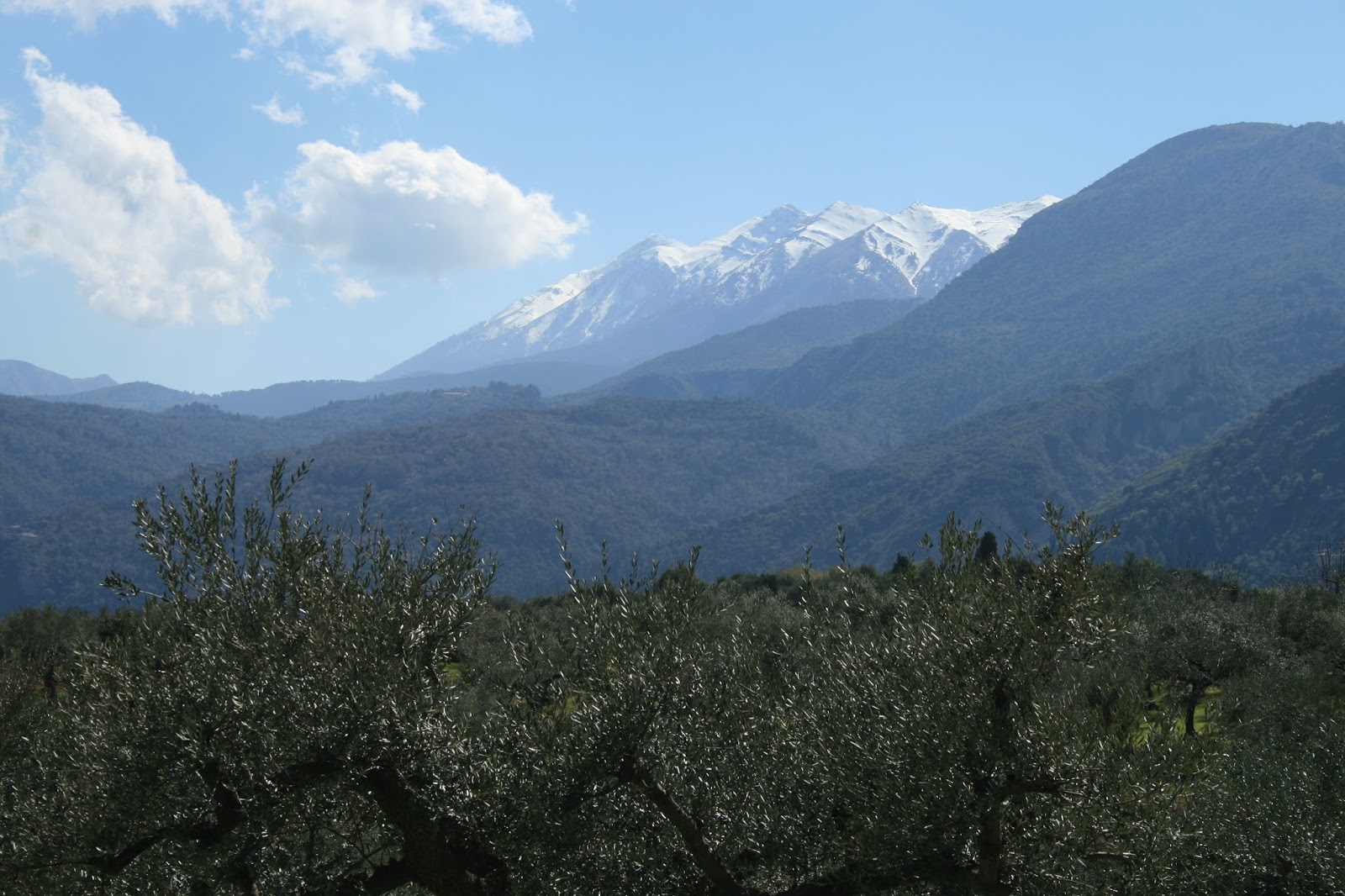
Taygetos -- the moutains behind Sparta

First, of course, is the simple fact that the alleged site of these murders on Taygetos has indeed revealed many skeletons – but only of adult males not infants. In short, there appears to be some truth to the notion that people were executed by being thrown off a particular cliff, but no evidence whatever that infants were killed in this way. That said, the actual method of murder is a more-or-less irrelevant detail; the issue is the systematic murder of infants deemed unlikely to grow up healthy and hardy enough to survive the agoge and be good hoplites.

My second problem with Plutarch’s account is King Agesilaus II. Agesilaus was King Agis’s brother, and allegedly attended the agoge because he was not heir apparent. He was also “lame.” So how did an infant that was lame and not the heir apparent to the throne avoid being murdered as an infant and survive the agoge? Did his lameness develop later? Possibly, but the historical record makes no reference to an accident or injury. It appears that at least by the late 5th century the definition of “unworthy” could be very subjective and even lameness was not necessarily grounds for elimination. 


Still, neither the lack of infant skeletons nor the singular case of Agesilas II actually refute or disprove Plutarch either. So we must admit the possibility that he is correct. Nevertheless, I still have a major problem with the modern discussion of Sparta’s policy, and it is the lack of context.

Most ancient Greek families were small. We do not hear of families with dozens of children as in the Middle Ages. Contemporary literature from comic opera to court documents make the notion of widespread sexual abstinence an unlikely explanation of the low birthrates. On the contrary, despite the ready availability of slaves, prostitutes and concubines, Greek literature, comedy, philosophy and legal proceedings assume frequent sexual contact between men and their wives. Birth control therefore had to come from contraception or infanticide. The documentary evidence is that infanticide in the form of abortions and exposure of unwanted infants after birth were the only effective contraceptive known in ancient Greece.

Historians hypothesize that at a woman in ancient Greece would have borne on average 4 to 6 children – and watched 2 to 4 of them die either due to intentional exposure or due to neglect. Most of those neglected/murdered infants would have been female because ancient Greek society was misogynous. Women were considered mentally and physically inferior to men, and they were a financial burden because they required dowries. In societies today with similar attitudes (Afghanistan, Pakistan, India, east Africa, traditional China), female fetuses are more likely to be aborted, and female infants are more likely to die of neglect. It is estimated that 2 million female infants die each year because they are unwanted. The Greek comic poet Posidippus put it this way: “Everybody raises a son even if he is poor, but exposes a daughter even if he is rich.”

In short, exposing unwanted children was a common (not to say universal) practice in ancient Greece. What shocked male commentators from the rest of Greece about the Spartan practice was that 1) it applied to males rather than (worthless) females, and 2) it was left to the state (elders of the tribe) rather than the father to decide a infant’s fate. It was not the fact of murdering children that other Greeks found offensive, but the fact that a father did not have absolute control over the fate of his sons. In Sparta and Sparta alone, an outsider (a tribal elder) could interfere in a father’s despotic control over his own family.

None of this makes the Spartan practice of murdering “unworthy” infants more palatable. It is and remains an aspect of Spartan society that I too find alienating. But I would welcome more recognition of the fact that infanticide was not one of the aspects of Spartan society that made it “weird” and different from the rest of Greece. Infanticide was the norm throughout ancient Greece – including in “enlightened” Athens.

The Sparta of my novels reflects the above reality rather than the artificial brutality of most modern writers. Read:


Buy Now!                                         Buy Now!                                       Buy Now!

Wednesday, February 15, 2017

Marines! - An Excerpt from "A Peerless Peer"

Sparta was elected to lead the coalition of Greek cities opposing the Persian invasion in 480 BC not only on land but also at sea. Compared to Athens and Corinth, Sparta’s navy was small, but Sparta’s naval tradition was considerably longer than numbers suggest, and Sparta’s perioikoi marines may have enjoyed a strong reputation for competence since they often fought alongside the Spartans.  


Fighting as a marine, however, was a very different skill from fighting in a phalax on land. In the following excerpt from “A Peerless Peer” I describe a completely fictional naval engagement in which Leonidas commands a mixed Spartiate and perioikoi force that is providing marines for a Corinthian fleet bringing grain from the Black Sea. The point of the episode is to remind readers of Corinth’s dependence on imported food, to highlight the fierce fight for the Aegean Sea during the Ionian revolt, and give the reader insight into what such naval actions might look like.

Specifically in this scene, Leonidas and his marines are trying to protect six ships that have been damaged in a storm and are now lashed together like a large float to enable the strong ships to drag the precious cargoes of the disabled ships to port. They are attacked by a squadron of Phoenician triremes under Persian command and manned by Persian marines.


Despite the unusual circumstances, thanks to a lifetime of keeping contact with their rank-mates and endless drill in adjusting their own movements to those of the men left and right, the Spartiates crossed onto the other ship in a line without serious gaps. That proved to be enough. When the Persian archers realized that the wall of bronze was moving toward them, they broke and ran. Only the fastest made it. Anyone who slipped and fell on the bloody deck or tripped over rigging and scattered weapons was stabbed mercilessly by the “lizard stickers” of the Spartan spears.

When the line of bronze shields and scarlet cloaks appeared along the side of the ship, the Phoenician captain shouted furiously and the trireme backwatered wildly, pulling itself free of its victim. As it withdrew, the Corinthian merchantman settled into the water and started to list noticeably. Leonidas turned and led his men up the incline, to get back to the fight that was taking place at the far side of the float.

By the time they were back aboard the “Golden Dawn,” the enemy was pouring over the railing on the far side. There were bodies strewn across the deck of the far ship—Greek bodies for the most part. Arrows were pouring down on them again. It flashed through Leonidas’ mind that he might die right here, along with every Lacedaemonian under his command. He could clearly expect no help from the two Corinthian triremes, which were both fully engaged. The sailors were proving surprisingly poor soldiers—something he hadn’t expected, since they were defending their own ships and lives and had nowhere to escape. But there was no point thinking about it.

He called a halt to dress their lines. They were two men short—the man with the eye wound and someone else. No time to identify the casualties. At least they were on a level deck now and they could advance across it at a steady pace, drawing on their discipline and training.

The second Phoenician hadn’t rammed, but had come alongside. The enemy troops poured over the gunnel along the whole length of the ship. Fortunately, they were the same poorly armed and unarmored men, and were just as undisciplined as their countrymen. Oddly, there seemed to be more of them, and the hindmost men were stabbing the men ahead of them in their backs! They were Greek marines!

At last Leonidas’ brain registered that there was another ship beyond the Phoenician trireme—the Corinthian freighter “Orcelle”!

The fool! But at the same moment, Leonidas felt such a rush of gratitude for the crippled Corinthian [captain commanding her] that it was as if he’d just been reinforced by the Guard. He increased the pace. Step and thrust, step and thrust. The enemy was going down before them with very little chance of defending themselves. The trick was to ignore the arrows, Leonidas decided. Raising his spear arm for the thrust, the man beside Leonidas took an arrow in the armpit and crumpled to the deck with a croaked-off wail. The man behind closed the rank with Leonidas without missing a beat. Step and thrust. They had cleared the deck of the “Golden Dawn.”

Ahead was a confused melee of sailors and an exceptionally large number of marines from the “Orcelle,” mixed with enemy archers and enemy marines. The sun broke over the horizon, and for the first time Leonidas could see that the Persians wore clothes of yellow and purple in bizarre stripes and chains of diamonds. It was the gaudiest sight he had ever seen in his life—all liberally splashed with red. And just beyond, the sun glistened blissfully on a calm and enchanting seascape.

By the time Leonidas made it aboard the Phoenician trireme, he realized that the Greek sailors had gained full possession of her after slaughtering the Phoenician crew. They cheered him and his marines as they crossed the trireme, heading for the “Orcelle.” Lychos was hanging over the side of his ship, clutching the rail. He was dressed in full panoply, and Leonidas knew that it must have half killed him just to put it on.

Leonidas shoved his helmet back and grinned up at the Corinthian from the deck of the captive trireme. “You stupid fool!”

“It worked, didn’t it?” Lychos grinned back at him. “I think the Phoenician captain died of pure astonishment when he realized a freighter was attacking him!”

“I sympathize!”

“It helped that my marines are first-class archers and sent him to Hades with an arrow in his throat.”

Leonidas threw back his head and laughed, then thought to ask, “Just how many marines do you have on board?”

“A lot. My father still won’t let me go anywhere without all the protection he can buy.”

“He’ll wring the marine captain’s neck when he finds out what you did!”

“But it was so beautiful, Leonidas! It was the most beautiful moment of my whole life—coming to your rescue.”


Buy Now!