Find Out More

Find out more about Helena P. Schrader's Sparta novels at: https://www.helenapschrader.com/ancient-sparta.html

Monday, April 25, 2011

Ancient Kythera

Kythera was magical as always, and this time I learned a little more about Kythera’s ancient past, particularly her ties to Lacedeamon. In this and the next entry, I will provide the highlights of my findings.
 
The island of Kythera sits off the southwest tip of Cape Malea on the Peloponnese and has been inhibited for millennia. Historical reference to Kythera goes back at least as far as the Iliad, and the archeological evidence suggests a thriving Minoan metropolis existed here about 2000 BC. According to legend, Kytheria was the first place in the Greek world where the goddess Aphrodite was worshiped. Except for brief periods of occupation by the Athenians during the Peloponnesian War, Kythera was an integral part of Lacedaemon for approximately 500 years, from roughly 600 to 100 BC.

The first evidence of Lacedaemonian settlement on Kythera was discovered less than 20 years ago, and money for extensive archeological research has not been made available. However, in 2010, archaeologist Aris Tsaravopoulos from Greece’s 26th Ephorate of Classical and Prehistoric Antiquities carried out a limited project with a team of twenty international, amateur volunteers supported by the local community and Bishop Seraphim, Kythera’s Metropoliti. These digs suggest that the role and influence of Sparta on the island was more significant than previously believed.

Although only able to (literally) scratch the surface during the one month of work in 2010, Tsaravopoulos is confident of finding additional artifacts and foundations which will undoubtedly enable more comprehensive conclusions if excavations continue. Tsaravopoulos found sponsors and volunteers for at least one more summer project, scheduled for July 2011. Unfortunately, Mr. Tsaravopoulos was not on Kythera during my stay, but I spoke with him by phone and his son was able to show me the site of a city dating from the Lacedaemonian period and answer a number of questions.

The classical capital of Kythera was a walled city perched on a steep hill just west and inland from the site of the old Minoan port of Skandeia. It housed about one thousand inhabitants and remained occupied from roughly 600 BC to 100 AD. Although the city would have been predominantly perioikoi in character, Tsaravopoulos believes there was a Spartiate garrison stationed in the city at least during the Peloponnesian war.

The city contained an agora and a number of temples and civic buildings. Initial digging, which uncovered only the youngest layer of the ancient city spanning the hundred years before and after the birth of Christ, revealed pottery, tiles, and coins, mostly from the Roman period. However, impressive Doric pillars from a late 7th/early 6th century temple to the Dioskouroi were incorporated into a Byzantine church built on the site in 1290, giving testimony to strong Spartan influence at the time of the city’s founding.

Outside the capital city, there are indications of a Laconian watch-tower on a hill north of the capital. The site provides a good view to the north and, when weather conditions permit, to the Straits of Malea and the Peloponnese (Laconia) beyond. Also visible from the city or the watch-tower are two tiny islands, the Dragonara. The larger of these, Megali Dragonara is the site of a temple to Poseidon. A large number of offerings from the 5th century have been found here, and Tsaravopoulos believes that sailors routinely put in to the sanctuary either to entreat or thank Poseidon for safe passage around the dreaded Cape Malea.

In addition, a sanctuary dedicated to Asclepios (Aiglapios in Laconian dialect) has been identified, but nothing to Aphrodite yet. According to the younger Tsaravopoulos, a large number of valuable offerings were found at the site of a major Minoan temple to an unidentified deity, and he believes this may be the source of the legend about an Aphrodite temple.

Mr. Tsaravopoulos also found a number of interesting objects in a grotto in the next bay north of ancient Skandeia, which he believes suggest the tactics used by Nicias to seize Kythera in 424 BC during the Peloponnesian War. Mr. Tsaravopoulos believes two Athenian vessels put ashore at night near the port of Skandeia, over powered the men at the watch tower and sent a signal to the rest of the Athenian fleet laying offshore. (Thucydides gives the size of the expeditionary force at 10 ships and 2,000 hoplites.) In the morning, the Lacedaemonian garrison, seeing only two Athenian ships on the beach below the city, came down from their fortress to attack the apparently weak invading force. Meanwhile, however, the full Athenian force had landed at the beach to the north (modern day Diakofti), hidden from view at shore level by a large hill. While the Lacedemonians were attacking the two ships at the foot of their city, the full Athenian force came over the hill and attacked them in the rear, presumably wiping them out.

Unfortunately, Mr. Tsaravopoulo said he did not yet have sufficient evidence to publish this thesis. It is not, however, completely inconsistent with Thucydides. According to the latter, the attacking Athenians found “all the inhabitants draw up ready to meet them. Battle was joined, and for some time the people of Kythera stood firm, but finally they were routed and took refuge in the upper city. Afterwards they came to terms with Nicias….” (Thucydides, 4:54) Thucydides was clearly not present at the capture of Kythera and he may not have known how the Athenians lured a strong fighting force down from their fortifications in the upper city into the port. He appears only to have heard (or reported on) the second phase of the encounter, after the full force of Athenians arrived to find the Lacedaemons were in the port and in full fighting order, ready to meet them. Certainly, accounts agree that the battle took place in the port, rather than in the fortress. If the Spartan garrison was slaughtered in the battle and only perioikoi escaped to the fortress, this would explain further why Nicias was willing to come to terms with them as he did.

Saturday, April 9, 2011

Shopkeepers and Shipmasters: The Perioikoi in Spartan Society

It is one of the ironies of recorded history that we generally know much more about the tiny, ruling elite in any society than about the masses that actually composed it. Thus we know about the lives and loves of medieval kings, but little about the peasants that represented more than 90% of their subjects. Likewise, Lacedaemonian history is dominated by the tiny class of Spartiates, albeit a great deal has also been written about the allegedly unjustly oppressed helots. The segment of Lacedaemonian society that has received the least scholarly attention is the “middle class” – the perioikoi.

The lack of modern literature on the perioikoi is undoubtedly a result of the lack of historical and archeological information about this segment of Spartan society. The fact is, we know almost nothing about them -- not their origins, their history, the density of population, their laws or the nature of their relationship with the ruling Spartiates or their relationship to helots.

The lack of archeological finds has led some historians to hypothesize that they were an essentially rural population, hardly better off than the helots themselves. Yet the very fact that they provided hoplites in at least equal numbers as the Spartans casts serious doubt on this conclusion. I would also note that the archeological finds in Sparta itself hardly reflect the might and wealth that we know Sparta enjoyed. For whatever reasons, the existing archeological evidence from Lacedaemon is an incomplete, indeed inadequate, reflection of the society that inhabited the region in the 7th to 3rd Centuries BC.

John Chadwick in “The Mycenaean World" claims that the Mycenaeans found a native population on the Peloponnese, which they subjugated. When the Dorians invaded, they conquered the remnants of the Mycenaeans. This sequence of events might explain the three class system in Lacedaemon: the helots were the original inhabitants already reduced to serf-like status by the Mycenaeans, and the Mycenaeans became the perioikoi after the Dorian invasion. All three groups were essentially ethnically distinct and status depended on who had conquered whom. The situation appears to have been stable until the Spartans invaded Messenia and subdued another Dorian population. But all this is speculation.

Yet, while we know almost nothing about the perioikoi, we can infer a great deal. We know, for example, that in the later years of the Peloponnesian war, perioikoi hoplites were fully integrated with Spartan units – and that implies comparable levels of training, equipment and above all trust. While the enemies of Sparta (and modern commentators) make much of the hostility of the helots to Spartiate rule, the loyalty of the perioikoi is rarely questioned – or mentioned, despite its significance. We know Sparta had a fleet but that Spartiates had virtually no opportunity to gain the extremely complex knowledge necessary to build and sail ancient vessels. We know that Spartiates were prohibited from pursuing any profession other than that of arms (and civic administration – see my last entry), but Lacedaemon had extensive international trade. We know further that Lacedaemon produced and exported timber, pottery, and bronze works. It had mines and quarries, and, of course, every kind of craft necessary to daily life in the ancient world from carpentry and metal working to tanning and basket-weaving. Who provided the manpower and the know-how for all these various industries, if the Spartiates were prohibited and the helots were working the land?

The logical answer is the perioikoi. Furthermore, by ascribing to the perioikoi these various urban professions generally held by citizens in other Greek cities, we quickly see a way in which the perioikoi could have been both integrated and co-opted into Spartan society despite their undeniable second-class political status. The Perioikoi had no voice in Spartan policy and yet were expected to risk their lives side-by-side with the Spartiates. It hardly seems credible that they would have accepted this situation for long – particularly in the bad years of the Peloponnesian War – if they had not enjoyed other benefits.

The financial benefits of a monopoly on industry and trade throughout the rich territory of Lacedaemon could be such an incentive. The very restrictive nature of Spartan citizenship, which confined Spartiates to the army and civic duties, opened immense opportunities for the perioikoi to enrich themselves. Even if completely excluded from land-holding (which to my knowledge they were not, but which might have been the case when the Spartiate population was expanding in the archaic era), there would still have been ample opportunities to not only earn a living but make a fortune as well. The experience of other societies shows that a manufacturing and trading middle-class can indeed prosper even when politically disenfranchised (see, for example, Medieval France). This, I believe, is the key to perioikoi loyalty and the essential character of the Spartiate-Perioikoi contract.

While Spartiates reserved political power to themselves and evolved a culture that disdained the public display of wealth; the perioikoi traded political enfranchisement for the dual benefits of economic freedom and security. Behind the shields of Sparta’s incomparable army, the perioikoi were free to enrich themselves for generations. Only after Sparta fell into decline and her citizen ranks grew too thin to guarantee the protection of Lacedaemon did the Spartiate-Perioikoi contract begin to unravel. The decline of Spartiate population forced an increasing dependence on perioikoi troops, which put perioikoi at ever greater risk. As long as Sparta was winning wars, that might have been acceptable, but once Sparta was defeated at Leuktra a perpetual disenfranchisement of the periokoi became untenable. Throughout the archaic period, however, the division of labor between Spartiate and perioikoi appears to have worked admirably.

My next entry will be posted April 25 as I will be travelling in Greece until then. Happy Easter!

Saturday, April 2, 2011

Leonidas of Sparta: A Peeress Peer

Leonidas is arguably the most famous of all Spartans. Numerous works of art depict him. He was the hero of two Hollywood films. There is even a line of chocolate confectionery named after him. But no serious biography has ever been written, and what is most often portrayed is his death. Leonidas is remembered for commanding the Greek forces that defended the pass at Thermopylae against an invading Persian army. He is revered for refusing to surrender despite betrayal that made defeat absolutely certain. Thus Leonidas came to symbolize the noblest form of military courage and self-sacrifice. The events leading up to the three-day battle and death of Leonidas with three hundred other Spartans and seven hundred Thespians at Thermopylae have been the focus of historians, writers, and artists from Herodotus onward.

But Leonidas was not a young man at the historic battle where he gave his life. He had lived close to half a century (if not more) and reigned for ten years before he took command of the Greek alliance defying Persia. It was those years preceding the final confrontation with Persia that made him the man he would be at Thermopylae. To the extent that we admire his defiant stand, learning more about his early life and tracing the development of his character is important. Yet so very little is actually known about his early life that historians have been discouraged from attempting a biography.

Leonidas of Sparta: A Boy of the AgogeNovelists, fortunately, enjoy more freedom, and what we do know about Leonidas’ early life is enticing. This is why I chose to devote a three-part biographical novel to Leonidas of Sparta. The first book, A Boy of the Agoge, was published last year. In it I built upon known facts about Leonidas’ birth and family situation and Sparta’s unique educational system to construct a plausible picture of Leonidas’ boyhood.

This week I delivered to my publisher the second book in the trilogy, A Peerless Peer. In this second book, I focus on the next stage of Leonidas’ life, the years when he was a common citizen before he became a king. This is the period in which he married his niece Gorgo and gained experience in battle and politics. Building on the few known facts, listening to the sayings attributed to Leonidas and Gorgo, and knowing how Leonidas met his destiny at Thermopylae, I have written this novel.

While based on all known facts about Leonidas, Gorgo and the society in which they lived, the novel goes beyond the bare bones of the historical record. It interpolates from these facts a reasonable hypothesis of what Leonidas and Gorgo might have been like and what they might have done, thought, and felt. The characters that emerge are greater than the historical input. Leonidas is consciously portrayed as the quintessential archaic Spartan, because that is what he has become in legend. Gorgo, likewise, epitomizes that which set Spartan women apart from their contemporaries—without robbing her of individual traits and personality. The two principals are surrounded by a large cast of secondary, largely fictional characters, each of which is unique and complex. In short, this novel is quite candidly fiction.

As the publication date approaches, I will post more information about release dates, price etc., and eventually provide a link to amazon.com for those of you (hopefully many of you!) interested in purchasing this novel.

Friday, March 25, 2011

Merciless Exploiters of Their Neighbors?

In his introduction to Persian Fire Tom Holland argues that “Sparta’s greatness…rested upon the merciless exploitation of her neighbors.” The sentence made me stumble. Is Holland truly unaware that the Peloponnesian League at this point in history gave every city-state an equal vote in the League Council? Is Holland unaware that some city-states in the League chose to march north with Sparta to fight the Persians at Thermopylae and Plataea?

Since Holland goes on to contend that “to people who had suffered under Spartan oppression for generations, Xerxes rule might almost have felt like liberty,” I gather that Holland is really talking about the helots. He apparently believes that the helots and perioikoi and other Peloponnesians, who fought with the Spartans at Plataea, were all “mercilessly oppressed” Spartan slaves fighting against their own best interests. One wonders how 5,000 Spartans managed to keep 40,000 oppressed slaves under control and prevented them from defecting to their Persian liberators, while simultaneous defeating the Persians on the battlefield? Spartans must have been truly superhuman indeed to succeed at such a feat!

It is a particularly notable feat when one considers that the mere proximity of a potential liberator induced 20,000 Athenian slaves to defect in 413. The freedom loving, benevolent and ever democratic Athenians apparently didn’t treat their slaves as well as the “merciless oppressors” of Sparta or 20,000 Athenian slaves would not have “voted with their feet” by abandoning Athens for Sparta.

It also seems incredible that Sparta would have been elected to supreme command of the Greek forces opposing the Persian invasion – including Athens, if at that time it was widely perceived as a brutal oppressor of its neighbors. Would the United States at any time in its history have elected Nazi Germany the leader of a joint coalition? Would we have asked the Soviet Union to assume command of joint NATO and Warsaw Pact forces to fight a joint enemy? It tries my imagination.

Whatever else one says about Sparta’s treatment of helots (and firmly believe they were far better off than chattel slaves in the rest of Greece, not to mention Persian), to suggest that Sparta “mercilessly oppressed” its neighbors is a gross distortion of the historical record. It is sad that such sweeping allegations are still standard fare in modern treatments of the ancient world.

Friday, March 18, 2011

From Choral Masters to Quartermasters: Sparta’s Invisible Professions

As everyone with even a cursory knowledge of Sparta knows, Spartan citizens were professional soldiers. Spartiates trained for war in the agoge, they spent the first ten years of their adult lives (ages 21-30) on what amounted to “active duty,” and the next thirty years of their lives in the ancient equivalent of the reserves. Not only this, but, we are told, Spartiates were prohibited from learning and pursing other professions and so there were no potters and no carpenters, no shipwrights and no smiths among Spartan citizens. These undisputed facts have led most people to see Spartan citizens as soldiers only, ignoring the fact that despite their life-long service in the military, Spartan citizens could in fact be much more than soldiers. They were also the administrators of a large, prosperous and exceptionally complex state.

Lacedaemon stretched from the Ionian to the Aegean Sea and had an estimated population of 60,000 or more. It had at least three classes of inhabitants (helots, perioikoi and Spartiates). It had a public school – unlike any other city of its age. It had a great number of public festivals with complex rituals involving choral, dance and athletic competitions. It successfully competed in the pan-hellenic games. It pursued extensive diplomacy throughout the then known world. And all this in addition to pursuing a brutal war that dragged out over generations in the second half of the fifth and early fourth century. In short, Sparta was a highly sophisticated society, which could not have been managed by two bickering kings, 28 men in their dotage and five amateurs elected for a single year. Sparta’s centuries of pre-eminence in the ancient world, and its reputation for good governance and order, can only be explained by hypothesizing a well-functioning administration that kept Sparta’s institutions operating.

This logical conclusion is supported by various sources which make oblique reference to various, often ill-defined, dignitaries that apparently supported the operation of the Spartan state. For example, the Paidonomos and his assistants, priests, magistrates, and heralds. While there is no explicit evidence (except with respect to the Paidonomos) that these positions were filled by Spartiates, it is unlikely that the Spartans would have entrusted the education of their children, their relationship with the Gods, communication with the enemy or the enforcement of their laws to helots or perioikoi. In short, there were many things beyond soldiering that almost certainly must have been performed by Spartiate full-citizens after they had been released from active duty.

Let’s start with the agoge. Although Xenophon and others speak only of “the” Paidagogos, as if one man alone controlled the entire agoge, such a notion illogical. We know that effective education requires low ratios of instructors to pupils, and even taking into account an age cohort of eirenes providing a degree of internal discipline each year, it is not credible that there were no other agoge officials. It is far more likely, given the size and importance of the agoge to Spartan society, that there were a relatively large college of instructors, or at least Deputy and Assistant Paidagogoi, maybe the Mastigophoroi usually portrayed as a bunch of whip-wielding thugs, but more likely responsible and respected educators.

Descriptions of Spartan life suggest a variety of other activities that would also have been performed by Spartan citizens if not “professionally” then, nevertheless, with the conscientiousness expected of full or part-time public service. For example, Sparta was famous for its choruses and dance performances. Anyone who has engaged in either knows that large groups of people cannot be brought to perform harmoniously together without someone choreographing, directing, or conducting. Sparta undoubtedly had chorus masters, and it is seems highly unlikely that for performances during Sparta’s sacred festivals that choral and dance masters would have been drawn from the ranks of the helots or perioikoi. Just as with the agoge instructors, it is far more probable that these were full citizens.

We also know that the Spartan kings kept records and maintained archives. Control of such delicate material as oracles from Delphi, communication between the kings and their permanent representatives, correspondence between the ephors and commanders in the field or ambassadors to foreign capitals would hardly have been entrusted to anyone but Spartiates. In all probability, therefore, there was at least one “archivist” for each royal house, and this position was probably filled by a Spartiate, who was either appointed or elected.
Then there is the issue of taxation. Taxation was particularly important in Sparta because citizenship itself depended on paying two kinds of tax: the agoge fees when immature, and the syssitia fees after attaining citizenship. Someone had to keep track of who paid how much, and they had to do that each and every month. Maybe each syssitia had a part time “treasurer” too keep track of fees, but the agoge was large and would have required at least one (and probably more) full-time “treasurers.” It is not credible that perioikoi would have been entrusted with control of records that revealed (and in part determined) the strength of the citizen body and so the army in future generations. Finally, taxes also had to be collected from the helots and perioikoi. Spartiates who collected too much from their helots were subject to sanctions, so someone – and it had to be one of their peers – must have been keeping track of how much was due and how much collected.

Even if not explicit, it is also fair to assume that the perioikoi were subject to taxation, just as metics in Athens. Again, an institutionalized means of assessing and collecting those taxes would have been necessary to ensure everything functioned properly, and at least until Sparta’s population decline became critical, such an apparatus would have been headed by Spartiates. Given the size and expanse of Lacedaemon, my guess is there would have been many more than one citizen engaged in tax collection!

Once taxes were collected, they had to be put to work, so we come next to the realm of financial management. Sparta would have needed some mechanism to allocate funding to various state expenditures. Money was needed for the army, of course, but also for the fleet, and for public works like roads and fountains and drainage systems and for public buildings from temples to theaters, monuments and barracks. Managing such projects requires full-time public servants committed to ensuring that the intentions of the state (as expressed, one assumes, by the Assembly via the ephors) are fulfilled and that funds are not misallocated.

And finally there was the Spartan army. Friend and foe alike admired the Spartan army not only for its relatively good performance on the battlefield but also for its organization and professionalism. Yet as most soldiers will tell you, an army’s effectiveness is not simply a matter of fighting capacity. A good army is well fed, well equipped, and well-supplied. It has effective command-and-control mechanisms, efficient lines of communication, and adequate, flexible transport. A good army has a medical corps and in centuries past good veterinaries as well. In short, there is a great deal more to creating an effective fighting force than drill with weapons. Sparta’s army must have had not just good soldiers and officers, but good quartermasters as well.

While all these various positions were “honorary” in the sense that they were without remuneration, they were nevertheless jobs requiring considerable time, energy, dedication and skill. Spartiates may not have earned a living from these jobs, since they all had their estates, but they probably viewed their performance in such jobs as honorable public service. Whether elected or appointed, ambitious Spartiates would undoubtedly have competed for these positions and performance would have contributed to a man’s reputation and prestige. I suspect that men who did well in these public function were most likely to be elected ephor, but whether they attained that honor or not, men in these positions would in turn have been influential.. They would have been part of the complex network of “leading” citizens that helped shape Spartan policy behind the scenes. There is nothing sinister about this. It happens in every society – including our own.

Friday, March 11, 2011

Women in the West: Sparta's Contribution

International Women’s Day, March 8, is celebrated here by parties, newspaper articles, speeches – and red roses. I was invited to give the keynote address at an event, but while, as expected, I outlined the major milestones of the women’s movement in the U.S.A., I couldn’t leave it there. The condition and position of women in many parts of the world is so incomparably worse than in the “West” that I felt an International Women’s Day should not focus exclusively on the demands of rich and successful Western women for more, but on the need for solidarity with the truly oppressed and misused.

The statistics are truly appalling. A woman dies in childbed every single minute. Two million female infants are either aborted or killed before they reach their first birthday. Five to six thousand women are murdered each year because their fathers or brothers think they did not behave “modestly.” Ten times as many women are trafficked across international borders each year in the 21st Century than Africans were transported across the Atlantic during the height of the African slave trade. A million children each year are forced into prostitution, and ten million children are currently sex-slaves, the bulk of these are girls. Women are not only denied education, access to medical treatment and excluded from economic and political power, they are tormented, enslaved, humiliated, neglected, and murdered – simply because they are women. In many societies, the position of women can only be described as systematic subjugation based on contempt, scorn, loathing and palpable hate.

What does all this have to do with Sparta? Maybe nothing at all, but it did strike me that women in “the West” have status, respect, and legal protection to a degree that is exponentially higher than women in other parts of the world. Furthermore, women in “the West” have enjoyed status, respect and legal protection for literally thousands of years. No, women were not “equal” to men in ancient Rome or in the Middle Ages, but the status of women in Rome and in Medieval England, France and Scandinavia, for example, was significantly higher than in many parts of the world today. Respect for women (not equality) is an integral part of “Western” civilization.

But what is “Western” civilization? It is not just Christianity (although that is an important component!). The “West” also claims the traditions of pre-Christian, ancient Greece as part of its heritage. That is the reason Marathon, Salamis and Thermopylae are often portrayed as the defense of “the West” against the Orient.

But we have a slight problem here. Women in Athens – that favored example of all things “golden” in the ancient world – were treated pretty much like women under the Taliban today. They were denied a healthy diet and exercise, and confined to the cramped, dark “women’s quarters” – just like women in Afghanistan today. They were kept illiterate, and married off at 12 or 13 to die in droves like the child-brides of Africa and Asia today because their immature bodies could not cope with childbirth. They could not inherit or even control property worth more than a bushel of grain.  If they were raped, their husbands were compelled to discard them or lose their own citizenship. They had no part of Athens famed culture. They did not even attend the symposiums unless they were sex-slaves. As Pericles put it, the less one talked about or saw Athenian women, the better. In short, they were an embarrassment that Athenian men would rather have done without – how the Taliban would have understood and applauded Pericles! If Athens is the source of our “Western” traditions with respect to women, than Christianity alone is the source of the higher status of women in the West. Possible.

But Sparta had a very different tradition with respect to women. In fact, the status of women in Sparta was notoriously high. Spartan women certainly had economic power – hence Aristotle’s diatribes against them and Sparta itself. They were educated. They received the same food as their brothers and engaged in sport. They were not married until they were sexually mature and had a better chance of surviving the rigors of childbirth.

In the contrast between the Athenian and Spartan treatment of women, we have a microcosm of the modern world -- with Athens firmly located in the regions in which women are most exploited and despised. If ancient Greece had any impact on modern Western attitudes toward women, then we are following – quite unconsciously in most cases – the example of Sparta. In short, Sparta’s influence on Western civilization may be greater than most people – raised on adoration of Athens’ intellectual and artistic accomplishments – realize.


Friday, March 4, 2011

Appeal for a Photo of the Pass at Thermopylae

The covers of the books in my Leonidas trilogy are composed of photos showing Greek landscapes combined with images that evoke ancient Greece. My aim is to remind the reader that ancient Greece was blessed with the same magnificent landscape as modern Greece and to hint at the fact that these books, while set in the ancient world, are an attempt to bring the ancient world to life. 

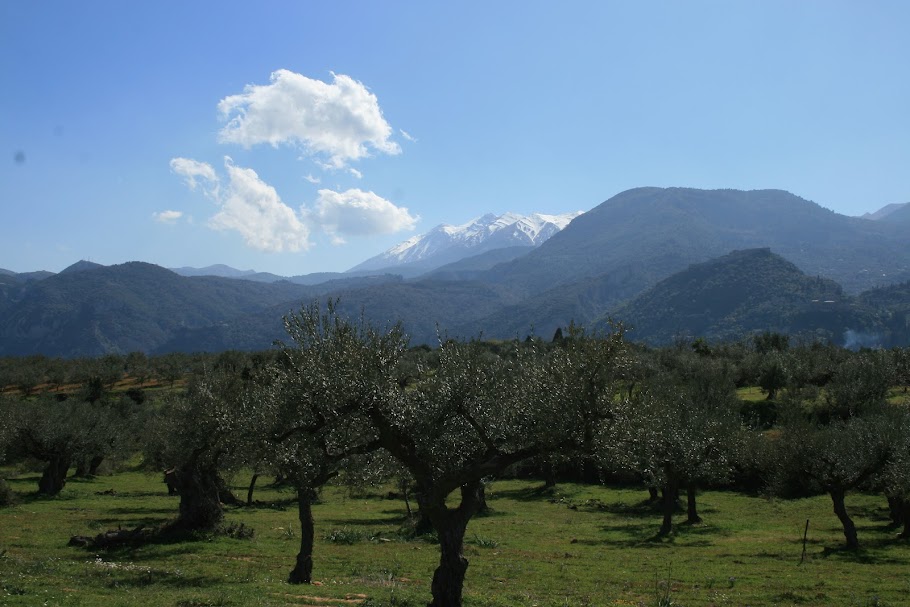
Leonidas of Sparta: A Boy of the AgogeThe image on the cover of A Boy of the Agoge shows the view from the Eurotas to Taygetos from Sparta -- a view Leonidas would have seen daily when growing up in the agoge.   

The image in the background of the cover of A Peerless Peer shows a white-washed wall on a shed on Kythera.  I chose this because I wanted to suggest that this was a book focused more on domestic issues -- hence an orchard and a shed and a family scene. Thanks to all, who helped select the latter!

For Book III, A Disposable King, I would like to have an image of the Pass at Thermopylae in the background.  I had hoped to take the photo myself, as I did the photos for Books I and II. Unfortunately, I will not be able to make it to Thermopylae in time.

So, I am requesting your help.

If you, or anyone you know, has a color photo of Thermopylae and like the idea of having your photo on the cover of a book, please send me a file with the photo to hps_books@yahoo.com, along with written permission to use the photo for this purpose.  I will give full credit for the photo in the acknowledgements of the book.

I look forward to seeing your photo!

Thank you!