Find Out More

Find out more about Helena P. Schrader's Sparta novels at: https://www.helenapschrader.com/ancient-sparta.html
Showing posts with label Architecture. Show all posts

Wednesday, April 3, 2024

Imagining Sparta: A City Like No Other

The ancient Athenian historian Thucydides made a prediction in his History of the Peloponnesian War that has come true with a vengeance.  He wrote that “…[if] Sparta were to become deserted and only the temples and foundations of buildings remained, I think that future generations would, as time passed, find it very difficult to believe that the place had really been as powerful as it was represented to be. Yet the Spartans occupy two-fifths of the Peloponnese and stand at the head not only of the whole Peloponnese itself but also of numerous allies beyond its frontiers. Since, however, the city is not regularly planned and contains no temples or monuments of great magnificence, but is simply a collection of villages, in the ancient Hellenic way, its appearance would not come up to expectation. If, on the other hand, the same thing were to happen to Athens, one would conjecture from what met the eye that the city had been twice as powerful as in fact it is.” (Thucydides, History of the Peloponnesian War, Book I, 10, 2.)
  

This statement was as much a criticism of Athens’ building program under Pericles (that had diverted contributions from the Delian League, intended for defense against the Persians, to building extravagant temples in Athens) as a critique of Sparta.  Yet it has misled modern scholars and novelists to portray Sparta as if it were a primitive village of dirt and mud. 

For example, in his best-selling novel Gates of Fire, Stephen Pressfield calls Sparta “a village” adding: “The whole stinking place would fit, with room to spare, within His Majesty’s [Xerxes of Persia’s] strolling garden at Persepolis. It is … a pile of stones. It contains no temples or treasures of note, no gold; it is a barnyard of leeks and onions, with soil so thin a man may kick through it with one strike of the foot.” (p.188).

Modern writers are often guilty of both a too hasty reading of Thucydides and a failure to consider other evidence.  Thucydides complains that Sparta “is not regularly planned” – but then nor is London. And he says it is “simply a collection of villages, in the ancient Hellenic way.”  This is not the same thing as saying Sparta was not a cosmopolitan city, it only means that Sparta had no plan and no walls and hence grew haphazardly -- as all major European cities did after their confining medieval walls were torn down. No one today would call Paris, Berlin or Rome “a collection of villages” simply because they are in fact many villages which have grown into a single metropolis after the need for fortifications disappeared and economic growth fueled urbanization. Why should we assume that just because Sparta was made up of five distinct villages in pre-Archaic times that it was not – in its years of glory – a cohesive, dynamic city?   


Sparta, April 2016, Photo by Author

Likewise, when Thucydides writes Sparta “contains no temples or monuments of great magnificence” he is not denying the existence of temples and monuments, only ones “of great magnificence” – such as Pericles built with stolen funds from Athens satellite states without their consent. In short, Thucydides never claimed that Sparta was not a major, metropolitan city, nor did he deny it had notable monuments, he was only making the astute statement that, judged by its buildings alone, future generations would over-estimate the power of Athens and under-estimate that of Sparta.

The assessment of Sparta's architecture has been aggravated for modern observers by the fact that today we cannot see what Thucydides did. Sparta was destroyed by earthquakes many times over the centuries. It was flooded by the Eurotas. It was abandoned. Nothing destroys architectural monuments so completely as abandonment.  Nor should it be forgotten that Sparta has not been systematically subjected to archeological excavation in almost a century. 
 
The Spartan Amphitheater, 2012, Photo by Author

Nevertheless, what has come to light demonstrates definitively that far from being a place full of primitive, mud structures, Spartan architecture was substantial, monumental (not the same as “magnificent”!), and very, very typical of Doric architecture throughout the ancient world. Sparta was, in fact, the ultimate Doric power. It attained its greatest artistic flourishing in the 6th rather than the 5th century BC, and consequently, its greatest monuments were archaic, not classical or Hellenistic. But they existed! We can still see some of the foundations and remnants to this day. Sparta was not just a heap of peasant hits, as Pressfield and other modern novelists would like us to believe. 

For anyone whose imagination is too weak to mentally reconstruct a great city from the remnants left in Sparta today, we have the meticulous record of an ancient travel guide. Pausanias traveled to Greece in the 2nd Century AD, long after Sparta’s decline from prominence and more than half a century after its “golden era” in the 6th Century BC.  Yet he needs 26 sections and more than 60 pages to describe the city! And that, although he claims he has not described everything but rather has selected and discussed only “the really memorable things.” (Pausanias, III.10. p. 37)

I would also like to point out that no Spartan has left a written description of his/her city that has survived to our time. Would a Spartan have found the Acropolis in Athens “magnificent” or simply “distant, intellectual and arrogant”? Would a Spartan necessarily have admired the altar at Pergamon?  Or found it “gaudy” and “busy”-- as many people see rococo architecture today?  Sparta was different from other cities of its age, particularly Athens. Does that necessarily mean it was less attractive?

Let me be heretical. We know that in ancient Greece most statues and temples were painted vivid colors and the statues of the gods were dressed in robes, ivory, gold, and jewels. What if Spartan austerity indeed extended to temples, statues, and monuments and these were adorned only with natural beauty – i.e. naked stone and marble sculptures set amidst flowering trees and running water? Isn’t that what we find strikingly beautiful in Greek architecture and sculpture today? The perfection of proportion, symmetry, and form in beautiful natural settings? Isn’t it the lifelike poses, gestures, and expressions that appeal to us? Would we rather see Venus de Milo painted in flesh tones with red lips and blond hair? Would we admire the Parthenon in Athens as much if it was dressed in bright paint?


Ancient Nemea Today, Photo by Author

What if Spartan homes were indeed devoid of elaborate interior paintings because, unlike their Athenian counterparts, they were not crammed into an over-crowded city and surrounded by high-walls that blocked out almost all daylight? Spartan houses could be built on a generous plan because the city had no plan. They could incorporate interior courtyards planted with fruit trees and herbs, they could surround themselves with gardens and orchards, they could sparkle not with gold and silver but the glinting of sunlight on water in internal fountains. Spartan homes could have windows that let in the light and they might have decorated their homes, as they did themselves, with things of nature: cut flowers, bowls of fruits, running water. Such things are transient; they rarely leave an archeological record.


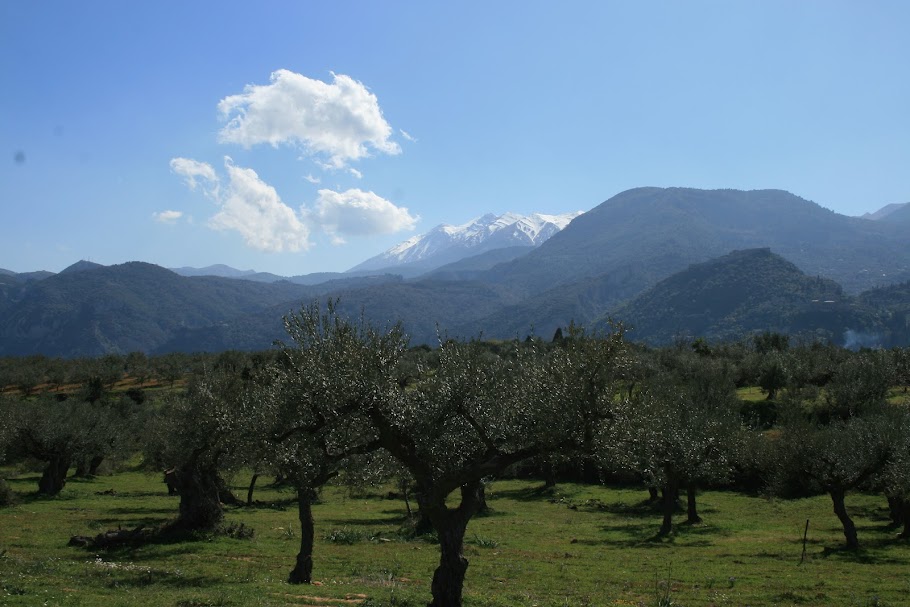
Spartan homes would have had views like this from the windows. Who needs wall paintings? Photo by Author

Sparta, far from being a “stinking village” full of pigsties and mud-huts as modern novelists portray it, was a city – as Pausanias describes -- full of marble monuments, pure Doric temples, sun-soaked theaters and imposing stoas. It was a city with large villas set in blooming gardens. And it was a city where the barracks and civic buildings were interspersed between sunny open spaces set aside for running, ball-games and horse-racing. It was a city decorated with fountains and flowering trees. In short, it was a city much as we would plan one today.

The Sparta of my novels is this attractive city rather than the "stinking village" of Pressfield.


 BUY NOW!


                                                        BUY NOW! 
 

Friday, September 15, 2017

Sparta Through Persian Eyes - An Excerpt from "A Heroic King"

At the start of the month I speculated on the way Sparta might have looked in Leonidas' time. This is another way of looking at Sparta, this time through the eyes of a Persian interpreter, used to the great, walled cities, magnificent palaces and planned gardens of the Persian empire.


"And this is it?" The Persian interpreter Zopyrus asked incredulously. "This is Sparta?" He looked around, baffled, as his chariot drew up in front of a modest, whitewashed building with a sober portico on a pleasant, but far from grandiose, square."

...

Traveling in easy stages, it had taken four months to reach their destination, and Zorypus had been looking forward to staying in one place for a month or more.  Now that he was here, however, he found Sparta so disappointing that he was no longer certain he wanted to stay for long.

There was no denying that the capital of Lacedaemon lay in beautiful surroundings. It sat cupped in the hands of a fertile valley enclosed on three sides by mountains. The majestic peaks of Taygetos rose up to the west, and the Parnon range provided protection to the east. The two ranges met in the north so that as the Persian convoy worked its way up from the port of Gytheon on the Gulf of Laconia toward the city, the valley narrowed more and more.

But Sparta itself made no sense to Zopyrus. Throughout the rest of the known world, cities were surrounded by massive walls. In the more primitive countries, these might be little more than mounds of earth surrounded by ditches, but in the more civilized parts of the world, the walls were of quarried stone and fired brick. Major cities often had walls twenty yards thick and fifty yards high, strengthened with towers that stood even higher, and many walls nowadays were faced with polished stone or glazed tiles.  While more prosperous cities spread beyond their walls, so that dwellings, stalls, shops and other semi-urban structures cluttered the surrounding countryside in ever greater density, all the important civic buildings and palaces of every metropolis Zopryus had seen up to now lay behind defensible walls with ramparts and fortified gates manned by soldiers.

Sparta was different. It had hundreds of temples, shrines, monuments and public buildings. It had fountains, broad avenues, gynasiums and palaestra, stoas and baths, and an amphitheater below the acropolis. It was undoubtedly urban, but because it had no walls, it seemed to sprawl across the plain as if some giant had spilled a basket full of buildings. It was haphazard. There was no urban planning. There was no gridwork of streets running at right angles to one another, and there was no logical organization into quarters for administration, trade, worship, finance and dwelling. There wasn't even any separation of rich and poor.

Furthermore, the royal palaces were primitive. Rather than sitting above the city surrounded by gardens fed by streams and encased in high, glistening walls, they were located right in the heart of the city, crowded by other buildings that had grown up around them over time.  They were too cramped to be comfortable or have pretty grounds, and they were completely indefensible.  


Saturday, August 31, 2013

Spartan Ethos:

Liberty, Equality and Fraternity among the Philosopher Warriors


What set Sparta apart from other Greek city-states was not language, religion, or even laws – all of which were shared in broad terms with the rest of the ancient Hellenic world – but a unique ethos that permeated all aspects of life.  While Spartan philosophy valued silence over empty words, simplicity over decoration and precision over expansiveness, Sparta placed the liberty, equality and fraternity at the center of their ethical system.  Love of liberty was shared by all the ancient Greek democracies, but the emphasis on equality and fraternity set Sparta apart. 


There is no clear explanation for the roots of Sparta's unique emphasis on silence, simplicity, and precision, although it probably had Doric roots. Doric architecture, for example, is the simplest of the three Greek architectural orders. Nevertheless, there is little doubt that by the 5th century BC, Sparta had cultivated a tradition that put conscious emphasis on silence and simplicity over eloquence and decoration.
What is often overlooked by modern commentators is that the silence cultivated in Sparta was not the silence of dumb animals, but of thinking men, who recognize that it is wise to think before speaking and to speak only when they have something worth saying. This is the essence of Spartan rhetoric and the reason it was so highly prized by philosophers such as Socrates and Plato. If one is looking for a more modern parallel, the example of the Quakers might be appropriate.

Simplicity in dress, architecture, and art was a natural expression of this fundamental philosophy that "less is more" and precision preferable to ambiguity and ambivalence. To say that Spartan dress and architecture were simpler than that of contemporary cities is not to say it was primitive, only that it was more precise and made more use of natural elements. The focus on the functional and the essential need not be associated with a disdain for beauty. Most modern observers admire the Parthenon in Athens today for the perfection of its proportions and would be irritated and distracted to see it painted brightly, as it was in ancient times. Likewise, modern architecture and design has rediscovered the Spartan love of the pure beauty of form and material.


The Spartan land reform (described in the essay on the Spartan government and constitution) made all Spartan citizens equals, or Peers; and they not only described themselves as such, but reinforced the notion of equality by discouraging anything that would set one citizen apart or above another. Sparta was the first city-state to introduce a uniform for its army: scarlet chitons and cloaks, and indeed uniform shields, all bearing the lambda, or L, for Lacedaemon. Spartans also wore their hair in the same fashion: the boys of the agoge going about shaved, the young men with short hair, and the men over the age of thirty growing out their hair and often wearing it braided. Not until the second half of the 5th century do artistic depictions of Spartans indicate that the neat appearance of the archaic period had given way to an unkempt, almost barbaric fashion.

All adult male citizens were, furthermore, bound together through three distinct and separate institutions. First, the sons of citizens were required to attend the public school system, the agoge, from the age of seven through the age of twenty. Second, all male citizens between and including the ages of 21 and 60 had to serve in the army. A distinction was made between the first 10 age cohorts, who were required to live in barracks and were in effect on active service, and the elder age cohorts, who lived at home but could be called up at any time, similar to reserve status today. Third, all male citizens were required to join a syssitia, or dining club, and to eat at this club every night (unless excused), providing set amounts of food from their estates to support the common meals. Although every citizen had to belong to a syssitia (also known as phiditia), each citizen chose which club he wanted to join and the existing members voted to admit the new applicant – or not. One veto from an existing member was sufficient to prevent a new member from joining. Unexcused absence from the mess incurred a fine – something not even the kings were exempt from. However, Spartiates (Spartan citizens) could be excused for a variety of reasons, from war to hunting and the Olympic Games.

The bonds of school, military, and club were designed to keep the society closely knit and not divided along family and clan lines. They did not, however, replace family ties, as some modern observers assume.
Attending the agoge, the public school, from the age of 7 did not sever family ties any more than sending children to school today does. There is no evidence that the small children slept in barracks – they may well have slept at home – but even if they slept in dormitories on school nights, they would still have gone home for holidays. Sparta had many holidays, and some were so important that observance of them was more important than going to war – even in an emergency. School children would have spent probably as much as one-third of any year away from school, much as they do today. Furthermore, Spartan girls went to the same schools and gymnasiums as their brothers – and future husbands. Spartan youth therefore had far more contact with the opposite sex than did their contemporaries in other Greek cities, which in turn meant that the bonds between the sexes were also stronger than elsewhere. Shared memories of a common schooling would have strengthened Spartan marriages, and parents would have been careful to pass on their experiences of the agoge to their offspring in order to help them survive this critical prerequisite of citizenship.
The military duties of Spartan men were likewise less onerous than modern military service in distant theaters of war, which can keep men away from their families for years on end. Until the Peloponnesian War, ancient warfare consisted of marching out, meeting the enemy on a flat, open plain, fighting a single battle, and then returning home – victorious or defeated – within a few weeks. Most campaigns lasted no more than a month or two, and they usually took place after the harvest was in. Sparta was not continuously at war until the second half of the 5th century. Before that, Spartan men would not have been away at war for more than a few months at a time, and by no means every year. Some men might have been absent at war no more than a month or two in their entire lives.
Finally, the fact that men ate their evening meal away from their families need not have been more disruptive of good marital or family life than the fact that most modern couples eat their midday meal apart. On the contrary, the rhythm of Spartan life might actually have fostered good family relations, because men and women probably would have shared the middle of the day together, when other activities were not possible because of the heat.

Friday, June 28, 2013

Spartan Architecture


Acropolis of Athens, 2012, Photo by author.
The ancient Athenian historian Thucydides made a prediction in his History of the Pelopponnesian War that has come true with a vengeance.  He wrote that “…[if] Sparta were to become deserted and only the temples and foundations of buildings remained, I think that future generations would, as time passed, find it very difficult to believe that the place had really been as powerful as it was represented to be. Yet the Spartans occupy two-fifths of the Peloponnese and stand at the head not only of the whole Peloponnese itself but also of numerous allies beyond its frontiers. Since, however, the city is not regularly planned and contains no temples or monuments of great magnificence, but is simply a collection of villages, in the ancient Hellenic way, its appearance would not come up to expectation. If, on the other hand, the same thing were to happen to Athens, one would conjecture from what met the eye that the city had been twice as powerful as in fact it is.” (Thucydides, History of the Peloponnesian War, Book I, 10, 2.)


This statement was as much a criticism of Athens’ building program under Pericles (that had diverted contributions from the Delian League, intended for defense against the Persians, to building extravagant temples in Athens) as a critique of Sparta.  Yet it has misled modern scholars and novelists to portray Sparta as if it were a primitive village of dirt and mud. 


For example, in his best-selling novel Gates of Fire, Stephen Pressfield calls Sparta “a village” adding: “The whole stinking place would fit, with room to spare, within His Majesty’s [Xerxes of Persia’s] strolling garden at Persepolis. It is … a pile of stones. It contains no temples or treasures of note, no gold; it is a barnyard of leeks and onions, with soil so thin a man may kick through it with one strike of the foot.” (p.188). Nicolas Nicastro is only willing to concede the dominant superpower of Greece was “an agglomeration of sleepy villages.”


These and other modern writers are guilty of both a too hasty reading of Thucydides, and a failure to consider other evidence.  Thucydides complains that Sparta “is not regularly planned” – but then nor is London. And he says it is “simply a collection of villages, in the ancient Hellenic way.”  This is not the same thing as saying Sparta was not a cosmopolitan city, it only means that Sparta had no plan and no walls and hence grew haphazardly -- as all major European cities did after their confining medieval walls were torn down. No one today would call Paris, Berlin or Rome “a collection of villages” simply because they are in fact many villages which have grown into a single metropolis after the need for fortifications disappeared and economic growth fueled urbanization. Why should we assume that just because Sparta was made up of five distinct villages in pre-Archaic times that it was not – in its years of glory – a cohesive, dynamic city?   


Sparta, April 2016, Photo by Author


Likewise, when Thucydides writes Sparta “contains no temples or monuments of great magnificence” he is not denying the existence of temples and monuments, only ones “of great magnificence” – such as Pericles built with stolen funds from Athens satellite states without their consent. In short, Thucydides never claimed that Sparta was not a major, metropolitan city, nor did he deny it had notable monuments, he was only making the astute statement that, judged by its buildings alone, future generations would over-estimate the power of Athens and under-estimate that of Sparta.

The assessment of Sparta's architecture has been aggravated for modern observers by the fact that today we cannot see what Thucydides did. Sparta was destroyed by earthquakes many times over the centuries. It was flooded by the Eurotas. It was abandoned. Nothing destroys architectural monuments so completely as abandonment.  Nor should it be forgotten that Sparta has not been systematically subjected to archeological excavation in almost a century. 


The Spartan Amphitheater, 2012, Photo by Author
Nevertheless, what has come to light demonstrates definitively that far from being a place full of primitive, mud structures, Spartan architecture was substantial, monumental (not the same as “magnificent”!), and very, very typical of Doric architecture throughout the ancient world. Sparta was, in fact, the ultimate Doric power. It attained it greatest artistic flourishing in the 6th rather than the 5th century BC, and consequently its greatest monuments were archaic not classical or Hellenistic. But they existed! We can still see some of the foundations and remnants to this day. Sparta was not just a heap of peasant hits, as Pressfield and Nicastro would like us to believe. 

For anyone whose imagination is too weak to mentally reconstruct a great city from the remnants left in Sparta today, we have the meticulous record of an ancient travel guide. Pausanias traveled to Greece in the 2nd Century AD, long after Sparta’s decline from prominence and more than half a century after its “golden era” in the 6th Century BC.  Yet he needs 26 sections and more than 60 pages to describe the city! And that, although he claims he has not described everything but rather has selected and discussed only “the really memorable things.” (Pausanias, III.10. p. 37)

I would also like to point out that no Spartan has left a written description of his/her city that has survived to our time. Would a Spartan have found the Acropolis in Athens “magnificent” or simply “distant, intellectual and arrogant”? Would a Spartan necessarily have admired the altar at Pergamom?  Or found it “gaudy” and “busy”-- as many people see rococo architecture today?  Sparta was different from other cities of its age, particularly Athens. Does that necessarily mean it was less attractive?
Let me be heretical. We know that in ancient Greece most statues and temples were painted vivid colors and the statues of the gods were dressed in robes, ivory, gold and jewels. What if Spartan austerity indeed extended to temples, statues and monuments and these were adorned only with natural beauty – i.e. naked stone and marble sculptures set amidst flowering trees and running water? Isn’t that what we find strikingly beautiful in Greek architecture and sculpture today? The perfection of proportion, symmetry and form in beautiful natural settings? Isn’t it the lifelike poses, gestures and expressions that appeal to us? Would we rather see Venus de Milo painted in flesh tones with red lips and blond hair? Would we admire the Parthenon in Athens as much if it was dressed in bright paint?

Ancient Nemea Today, Photo by Author
What if Spartan homes were indeed devoid of elaborate interior paintings because, unlike their Athenian counterparts, they were not crammed into an over-crowded city and surrounded by high-walls that blocked out almost all daylight? Spartan houses could be built on a generous plan because the city had no plan. They could incorporate interior courtyards planted with fruit trees and herbs, they could surround themselves with gardens and orchards, they could sparkle not with gold and silver but the glinting of sunlight on water in internal fountains. Spartan homes could have windows that let in the light and they might have decorated their homes, as they did themselves, with things of nature: cut flowers, bowls of fruits, running water. Such things are transient; they rarely leave an archeological record.

Spartan homes would have had views like this from the windows. Who needs wall paintings? Photo by Auhthor

Sparta, far from being a “stinking village” full of pigsties and mud-huts as modern novelists portray it, was a city – as Pausanias describes -- full of marble monuments, pure Doric temples, sun-soaked theaters and imposing stoas. It was a city with large villas set in blooming gardens. And it was a city where the barracks and civic buildings were interspersed between sunny open spaces set aside for running, ball-games and horse-racing. It was a city decorated with fountains and flowering trees. In short, it was a city much as we would plan one today.


This Sparta is the setting of my novels about Leonidas:


Buy "A Boy of the Agoge" Now!

Buy "A Peerless Peer" Now!
Buy "A Heroic King" Now!