Find Out More

Find out more about Helena P. Schrader's Sparta novels at: https://www.helenapschrader.com/ancient-sparta.html
Showing posts with label Chilon. Show all posts

Saturday, March 31, 2018

Nothing in Excess - A Pervasive Spartan Philosophy

It was the Spartan statesman Chilon "the Wise" who coined the laconic phrase “nothing in excess.” Yet the degree to which this philosophy dominated Spartan culture is often overlooked. Today Dr. Schrader looks at this aspect of Spartan society.


Chilon's saying translated either as "nothing in excess" or "everything in moderation" was carved in stone at the sacred pan-Hellenic site of Delphi. It was recognized as wise advice to all Greeks. Yet it was only in his native Sparta that the concept of avoiding excess was internalized and enshrined in daily behavior. Spartan culture proscribed, for example, economy in the use of words, in drinking, in eating, in making love and in dress and decoration.  

The Spartan disdain for excessive drinking was legendary to the point where Spartans were willing to blame the madness of a king (Cleomenes I) on nothing more than drinking his wine "neat" (i.e. unmixed with water). When it comes to food, Xenophon claimed that boys of the agoge received short rations, while grown men in the syssitia were fed a restricted diet. According to Plutarch even sex was inhibited in Sparta, with newlyweds forced to engage in various tricks and deceit in order to come together. By the end of the fifth century BC, the Spartans were infamous for the lack of decoration on their clothes and homes. Meanwhile, their preference for pithy, precise expression rather than verbose eloquence, had given rise to a contemporary cult of “Laconic” expression.  

Most ancient commentators praise Sparta’s culture of “less is more.”  Xenophon claims that the short rations of the agoge helped boys to grow tall, while the syssitia’s rigid regime kept men from growing fat.  Plutarch suggests that Spartan marriage customs increased affection between young couples by restricting their ability to sate passion, apparently on the assumption that too much sex leads to disinterest.  Certainly, Spartan prudery was viewed by philosophers as more admirable than the reverse.  The benefits of teaching children silence were, of course, widely eulogized and Laconic speech particularly praised by Plato and the philosophers.

Modern commentators, in contrast, are more likely to focus on the harshness of Spartan society. Sparta is frequently compared to totalitarian societies in which freedom is sacrificed for conformity and the state is ever-present.  The emphasis is on children torn away from their parents, on young men confined to barracks rather than living with their wives, on adults with no choice of profession, and soldiers expected to die rather than retreat even in hopeless situations.

Yet Chilon’s admonishment applied to excessive cruelty, brutality, rigidity, hatred and violence as much as to excessive luxury, food or sex!  Nothing in excess means exactly that.  Sparta was no Taliban state in which pleasure, music and sport were forbidden. On the contrary, in Sparta music and dance were valued nearly as much as valor on the battlefield.  

Even war itself was not adored, but rather seen as a dangerous passion that-- just  like appetite and lust –- needed to be controlled. This attitude was symbolized by a temple in which Ares was chained. Spartans feared an unleashed God of War as much –- if not more –- than they feared an uninhibited Aphrodite. The cult of Aphrodite, after all, first took root in Lacedaemon, on Kythera, and according to some sources the Spartans sacrificed to Eros on the eve of battle – not to Ares.

Yet arguably the greatest evidence that Spartan society was not grim was the fact that Sparta had a temple to laughter and so a cult of happiness. To my knowledge, no other ancient city-state shared this open and explicit adulation of happiness. To be sure, Sparta also had a temple to fear, and it would be wrong to argue that Spartans “adored” fear.

Rather, temples were built to all supernatural forces which mortals needed to respect. The Spartans knew that fear was powerful and could seize control of even the bravest heart, therefore it was a force to reckoned with and respected, like death itself.  The significance of a temple to laughter is that it shows that Spartans, far from scorning the light side of life, joy and humor, recognized the power of laughter no less than that of fear.  Unlike any other ancient society that I know of, it placed enjoying life on a par with the undeniably dark forces of death and fear. (See also: Loving Life inLacedaemon.)

Spartans and their unique culture are depicted as realistically as possible in all my Spartan novels:


       Buy Now!                                         Buy Now!                                     Buy Now!

Wednesday, April 1, 2015

I Give You Tegea...

Herodotus records that sometime before the Persian invasion and probably in the mid-6th Century BC as we reckon time, the Spartans became restless and wanted to conquer their northern neighbors in Arkadia. As the Spartans were wont to do, they sent to Delphi for advice and received the following oracle:

Arkadia? Great is the thing you ask. I will not grant it.
In Arkadia are many men, acorn-eaters,
And they will keep you out. Yet, for I am not grudging.
I will give you Tegea to dance in with stamping feet
And her fair plain to measure out with the line.

Taking this to mean that they would be successful, the Spartan army invaded Tegea only to suffer a devastating defeat. As Herodotus explains: “…and those who were taken prisoner were forced to wear on their own legs the chains they had brought, and to ‘measure out with the line’ the plain of Tegea as labourers. In my own lifetime the fetter they were bound with were still preserved in Tegea, hanging up round the temple of Athene Alea.” (Herodotus, The Histories, Book 1, 66)

Although Herodotus does not tell us just how many Spartiates were killed or captured, it is clear that Sparta was both defeated and that a significant number of citizens surrendered. (Incidentally demonstrating that Sparta did not have any kind of a “do or die” mentality at this time!) Indeed, Herodotus suggests that Sparta suffered more than one defeat saying they “continually” had the worst of it against Tegea and “a long series of reverses” until the reigns of Anaxandridas and Ariston. These kings certainly lived in the second half of the 6th century and under their leadership Sparta sent for a second oracle from Delphi.  This told them:

In Arkadia lies Tegea in the level plain,
Where under strong constraints two winds are blowing;
Smiting in there and counter-smiting, and woe on woe;
The earth, the giver of life, holds Agamemnon’s son.
Bring him home, and you will prevail over Tegea.

At this point a clever Spartiate, Lichas, learned that a smith in Tegea had discovered a coffin ten feet long with a skeleton inside that was just as large. Interpreting this as the body of Orestes, Lichas reported what he had heard to the Gerousia. The Spartans pretended he had committed some crime and exiled him. He returned to the forge, explained what had happened and leased the plot of land with the bones. In secret he then dug up the bones and brought them back to Sparta, and, according to Herodotus, “ever since that day the Lacedaemonians in any trial of strength had by far the better of it.”

But that is only half the story, for -- despite having recovered what was believed to be Orestes’ bones -- Sparta refrained from launching a new war against Tegea and negotiated a non-aggression pact instead.

Why? Herodotus is silent on this, so we are left to speculate.

We know is that Sparta opted to negotiate with Tegea rather than to resort to arms. We also know that the resulting “non-aggression” pact became to pro-type of all subsequent agreements with other cities in the Peloponnese, and so the core of the Peloponnesian League. We also know that a key feature of this agreement was that Sparta agreed to assist Tegea against external enemies (presumably they were thinking of Argos), but also that Tegea agreed to assist Sparta against internal revolts. This suggests that recognition of the threats inherent in a large subject population may have induced Sparta to seek an alliance in place of conquest. A number of historians point out that the Tegean conflict probably fell in the life-time and possibly the ephorate of Chilon the Wise, and postulate that this universally respected Spartan leader may have been the voice of reason that held Sparta back from new aggression.

The course of history: the attack, defeat, new appeal to Delphi, successful re-location of “Orestes” and then the astonishing restraint demonstrated by Sparta in not attacking again suggest that Spartan society was probably divided between “hawks” and “doves.” Far from being a monolithic society with a single will and a robot-like population, Sparta was a complex society inherently vulnerable to internal division by the peculiar institution of the dual kingship. Since the Kings were equal in all things, any fundamental policy differences between the kings led inevitably to political strife. Each king could be assured support from his own relatives, friends and clients in both the Gerousia and Assembly. This means that each king would seek to win majorities by various means of persuasion and the same kind of political maneuvering we are familiar with today in the U.S. Congress and British Parliament. The “hawks” won the first round; the “doves” – very probably led by Chilon the Wise – won the second round.

The above hypothesis is the basis for my novel The Olympic Charioteer. The novel opens in Tegea, after Sparta’s defeat. In the absence of any historical record about the political system in Tegea at this time, I have used Tegea to portray one of the characteristic political developments of the period: the rise of tyrants on the backs of increasing political demands by the hoplite-class against the aristocratic elite. The novel moves from Tegea to Sparta, where the internal divisions between two factions in Sparta are revealed. The central character of the novel is one of the Spartiates taken captive in the Spartan defeat: a young man, who just before the start of the war had driven his father’s chariot to victory at the Olympic games.

For more visit my website: http://schradershistoricalfiction.com

Two cities at war
Two men with Olympic ambitions
And one slave
The finest charioteer in all Hellas.

This is the story of a young man’s journey from tragedy to triumph, and the founding of the first non-aggression pact in recorded history.


Thursday, January 1, 2015

Life in Sparta: Hardship or Happiness?


During the Peloponnesian War Sparta’s enemies allegedly joked that it was no wonder the Spartans were willing to die in battle -- because no one would have liked to live the way they did. Aside from the fact that these commentators probably knew very little about the way Spartans actually lived, the assumption is that lack of luxury and the pervasive deprivation to which Spartans were condemned by their laws made them unhappy men.  Yet Xenophon, a noted Laconophile who lived and campaigned with Spartans for decades, argued the other way around: that precisely because the Spartans learned to get along with very little, they were actually happier. 


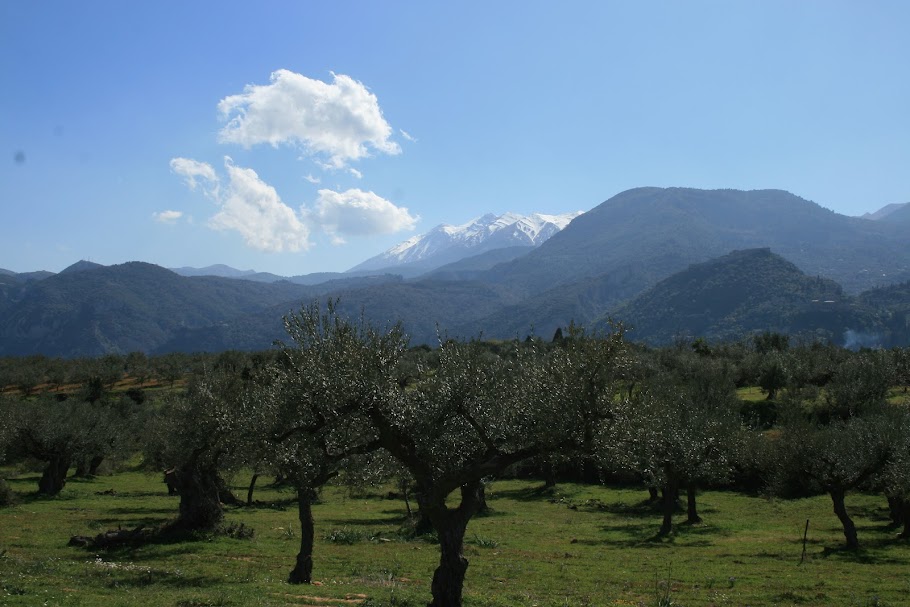
The view west from Sparta to Taygetos -- a good reason to for good spirits!

Certainly modern efforts to measure happiness have produced various indexes which prove that there is no direct correlation between wealth and happiness. Unscientifically, I would add that in my personal experience the Nigerians surrounded by corruption, pollution and collapsing infrastructures are much happier and have a greater joie de vivre than do the Norwegians – a people with one of the highest standards of living and one of the most equitable and developed societies on earth.

Without getting too deeply into the philosophical topic of what constitutes happiness, I would like to suggest that happiness has less to do with objective circumstances and more to do with a state of mind – i.e. attitude rather than possessions. We all know that whether a glass is described as half empty or half full depends on whether the observer is a pessimist or an optimist, but as my father pointed out: the optimist and the pessimist are both wrong – but the optimist is happier.

When outsiders looked at Spartiate society and (based on what they knew) decided such a life wasn’t worth living, they may indeed have accurately described how they would have felt if forced to live the way the Spartans did. However, they tell us nothing about the way the Spartans themselves felt. They are describing Spartan society as “half empty” – but that is not necessarily the way the Spartans saw it. The historian has to look beyond the opinion of outsiders and search for hints about Spartans attitudes toward their society.

Returning to the opening comment, I would argue that, in fact, men are very rarely willing to die for something they don’t think work preserving. Troops notoriously break, run and surrender when they have lost faith in what they are fighting for. If Spartan rankers thought that their way of life wasn’t worth living, then they would have welcomed defeat as a way of introducing revolution and constitutional reform. Indeed, if young Spartans thought the Spartan way of life was so abdominal that it was better to die than live as they were supposed to live, then idealistic young Spartans would have deserted to the Athenian side, helped defeat the oppressive regime they hated, and introduced Athenian-style democracy. In short, witty as the Athenian joke is – and it made me laugh out loud – it does not describe the Spartan frame of mind.

So how do we come closer to the Spartan attitude toward life? What made Spartans willing to die for Sparta? Was it really just a mindless fear of showing fear? A fanatical devotion to a code of honor? Or was Xenophon on the right track when he suggested that the Spartans learned to enjoy life – and love it better – by learning self-control and restraint?

As evidence of a certain, if not joie de vivre, at least contentment, I would like to first draw attention to those pieces of Spartan art that we have to date uncovered. Unlike the art of some warlike cultures (notably the Aztecs), Spartan art depicts many peaceful scenes: farm animals, lions and mythical beasts, bulls and horses (lots of horses!), riders with and without hunting dogs, chariots with horses and charioteers, girls running, married couples side-by-side, a king watching the correct weighing of goods for export, youths and maidens and hoplites, lots of hoplites. It is notable that the facial expressions on the human figures are uniformly benign. A convention certainly, but I would argue that a society that rarely smiled would not have conventionalized the smile as the expression in its art.

As a witness to Sparta’s love of life I would also like to call Sparta’s most famous philosopher, Chilon. According to a variety of ancient sources, Chilon was the origin of the quintessential laconic advice “Know Thyself” – inscribed in the forecourt to the Temple of Apollo at Delphi. Maria Papadopoulos points out in her contribution to “Sparta: A city-state of Philosophers: Lycurgus in Montaigne’s essais” (Sparta: Journal of Ancient Spartan and Greek History, Vol. 7, No. 1, July 2011), however, that this expression is a condensation (laconic interpretation!) of the longer command from Apollo to “know that you are not a God, know that you are mortal, know that the finitude called death is an irreducible component of life. Live accordingly.”  If Papadopoulos is correct, then Chilon’s admonishment to “know thyself” was not so much advice to know one’s own abilities and limitations, but advice to live each day in anticipation of death – which is much the same thing as “Carpe Diem”—usually translated as “use each day.” Arguably “using” each day is not the same as enjoying each day, and yet as Papadopoulos goes on to note: “The ancient Spartans trained hard but they enjoyed themselves [too]: feasts, dancing and singing, creative imagination and satirical banter and a temple dedicated to the God of Laughter….”

Combined I think these fragments of evidence suggest that the Spartans themselves did not find their lifestyle so burdensome and certainly not intolerable. The “deprivations” and hard work that strangers found so depressing were in contrast of little importance in a society that learned to love life itself in full consciousness of its transience.  A man who keeps in mind the alternative (death) loves even the simplest things in life.  This, I postulate, was the secret of Sparta’s love of life.

Saturday, November 1, 2014

Chilon the Wise

It may surprise many modern readers that Plato, writing a history of philosophy in the 4th Century BC, claimed that all early philosophers were “imitators, lovers and disciples of Spartan education.”  Furthermore, the seven “wise men” that Plato considered the fathers of philosophy included two Lacedaemonians, one of which was Spartiate: Chilon the Wise. Although in the 5th century BC it had become common to speak about “seven” wise men, whose selection varied from writer to writer so that a total of 17 are actually named on one list or another, Chilon – like Solon of Athens – is always among the seven.

So just who was Chilon of Sparta?

Based on the stories told about Chilon, which include personally meeting the famous writer of fables, Aesop, and Hippokrates, the father of the Athenian tyrant Peisistratos, historians conclude that Chilon lived in the first half of the 6th century BC, or – one might say – in the Golden Age of Sparta.  Furthermore, he is said to have been an ephor during the 56. Olympiad, or between 556 and 554 BC, by which time, the sources say, he was “very old.” Modern historians such as Conrad Stibbe suggest he was somewhere between 60 and 75 when he was elected ephor in ca. 555 BC.

Chilon was a Spartiate, but apparently not from a “leading” or royal family. The fact that his descendants married into both royal houses, however, is an indication of just how highly he was regarded by his contemporaries and admired by subsequent generations of Spartans.  Particularly significant is that a great-granddaughter of Chilon was selected by a later college of ephors as the bride for the then childless Agiad King Anaxandridas.  Anaxandridas had been married for many years to his niece, who appeared to be barren, and the ephors after futilely urging the king to set aside his wife and take a new wife, convinced him to take a second wife.  This wife (who is nameless in Herodotus) promptly became pregnant and gave birth to a male child, who later became one of Sparta’s most controversial kings, King Cleomenes I.  What is striking about this particular marriage is less that the college of ephors would put forward the name of a girl descended from one of their own predecessors, than that Anaxandridas, who would have been a reigning king at the time Chilon was an ephor, would accept her as his bride.

The importance of this fact is best understood when we remember that Chilon is credited by ancient and modern historians with raising the status of the ephorate to a body almost as powerful as the kings.  The ephors are not mentioned in the so-called Great Rhetra which allegedly encapsulated Lycurgus’ constitutional reforms, nor do they appear in any of the fragments of Tyrtaeus’ poetry that have survived. Originally, the ephors appear to have been little more than official servants of the kings, charged with executing the kings’ orders. In consequence, the ephors make no particular mark in history prior to the mid-6th century.

The first historical act of the ephors was the already mentioned incident in which they forced a reluctant King Anaxandridas to take a second wife. This interference in the personal life of a king was justified by their concern over the future of the Agiad line and indirectly the Spartan Constitution. It was initiated because, according to Herodotus, the ephors were tasked with observing the heavens at regular intervals and interpreting the stars.  In other words, this first act of interference could be interpreted as more a religious than a political role, in that the ephors were simply interpreting the Will of the Gods, rather than acting in a constitutionally independent role.

In the centuries to follow, however, the ephors increasingly engaged in activities that are unashamedly political. By the late 5th century, the ephors could fine citizens for misdemeanors and bring charges against them for more serious crimes, even those elected to public office.  They controlled relations with the perioikoi and helots (at some point initiating the practice of declaring war on the helots annually.) The ephors drafted bills for presentation to the Assembly and set the agenda at Assembly meetings. They could summon the Assembly and presided at it.  The ephors decided based on their estimate of the comparative volume of the shouted “ayes” and “nays,” whether a motion had passed, and they enforced the decisions taken at Assembly.

The ephors, furthermore, had diplomatic and military roles as well as political and administrative ones. Not only did they receive and dispatch ambassadors, they also named – and recalled – commanders, such as Pausanias and Lysander.  They appointed the three hippagretai, who then each selected one hundred men from among the 21 – 30 year olds to form the royal body guard.  After the Assembly voted for war, it was the ephors, who mobilized the troops, and two ephors accompanied whichever king commanded the Spartan army on campaign.  The latter was clearly intended as a check on the behavior of the kings.  Although the kings commanded absolute obedience while the Spartan army was outside of Lacedaemon, the ephors were expected to keep an eye on them and exercise their right to bring charges against the kings on their return.  If a king was charged with a capital offense, the ephors sat in judgment of him along with the Gerousia.

But returning to Chilon himself, Conrad Stibbe in his excellent work on archaic Sparta Das Andere Sparta (Mainz: 1996) credits Chilon with conceiving of the Peloponnesian League.  As he points up, throughout Sparta’s previous history, complete subjugation of a conquered people followed successful Spartan conquests. This was true for the conquest of the heartland of Lacedaemon, the Eurotas Valley in the 9th century and for the conquest of Messenia in the second half of the 7th century. Yet after a bitter war with Tegea during the first half of the 6th century BC, in which Sparta suffered at least one humiliating defeat resulting in the enslavement of Spartiate hoplites, Sparta chose a different path. Following a decisive victory over Tegea under the leadership of King Anaxandridas, Sparta made the revolutionary decision not to subjugate and occupy Tegea, but rather to form a defensive alliance with its defeated foe. This course was unprecedented in Greek history at the time. (Note: My novel The Olympic Charioteer deals with this period of Spartan history.)  Furthermore, the alliance with Tegea was not a one-off event, but rather signaled a completely new Spartan foreign policy that was pursued throughout the rest of the century. Under both Anaxandridas and his sons, Sparta built up her power and prestige not through direct conquest but through the formation of a system of alliances, first on the Peloponnese (under Anaxandridas and Cleomenes) and with all of Hellas under Leonidas.

Yet while Chilon sought peace and alliances with Sparta’s democratic neighbors, he was according to ancient tradition together with Anaxandridas the driving force behind a series of military actions undertaken by Sparta to depose tyrants in Sikyon, Samos, and Athens. The fact that Chilon and Anaxandridas are mentioned as working together to depose the tyrants is significant because it suggests a joint policy – something that makes the later marriage of Anaxandridas to a great-granddaughter of Chilon more understandable. 

Interestingly, Chilon is described in Herodotus as a seer and Chilon’s first act of extraordinary wisdom was advice that, had it been followed, would have spared Athens the tyranny of Peisistratos in the first place.  Chilon’s wisdom was thus associated with Sparta’s opposition to tyranny.  According to legend, when the father of Peisistratos, Hippokrates, was in Olympia, he received a sign from the Gods.  A cauldron full of sacrificial meat he had donated to the gods boiled over without a fire being lit under it.  Although Hippokrates recognized that this could only be a message from the gods, he could not interpret it, and turned to Chilon for advice.  Chilon told him not to marry and if he was already married to disown any son he already had.

The Spartan Chilon was according to ancient tradition also a contemporary of the fable-writer Aesop.  According to legend, Chilon told the former slave that Zeus’ job was to “humiliate the mighty and rise up the humble.” While this was clearly a reference to Aesop’s own fate, it is a strikingly revolutionary statement nonetheless – heralding the Christian notion that “the meek shall inherit the earth.”

Likewise with respect to women, Chilon set revolutionary standards of behavior that were uniquely Spartan.  While the Athenian philosopher Socrates showed utter contempt the intellect of his wife, refusing to even take leave of her after he was condemned to death, Chilon was depicted on his grave sitting side-by-side with his wife. Even more impressive, one of his daughters, Chilonis, was recognized by name as a disciple of Pythagoras. In short, while the Athenians contended that women were permanent children with brains incapable of developing rational thought,[i] Sparta’s greatest philosopher encouraged his daughter to study under the greatest of his contemporaries.

But it was hardly for his attitude toward women or former slaves that Chilon attained so much fame among his fellow Greeks. Rather, Chilon was admired and honored by subsequent generations of Greek philosophers and their Roman and modern admirers primarily for his “wisdom.” Chilon was the author of some 600 verses familiar to the ancients that they admired greatly. Unfortunately, none of these have survived into the present, at least none have been identified as the work of Chilon. More famous, however, were three – typically Laconic – sayings that were craved over the entrance to the Delphic oracle and attributed to Chilon. Let me close these brief essay on Chilon by quoting him.  I think many would find his advice relevant even today:

Sponsorship brings misfortune.
Nothing in excess.
Know thyself.


Chilon plays a minor -- but important -- role in my novel: The Olympic Charioteer.


[i] Good sources on Athenian attitudes for women can be found in the Sarah Pomeroy’s Goddesses, Whores, Waves and Slaves, (New York: 1975), Sue Blundell’s Women in Ancient Greece, (London:1995) and in the chapter on “Citizen Women in Athens,” in Anton Powell’s Athens and Sparta: Constructing Greek Political and Social History from 478 BC, (Portland, Oregon: 1988). 

Saturday, July 14, 2012

“Nothing in Excess” or Ares Chained


It was the Spartan Statesman Chilon the Wise who coined the laconic phrase “nothing in excess.” Yet the degree to which this philosophy dominated Spartan culture is often overlooked.

It will come as no surprise to scholars of Sparta that Spartan culture proscribed, for example, economy in the use of words, in drinking, in eating, in making love and in dress and decoration.  By the end of the fifth century BC, the Spartans were infamous for the lack of decoration on their clothes and homes. Meanwhile, their preference for pithy, precise expression rather than verbose eloquence, had given rise to a contemporary cult of “Laconic” expression.  Likewise, the Spartan disdain for excessive drinking was legendary to the point where Spartans were willing to blame the madness of a king (Cleomenes I) on nothing more than drinking his wine neat. When it comes to food, Xenophon claimed that boys of the agoge received short rations, while grown men in the syssitia were fed a restricted diet. According to Plutarch even sex was inhibited in Sparta, with newlyweds forced to engage in various tricks and deceit in order to come together.

Most ancient commentators praise Sparta’s culture of “less is more.”  Xenophon claims that the short rations of the agoge helped boys to grow tall, while the syssitia’s rigid regime kept men from growing fat.  Plutarch suggests that Spartan marriage customs increased affection between young couples by restricting their ability to sate passion, apparently on the assumption that too much sex leads to disinterest.  Certainly, Spartan prudery was viewed by philosophers as more admirable than the reverse.  The benefits of teaching children silence were, of course, widely eulogized and Laconic speech particularly praised by Plato and the philosophers.

Modern commentators, in contrast, are more likely to focus on the harshness of Spartan society. Sparta is frequently compared to totalitarian societies in which freedom is sacrificed for conformity and the state is ever-present.  The emphasis is on children torn away from their parents, on young men confined to barracks rather than living with their wives, on adults with no choice of profession, and soldiers expected to die rather than retreat even in hopeless situations.

Yet Chilon’s admonishment applied to excessive cruelty, brutality, rigidity, hatred and violence as much as to excessive luxury, food or sex!  Nothing in excess means exactly that.  Sparta was no Taliban state in which pleasure, music and sport were forbidden. On the contrary, in Sparta music and dance were valued nearly as much as valor on the battlefield.  

Even war itself was not adored, but rather seen as a dangerous passion that –just  like appetite and lust – needed to be controlled. This attitude was symbolized by a temple in which Ares was chained. Spartans feared an unleashed God of War as much – if not more – than they feared an uninhibited Aphrodite. The cult of Aphrodite, after all, first took root in Lacedaemon, on Kythera, and according to some sources the Spartans sacrificed to Eros on the eve of battle – not to Ares.

Yet arguably the greatest evidence that Spartan society was not grim was the fact that Sparta had a temple to laughter and so a cult of happiness. To my knowledge, no other ancient city-state shared this open and explicit adulation of happiness. To be sure, Sparta also had a temple to fear, and it would be wrong to argue that Spartans “adored” fear.  Rather, temples were built to all supernatural forces which mortals needed to respect.  The Spartans knew that fear was powerful and could seize control of even the bravest heart, therefore it was a force to reckoned with and respected, like death itself.  The significance of a temple to laughter is that it shows that Spartans, far from scorning the light side of life, joy and humor, recognized the power of laughter no less than that of fear.  Unlike any other ancient society that I know of, it placed enjoying life on a par with the undeniably dark forces of death and fear. (See also: Loving Life inLacedaemon.)