Find Out More

Find out more about Helena P. Schrader's Sparta novels at: https://www.helenapschrader.com/ancient-sparta.html

Sunday, July 1, 2018

The Making of Sparta

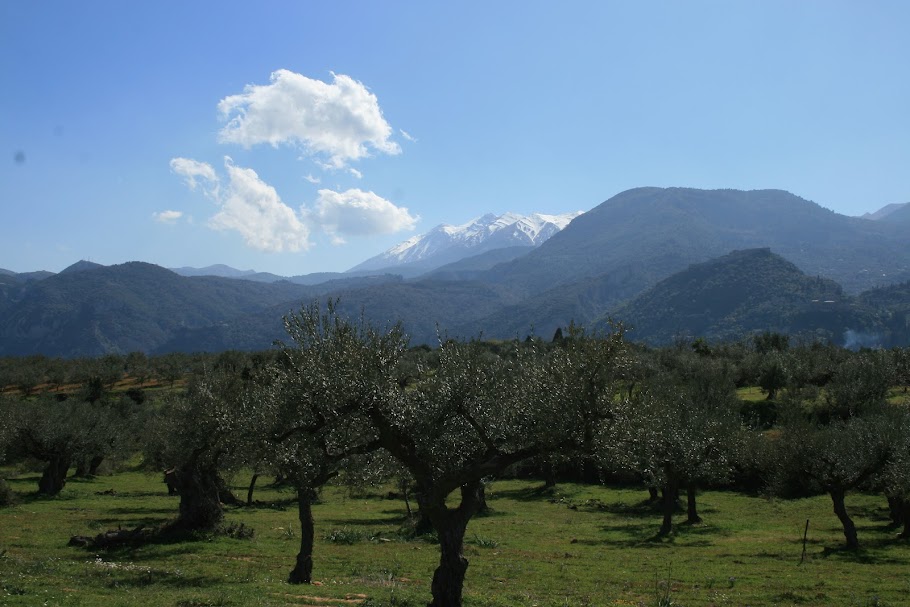
The road from Sparta to Messenia is through a dramatic pass.
Modern histories of Sparta tend to brush over the Messenian War(s) in considerable haste and without providing a great deal of detail.  The reason is obvious. As Paul Cartledge stresses in Sparta and Lakonia: A Regional History 1300 to 362 BC (one of the few general histories of Sparta to focus seriously on the early history), the literary evidence is almost nil and the archeological evidence ambiguous. Indeed, he describes Tyrtaios, a poet whose works have been handed down to us only in fragments, as the only "reliable" [sic!] literary source, while pointing out that the ancient sources Herodotus and Thucydides refer to only one war.

Yet, arguably, nothing was more important to the evolution of Sparta into a city-state with a radically unique constitution than the Spartan conquest of Messenia.  W.G. Forrest argues, for example, that the conquest of its agriculturally rich neighbor reduced the need for distant colonies and so the interest in the wider world, while the agricultural basis of Spartan wealth reduced Sparta’s interest in industry and trade. Others argue that the conquest of such a vast territory and the subjugation of an entire people resulted in a permanent fear of revolt that in turn created the need for a militaristic state. Sparta as we know it – with its unique institutions from the agoge to citizens permanently under arms – is a function of its conflict with Messenia.

The facts of conquest which are undisputed are quickly summarized: Sparta controlled Messenia completely by the start of the 6th century BC. Sometime in the 7th Century, during the life of the poet Tyrtaios, Sparta was engaged in a bitter struggle with the Messenians, a struggle that Tyrtaios clearly describes as one involving pitched battles between hoplites (though not phalanxes). Tyrtaios furthermore refers in his poems to the great deeds of “our father’s fathers,” which is usually interpreted to mean that the initial conquest of Messenia occurred two generations earlier. Tyrtaios also speaks of a struggle that lasts 20 years. Both the references, however, may be purely poetical; the first may mean little more than “our forefathers,” and the latter be a literary device to stress that it was “a long struggle” by making the fight in Messenia exactly twice as long as the conquest of Troy.  Archeologically, we can trace a gradual expansion of Laconian influence into Messenia starting in the late 8th Century.

We also know that in the first quarter of the 7th century BC, Sparta adopted a new constitution attributed to Lycurgus. (I know there has been scholarly debate about the exact dating of the Spartan constitution, but I find W.G. Forrest’s arguments dating the Spartan revolution to the period between 700 and 670 cogent and convincing. See A History of Sparta, 950-192 BC, pp. 55-58.)  Furthermore, we know that Sparta’s only colony was established at the turn or very end of the 8th Century BC, traditionally in 706 BC. Both the introduction of a radical, new constitution sanctioned explicitly by Delphi and the establishment of a colony are attributed by ancient sources to internal unrest in Sparta.

Conventionally, these facts are woven together as follows: Sparta invaded and conquered Messenia in the late 8th Century, subjugating the local Messenian population. This conquest was allegedly followed by a period of intense internal unrest that led, first, to the founding of Sparta’s only colony, and second to the Lycurgan reforms. The later, however, are usually seen as contemporary with Tyrataios and were, therefore, implemented during a second period of conflict with Messenia, usually described as “the Second” Messenian war. If one presumes that Sparta won the initial conflict with Messenia, this can only be explained by a revolt of some kind. So the -- allegedly brutally oppressed -- Messenians were capable of financing hoards of hoplites and fielding entire hoplite armies within just two generations.

This taxes my imagination. Periods of intense domestic unrest rarely follow victorious wars – particularly not wars of conquest that have greatly increased the wealth of a state. Likewise, slave revolts do not involve pitched battles between hoplite armies and don’t take two decades to defeat.

The history of modern revolutions shows that revolutions most commonly occur during economic crises or after military defeats. Classical revolution theory says that revolutions occur when a period of rising living standards and expectations ends abruptly in a crisis that threatens recent gains.  If we apply this to the Spartan revolution we get some interesting hypotheses – that square remarkably well with the (scanty) historical record.

What if, following a period of increasing prosperity, productivity and population growth, Sparta’s kings/leadership decided to conquer neighboring Messenia, invaded – and then got bogged down in a terrible war that they failed to win? What if, to obtain/retain support, Sparta’s kings and aristocratic elite promised the poorer and lower classes land in Messenia? What if they then couldn’t deliver on that promise?  What if, as the war dragged on, casualties mounted, and popular support for a lost war waned? What if, the Messenians became increasingly successful and aggressive, bringing the war to Laconia?

Such a situation would have produced all the features of mid-seventh century Sparta that we know existed: the domestic unrest, the calls for a redistribution of land, impetus for the founding of an external colony, and finally readiness to accept a new, revolutionary constitution and lifestyle – as well as the continuing conflict with organized, well-armed Messenian forces. 

Furthermore, if Sparta lost the First Messenian War (at least in the sense that it did not obtain its objectives) and it took three generations to subdue the Messenians, then we have a better explanation of why Sparta became a militarized society. Only sustained conflict and perpetual threat could force a society to adopt a system of government that is so singularly focused on ensuring military preparedness at all times.

The paranoid excesses of late classical Sparta (krypteia, mass executions, etc.), followed a presumed helot revolt in 465. Yet, if true, they probably took the disproportionate form they did because there was still popular memory of the first lost war. A first lost war that traumatized Sparta would explain why Sparta responded with unparalleled harshness toward the rebellious Messenians two hundred years later. We need only consider how memories of past wars still shape, for example, Greek-Turkish, British-Irish, or Russian-Polish relations today. I believe it was more likely the trauma of a lost war -- rather than an unbroken series of victories by an invincible army -- that sparked the revolution that made Sparta the unique society it was.

My novel Are They Singing in Sparta? is set in the later part of the Messenian Wars and is based on a legend: that the Spartans asked Delphi what they should do and were told to send to Athens (then a rival and hostile to Sparta) for a polemarch. According to the legend, the Athenians (since they sided with the Messenians) sent an old, lame schoolmaster by the name of Tyrtaios.....

BUY NOW!
Spartans and their unique culture are depicted as realistically as possible in all my Spartan novels:


       Buy Now!                                         Buy Now!                                     Buy Now!

Friday, June 15, 2018

Some Kleros More Equal than Others: An Excerpt

At the start of the month I talked about the Spartan land reform, an effort to ensure every Spartan citizen had enough land to ensure his independence, i.e. his ability to devote himself to the profession of arms. Each kleros had to sufficient produce for 50% of the harvest to pay the citizen's contribution to his syssitia and the agoge fees for any sons he had.  But while every Spartiate had a kleros, many had more than a kleros, and, as this excerpt underlines, not all kleros were equally productive -- and much depended on the ability of a man's wife to manage his estate effectively.


They left by the back door and went along the path behind the kennels and stables toward the rushing stream. The ruins of the mill were still charred and ominous amidst chestnut trees that, despite the fire which had shorn them nearly two years ago, were now sprouting buds. "Aren't you going to rebuild?" Agesandros asked, nodding to the ruins.

"I don't know. I can't afford to right now. Maybe I'll let someone else rebuild.  Orsippos came to me the other day and says he knows a man who'd be willing to rebuild at his own expense if I give him a 10% discount on the subsequent rents. That would be a very good deal for him, of course." Alethea cast Agesandros a little, bemused smile. "He'd be able to pay off his investment in five years or so, and be perpetually better off thereafter. I hesitate to make such a bad deal on Niko's behalf -- even if it means going without the mill income for another couple of years."

Agesandros looked at her sidelong. She spoke of these economic considerations with a self-assurance he would not have had -- not to mention his mother or sister. ...

He focused his thoughts on the present again by focusing on the mill ruins and was reminded of what his own kleros was like. There was no mill there to supplement his income. Nor were there any orchards or vineyards. The old resentments filled him for a moment, but he did not want to resent Alethea. He was tired of being bitter.

Alethea noted his change of mood, but she hesitated to ask what was wrong.

Agesandros pulled himself together, nodding shortly at the mill again to remark in as neutral a tone as he could manage, "my father got a piece of bad land cut out of a large estate without even a house on it -- much less a mill. It was pastureland on a steep incline. We've had to terrace it stone-by-stone to make it support barley. We don't have a single tree for shade, much less olive oil or fruit. And there's no wine either."

Alethea listened with a growing sense of helplessness. She knew Agesandros was a New Citizen. Euryanax had lectured her at length about the imperfection of the Land Reform precisely because the land plots were equal in size but not in productivity. "I -- I know the Land Reform wasn't entirely fair," she told Agesandros anxiously.  "But what would have been better? You couldn't cut houses in half or draw the borders squiggling through the countryside. Many men wouldn't have voted for the Reform at all, if they'd thought they would lose their very homes...." Her arguments sounded weak to her, and her voice trailed off.

Agesandros considered her earnestly, realizing that he hadn't expected even this much understanding. Then again, intuitively he had known she was not a woman who was indifferent to the sufferings of others. He had only to think of Leon.  "I didn't mean to complain. Where else in the world have men without anything been given land at all? Besides, a city-rat like me wouldn't know how to manage all this." He gestured vaguely toward her vineyards and orchards. "I've barely learned the essence of planting barley." He offered the latter with a short laugh.

"But your wife should manage things for you," Alethea remarked, flushing at her own boldness, and not daring to meet his eyes when she flirted so shamelessly.

"True. That's why I need to marry a woman who understands something of -- barley."

"More than that!" Alethea insisted looking up and seeing -- too late -- the glint of amusement in his green-gold eyes. 

"I only have barely."

"But I'm sure that's not all your kleros could produce,"  Alethea countered, adding eagerly, "look at this. You don't think this kleros was always this diverse, do you? When the reforms came we had only the olives and a strip of barely. We'd lost our pastures and vineyards and fruit orchards, the flax fields and--" She stopped herself recognizing too late that in listing all Euryanax had lost she only emphasized how rich he had once been.

But Agesandros knew how rich Euryanax had been and he was not offended, only surprised.

Read more in:


Tuesday, May 15, 2018

An Evening at the Syssitia - An Excerpt from "A Peerless Peer"

At the start of the month I discussed the Spartan custom of syssitia, or dining clubs. In today's excerpt from A Peerless Peer we see inside a syssitia. Gorgo, Leonidas' niece, has recently announced that her father intends to marry her to a foreigner, and she has named Leonidas as her preferred husband.


The entire syssitia fell silent as Leonidas entered, and they looked at him expectantly. He frowned. "If you're gossiping about me, I'll leave again so you can carry on."

"You'll do nothing of the sort!" Nikostratos countered.

Leonidas turned on his heel to leave. Nikostratos nodded to two of the youngest members of the mess, and they sprang to their feet to block the door.

"You'll come in and sit down with us and behave like an adult," Nikostratos told off the younger man.

"I'm not going to talk about this nonsense."

"Calm down and have your soup!"

Warily Leonidas eased himself down on the couch and held out his hands to the mess-boys. One of the boys held the bowl while the other poured water over his hands, and then handed him a towel.  Leonidas watched the entire ritual intently as if he were seeing it for the first time. The boys, both eight-year-olds, were very diligent, but just as they finished, one of them risked glancing up at him. Leonidas recognized the look of boyish delight at the prospect of hearing something worth telling their friends. Frowning, he sent the boys scampering back toward the kitchen.

A moment later they were back, rolling in the soup in a deep cauldron. The boys filled individual bowls with the thick stew while a loaf of warm bread was passed around. Leonidas tore off a chunk of bread and dipped it into the steaming-hot soup. Only after he had put the bread in his mouth did Nikostratos open his attack. "You realize your elder brother has outmaneuvered you, don't you?" he asked casually, not even looking at Leonidas -- but there was no question to whom he was speaking.

Leonidas looked up furiously, his mouth too full to retort, while Nikostratos continued, "King Cleomenes was called in to explain himself to the ephors, and he swore solemnly that you were his first choice for his beloved daughter -- but that you wouldn't take her. It was only because you'd already turned him down --"

Leonidas swallowed what was left in his mouth and insisted, "That's complete nonsense! He's lying!"

"Oh, I don't doubt he's lying, Leo. That's not the point. The point is, he has now publicly gone on record saying that you were his first choice as husband for his daughter, and only because you refused has he been forced to look for alternatives. He insisted that his daughter is too intelligent, independent, and precocious -- all of which is patently true -- to give to anyone but a prince or, short of that, a ruler.  He suggested that a Persian satrap would be more suitable than an ordinary ranker."

"That's ridiculous!" Leonidas scoffed.

"Maybe, but he has neatly shifted the blame for seeking a foreign bridegroom from himself to you," Nikostratos pointed out. "And made you look doubly bad, since you are well over thirty, unmarried, and childless, and so in open violation of the law already."

"Meanwhile, your other brother is talking divorce, so he would be free to marry Gorgo," Euryleon joined in.

"Brotus?" Leonidas asked, incredulous. "Brotus wouldn't last a day with Gorgo -- she'd dissect him!"

Euryleon laughed, but retorted. "But she'd do it so intelligently, he might not even notice -- thick as he is." The remark harvested a general laugh from their mess-mates.

Nikostratos, however, insisted seriously, "Well, as next in line to the throne, there is a certain logic to Brotus marrying Gorgo." He wiped the bottom of his bowl clean with his bread.

"There's no logic to it at all!" Leonidas retorted hotly. "Besides, Brotus has no grounds for divorce -- and Sinope will kill him if he even mentions it!"

"Well, in that case, for an Agiad prince there is always the precedent of two wives."

"That would only perpetuate the entire nightmare of two rivals for the throne. Pausanias would naturally claim the throne as the first born, and any child by Gorgo would claim it by right of his double royal blood. The ephors can't be that stupid!"

Nikostratos shrugged and signaled for more soup. "Leonidas, you may well be right. I admit the situation is unprecedented. Ever since the sons of Herakles came to this valley, there has never been a situation exactly like this. But you can't just look on this as a personal matter. There will be consequences to your refusal to marry your niece and not all of them will be to your liking."

Sunday, April 15, 2018

An Ionian in Sparta - An Excerpt from "A Peerless Peer"

At the start of this month I discussed how Sparta's culture of "less is more" pervaded Spartan society. But the impact of this philosophy was not the only feature of the Spartan lifestyle that bewildered outsiders. In this excerpt from "A Peerless Peer," an Ionian visitor gets a "shocking" introduction to Sparta.


What impressed Aristagoras most, however, was the behavior of the citizens.  The boys, as he had expected, were shaved, barefoot and scruffy -- but he had never met such well-mannered youth in his whole life! Even the poorest urchins in Miletos were rude and impudent, while the sons of the rich were spoiled and self-centered. Here, all Leonidas had to do was call to any of these boys, and they came and stood at attention before him with their eyes down and their hands at their sides...

The young men...were impressive too. Again, they behaved with marked deference and respect when Leonidas introduced them.... Aristagoras told himself that there had to fat, lazy, weak and ugly Spartans, but they were not in evidence.

What was in evidence everywhere were the women.  Hadn't Homer described Sparta as the 'land of beautiful women'? Evidently he had not been referring to Helen alone. Aristagoras was utterly amazed -- and a little disconcerted -- to discover that women dominated the Spartan agora. In other Greek cities, the agora was not just a place of commerce, but above all the place for men to congregate, exchange news, and discuss everything from politics and court cases to the latest theory of alchemy. In Sparta, in contrast, there were no citizens in evidence at all -- only craftsmen, merchants, farmers selling their good -- and women.

At first Aristagoras was not entirely certain just who these women were. On the one hand they wore old-fashioned peplos, which meant they showed quite a lot of leg when moving rapidly, but there was nothing lewd about them. They generally wore a himation up over their head (though not shrouding their faces), and they appeared more intent on striking a bargain with the salesmen than on attracting attention to themselves. In other words, they were not whores. Because they were shopping and wore neither gold nor silver, they might have been household slaves, he thought, but most wore very expensive fabrics beautifully dyed in rich colors, set off with bold borders, and clasped with heavy bronze, silver or ivory pins. Furthermore, they walked upright and seemed very self-confident. "Who are these women?" Aristagoras asked at last.

"Mostly citizen's wives."

"Your wives have to do the daily shopping?" Aristagoras gasped in shock. He would never have let his wife go down to the agora and haggle with craftsmen and other charlatans. She couldn't add two and two together, anyway. "You own wife comes here?" Aristagoras pressed him.

"Of course." When she was in Sparta, Leonidas added mentally with a sigh.

"Have you no slaves?"

"The helots do the heavy work, but it is usual for a Spartiate wife to make most household purchases."

"So your women have driven the men out," Aristagoras concluded, because obviously, men would not willingly congregate where they would be surrounded by a bunch of gossiping women.

"It is considered bad manners for a young man to loiter around the agora," Leonidas replied.

"Why? What can be bad about meeting with one's fellows and discussing the developments of the world?"

"We can do that in our syssitia -- not here in the open where helots, perioikoi, and strangers may see and hear.  Besides, there is a prohibition against Spartiates having coins and 'engaging in trade,' which some of our more conservative citizens interpret to mean even daily shopping. Our wives are not subject to the same prohibitions, because they have control of the household finances and must be able to both buy and sell goods as needed."

"But -- that is madness! You let women run your finances?"

"For the most part, yes, our domestic finances. They city has an elected treasurer, of course -- a highly respected man of great knowledge in mathematics and accounting."

"Yes, but how can you let your women run your private affairs? Their brains are underdeveloped, and they are not -- no matter how much they try -- capable of understanding higher principles. Why, if I let my wife run my household, we would have noting but sweets and pretty baubles, and we would all starve."

Leonidas shrugged, "We've been letting our wives run our households for the last forty Olympiads, and our prosperity is unimpaired."

The evidence appeared to support Leonidas. Lacedaemon was certainly prosperous, but Aristagoras could not believe women had anything to do with it....

While the mature women were baffling and incomprehensible to Aristagoras, the girls were delectable -- and they appeared to run around everywhere.  He could hardly credit his eyes when he first spotted them watching the boys at drill outside the city, dismissing them as younger boys watching their elders. But at the baths and then the racecourse, there could no longer be any doubt. Nubile and even younger prostitutes were put on display in a most unusual way. Namely, they were allowed to strip completely naked and then take part in sports alongside the young men. Apparently, by the time they got to be sexually mature they were sequestered away for their paying clients, but the young one were evidently put on display like this to encourage youths and men to bid for first rights or the like. It was an intriguing custom, and Aristagoras was about to ask more about it, when one of the girls walked right up to them.

She had just finished bathing, come ashore, dried herself down in full view of everyone, and then pulled on a simple chiton. She was still rubbing dry her bright red hair when she came over to them. "Excuse me," she said shortly to the stranger, and then turned at once to his companion. "Uncle Leo, may I ride Cyclone in the Gymnopaedia?" Then before he could get a word in edgewise, she hastened to assure him. "I know it's my own fault that Shadow isn't up to it anymore, but she's couldn't have won even without the accident. She's sweet, but she's not really fast. Not like Cyclone. If you let me ride her, I'll bring you the laurels! Cyclone is the best mare in all of Lacedaemon! You won't be riding her yourself, will you? I asked Eirana last time I saw her, but she said she didn't ride anymore. Please let me ride her!" 

"I'm not going to make a decision now," Leondias told his neice simply because he was embarrassed by the way she had plunged in, ignoring the stranger. Pointedly he added,"This is your father's guest, Aristagoras of Miletos."

Too late, Gorgo realized that the man with her uncle was someone important. She had been so determined to make her case to Leonidas that she had dismissed the man with him as "some stranger." Now she turned her attention to Aristagoras, frowning slightly, and noticed his gold rings and bracelets, his woven chiton -- and the scandalized look on his face. Embarrassed, she realized her hair was a mess and her chiton was falling off one shoulder. Self-consciously she pulled the chiton back in place and reached up to comb her fingers through her hair. "I'm sorry to have interrupted, sir," she stammered, then turned and darted away.

"Who -- who -- was that -- girl?" Aristagoras stammered in utter confusion. It was one thing for a girl-whore to address a favored customer as "uncle," but to be told he was her father's guest was outrageous. He was here to see a king!

"That was my niece Gorgo. My brother's only child, since his son and heir died in a accident five years ago. He spoils her, I'm afraid." Leonidas paused, laughed, and added. "We all do."

"Your brother's child? A Spartiate's daughter? By a slave girl, then?"

"No, by his wife." Leonidas turned and looked at Aristagoras straight in the eye. "You didn't think these girls were slaves, did you?" Aristagoras' expression was answer enough, and Leonidas continued firmly. "They are all the daughters of citizens. They are dressed simply and barefoot only because they are in the public upbringing." Leonidas was angry because he could tell how shocked Aristagoras was, but he was angry with himself, too. He should have known how the foreigner would react. He should have made a point of telling him about the girls.  And Gorgo didn't make things better by being so bold. But it was too late now. "I think it is time I took you to my brother."

"Your brother?"

"King Cleomenes."

Aristagoras stared at him.


Saturday, March 31, 2018

Nothing in Excess - A Pervasive Spartan Philosophy

It was the Spartan statesman Chilon "the Wise" who coined the laconic phrase “nothing in excess.” Yet the degree to which this philosophy dominated Spartan culture is often overlooked. Today Dr. Schrader looks at this aspect of Spartan society.


Chilon's saying translated either as "nothing in excess" or "everything in moderation" was carved in stone at the sacred pan-Hellenic site of Delphi. It was recognized as wise advice to all Greeks. Yet it was only in his native Sparta that the concept of avoiding excess was internalized and enshrined in daily behavior. Spartan culture proscribed, for example, economy in the use of words, in drinking, in eating, in making love and in dress and decoration.  

The Spartan disdain for excessive drinking was legendary to the point where Spartans were willing to blame the madness of a king (Cleomenes I) on nothing more than drinking his wine "neat" (i.e. unmixed with water). When it comes to food, Xenophon claimed that boys of the agoge received short rations, while grown men in the syssitia were fed a restricted diet. According to Plutarch even sex was inhibited in Sparta, with newlyweds forced to engage in various tricks and deceit in order to come together. By the end of the fifth century BC, the Spartans were infamous for the lack of decoration on their clothes and homes. Meanwhile, their preference for pithy, precise expression rather than verbose eloquence, had given rise to a contemporary cult of “Laconic” expression.  

Most ancient commentators praise Sparta’s culture of “less is more.”  Xenophon claims that the short rations of the agoge helped boys to grow tall, while the syssitia’s rigid regime kept men from growing fat.  Plutarch suggests that Spartan marriage customs increased affection between young couples by restricting their ability to sate passion, apparently on the assumption that too much sex leads to disinterest.  Certainly, Spartan prudery was viewed by philosophers as more admirable than the reverse.  The benefits of teaching children silence were, of course, widely eulogized and Laconic speech particularly praised by Plato and the philosophers.

Modern commentators, in contrast, are more likely to focus on the harshness of Spartan society. Sparta is frequently compared to totalitarian societies in which freedom is sacrificed for conformity and the state is ever-present.  The emphasis is on children torn away from their parents, on young men confined to barracks rather than living with their wives, on adults with no choice of profession, and soldiers expected to die rather than retreat even in hopeless situations.

Yet Chilon’s admonishment applied to excessive cruelty, brutality, rigidity, hatred and violence as much as to excessive luxury, food or sex!  Nothing in excess means exactly that.  Sparta was no Taliban state in which pleasure, music and sport were forbidden. On the contrary, in Sparta music and dance were valued nearly as much as valor on the battlefield.  

Even war itself was not adored, but rather seen as a dangerous passion that-- just  like appetite and lust –- needed to be controlled. This attitude was symbolized by a temple in which Ares was chained. Spartans feared an unleashed God of War as much –- if not more –- than they feared an uninhibited Aphrodite. The cult of Aphrodite, after all, first took root in Lacedaemon, on Kythera, and according to some sources the Spartans sacrificed to Eros on the eve of battle – not to Ares.

Yet arguably the greatest evidence that Spartan society was not grim was the fact that Sparta had a temple to laughter and so a cult of happiness. To my knowledge, no other ancient city-state shared this open and explicit adulation of happiness. To be sure, Sparta also had a temple to fear, and it would be wrong to argue that Spartans “adored” fear.

Rather, temples were built to all supernatural forces which mortals needed to respect. The Spartans knew that fear was powerful and could seize control of even the bravest heart, therefore it was a force to reckoned with and respected, like death itself.  The significance of a temple to laughter is that it shows that Spartans, far from scorning the light side of life, joy and humor, recognized the power of laughter no less than that of fear.  Unlike any other ancient society that I know of, it placed enjoying life on a par with the undeniably dark forces of death and fear. (See also: Loving Life inLacedaemon.)

Spartans and their unique culture are depicted as realistically as possible in all my Spartan novels:


       Buy Now!                                         Buy Now!                                     Buy Now!

Friday, March 23, 2018

Special Offer: "A Peerless Peer" at $2.99 for four days only!

Three days only!

(March 24-26, 2018)

A Peerless Peer is on sale for just $2.99

Buy Now! 

Buy all three books of the Leonidas Trilogy together:

A Boy of the Agoge 

   A Peerless Peer 


 and A Heroic King together

for less than $16!


Wednesday, March 14, 2018

"...not like we Messenians..." - An Excerpt from "A Peerless Peer"

At the start of the month I provided a short comparison of Athenian chattel slaves and Spartan helots. In this excerpt, Leonidas' Messenian helot-attendant points out yet other differences between the two slave populations.


Leonidas gladly submitted to Mantiklos’ barbering. The Messenian had become quite good at it. Besides, it was a good opportunity to gather more intelligence. “What else have you seen here?” 

“The slaves live rotten lives,” Mantiklos told him bluntly. 

“Don’t tell me worse than Messenians?” Leonidas opened one eye to observe his squire. 

Mantiklos grimaced. “I hate to admit it, but they do. Can you believe it? Slaves are not allowed to testify at a trial of a citizen unless they have been tortured! So anytime a citizen gets accused of one thing or another—as they are all the time around here—the slaves of the household are tortured either by the prosecution to make them testify against their masters, or by their own masters to make them vindicate him! Everyone in the household is terrified that in these unsettled times that their master will get into some lawsuit, and they will be put on the rack and stretched until they come apart at the joints or hung over a fire until the skin falls off their feet. The former housekeeper was put to the rack a couple of Olympiads ago, and he can hardly walk anymore. It’s the most barbaric custom I’ve ever heard of! At least you Spartans only kill us or what we have done or not done, not for what you accuse each other of doing!” 

Leonidas laughed at this conclusion, but Mantiklos only glowered at him more furiously and continued, “None of them are allowed to marry. They are locked up at night to keep them apart from the women—like animals.” 

“I don’t expect that’s terribly effective,” Leonidas remarked, thinking how easy it was for lovers to meet at other times and locations. 

“But if a slave girl gets pregnant, the child belongs to the master, not the father. Usually, if the master doesn’t want it, he leaves it in the agora for anyone who does, or puts it to death right away. And the young Athenian men are no better about keeping away from the slave girls than the Spartans in Messenia. The young master here has had all the women at one time or another, except his old nurse.” 

“I thought you said his wife lived here.” 

“She does, but that doesn’t stop him from taking his pleasure with the slaves.” 

“She must be a singularly stupid woman. Imagine what Hilaira would do to Alkander if he looked sideways at one of the helots on her kleros!” Leonidas laughed at the thought, because it was unimaginable that Alkander would look at another woman—but if he did, Hilaira would make his life hell! 

Mantiklos, however, only shrugged. “What should the poor girl do? She’s only just turned fifteen, and according to the slaves she hardly dares say a word to anyone, though she’s been here almost two years. I caught a glimpse of her and she is very frail and sickly looking—pale white skin and an enormous belly. In fact, she seemed to be all eyes and belly. I don’t expect she’ll survive childbirth. She’s too little and weak for it.” 

Leonidas stared at Mantiklos.... Mantiklos, however, had moved on to the next subject. “The worst thing about the slaves here is that they are all cut off from their families. They have been bought and sold—sometimes more than once. They don’t know who their fathers or brothers are. They don’t know the stories of their ancestors or the names of their household Gods. They are all just individuals struggling to survive in a strange place. They don’t even all speak the same language. There’s a slave here who came from someplace in the far north and knows only a few broken phrases of Greek, and another who is from Africa and talks to himself all the time in his own barbarian tongue. It drives the others crazy, because he is vicious and they are afraid of him. They say he once carved up a man—first killed him and then carved up his body into little pieces and cooked them in a big pot.” 

“Here in this house?” Leonidas asked in horror, sitting bolt upright. 

“No, before he came here; but they swear it is true.” Leonidas looked skeptical, and Mantiklos let it go. Although he was now finished with Leonidas’ haircut and shave, they were content to continue gossiping, sitting side by side in the only patch of sun available in the courtyard. 

“Because they all come from different places, they are always bickering among themselves. The Greeks think they are much better than the rest, of course, but some of the barbarians are just as proud. That is why, although they all hate the Athenians, they will never be a threat to Athens as we Messenians are to Sparta.” 

“What do you mean?” 

“Well, if you go out into the streets you’ll see. There are many times as many slaves and metoikoi as Athenians, but they are so different from one another that they would never unite against the Athenians. We Messenians, on the other hand—” 

Leonidas knew about Messenia. He wanted to understand more about Athens. “What are metoikoi?” 

Mantiklos scratched his head and thought about it. “They’re free men from somewhere else in the world. Athens seems to attract human rubbish. I was told they have to find a patron and get themselves registered with a community if they want to live here permanently, and they have to pay a special tax. Anyone who lives here without being registered or who fails to pay the taxes is arrested and sold into slavery. The paidagogos here is an old Thespian who moved here to set up a school for boys but somehow fell on hard times and couldn’t pay his taxes, so he was sold into slavery.” 

“The Paidonomos?” Leonidas asked, horrified—thinking of the headmaster of the agoge, one of the most revered and powerful of all Spartiates. 

“No, the paidagogos. I was told all the wealthy men here in Athens have them: slaves that look after their school-aged boys. You know, escort them places, carry their things for them, recite the Iliad to them, and the like.”