Find Out More

Find out more about Helena P. Schrader's Sparta novels at: https://www.helenapschrader.com/ancient-sparta.html
Showing posts with label Spartan Army. Show all posts

Wednesday, May 15, 2024

Debunking Myths: Spartans Never Retreated

The fate of Spartans found guilty of the “crime” of cowardice has inspired pity in modern readers, and indeed formed the basis of entire novels.   


The latter appear to have been based on Xenophon’s description of the fate of Spartan cowards. Xenophon writes:

…at Sparta everyone would be ashamed to be associated with a coward in is mess or to have him as a wrestling partner. When sides are being picked for a ball game, that sort of man is often left out, with no position assigned, and in dances he is banished to the insulting places. Moreover, in the streets he is required to give way, as well as to give up his seat even to younger men. The girls of his family he has to support at home, and must explain to them why they cannot get husbands. He must endure having a household with no wife, and at the same time has to pay a fine for this. He must not walk around with a cheerful face, nor must he imitate men of impeccable reputation: otherwise he must submit to being beaten by his betters. When disgrace of this kind is imposed on cowards, I am certainly not surprised that death is preferred [in Sparta] to a life of such dishonor and ignominy. (Xenophon, Spartan Society, 9.)
Interestingly, Xenophon’s description of the treatment of cowards is an expanded version of Herodotus’ description of the fate of Aristodemos, the sole Spartiate survivor of Thermopylae.  According to Herodotus, “.. [Aristodemos] was met upon his return with reproach and disgrace; no Spartan would give him a light to kindle his fire, or speak to him, and he was called a Trembler.”(Herodotus, The Histories, Book Seven: 231)
Yet while the ancient sources on Sparta agree on what the treatment of “cowards” was, many modern writers jump to incorrect conclusions about just how Sparta defined “coward.” Not every man, who had the misfortune to fall into enemy hands, was in Spartan eyes a coward. The best evidence of this is the surrender of 120 Spartiates to the Athenians in 425 BC, after being cut off by the Athenian fleet on the island of Sphakteria.

Had Sparta believed that these men ought to have died rather than surrender, then Sparta would have treated the men as dead. In short, Sparta would have written them off and continued to pursue the war, as if they had all died.  Yet quite the reverse happened. Instead of continuing as if the men were dead, Sparta sued for peace again and again. The sole objective of these peace offers was to obtain the release of the captive “cowards.” The increasing desperation with which Sparta sought to have these captive Spartiates returned to Sparta is the most eloquent evidence that these men were not disgraced. 

On the contrary, as Anton Powell underscores in Athens and Sparta: Constructing Greek Political and Social History from 478 BC, (London:1988), although the captive Spartiates were degraded from full-citizenship status to lesser citizenship on their return from Athens, this was not because of a presumption of wrong-doing.  Rather, fear that they might have been infected by Athenian ideas, after three years in Athenian captivity, motivated Spartan sanctions.  Furthermore, they were later completely reinstated, and some were even elected to public office! Such treatment is not consistent with the social ostracism described by Herodotus and Xenophon.
The key to understanding the situation is a verbal exchange, recorded by Thucydides (History of the Peloponnesian War, Book IV, 40), between an Athenian and one of the captured Spartiates. The Athenian mocked the prisoners by saying that the “real Spartans” were the dead. The Spartan answered: “spindles (by which he meant arrows) would be worth a great deal, if they distinguish brave men from cowards.” As Thucydides stressed, “the whole Greek world” was amazed that Spartiates surrendered, precisely because they failed to understand – as do most modern commentators – that Spartans did not admire senseless sacrifice.

There was a world of difference – at least to professional soldiers like the Spartans – between Leonidas’ position at Thermopylae, and the situation faced by the Lacedaemonian troops trapped on Sphakteria in 425 BC. Leonidas learned that he was out-flanked and the Pass at Thermopylae no longer defensible only after daybreak on the morning of the third day of the battle. In that moment, the most important strategic concern became saving the lives of as many Greek hoplites as possible. Leonidas was not interested in glory – much less futile gestures.  He was interested in preserving Spartan independence from Persia, and this in turn depended on ensuring that Sparta and her allies had the means to fight the Persians at another place on another day. Leonidas had a very clear strategic objective when he sacrificed himself and his troops: giving the rest of the Greek forces time to withdraw.  Leonidas and his 300 Spartiates, along with the Thespians and Thebans, remained in the pass not to die, but to delay the advance of the Persians long enough for the rest of the Greek forces to get away.
The Spartiates at Sphakteria, on the other hand, could gain nothing whatsoever by dying where they were trapped. The Spartan high command, the Gerousia, and the kings all recognized that fact. The fact that the Spartan leadership pointedly refused to give orders to the local commander indicates that no higher strategic aims were at stake. The commander on the ground was given instructions (according to Thucydides) to “make your own decision about yourselves, so long as you do nothing dishonorable;” he was told to act at his discretion.  (Note: this is evidence that the Sparta's leaders expected junior commanders to be able think and act in accordance with sound military principles about when and what sacrifice was commensurate to the tactical objective.) The fact that the commander at Sphakteria, after consultation with his men, chose to surrender – despite the admonishment not to do anything “dishonorable,” demonstrates that these Spartiates in no way considered their actions “dishonorable” or “cowardly.” They were acting reasonably to prevent unnecessary casualties in a situation, where no military utility could be gained by further sacrifice.

The Spartan attitude can be illustrated by the alleged retort of a Spartiate offered a fighting cock “willing to die.” Reportedly, the Spartan replied that he preferred a cock “willing to kill.” Likewise, the following quote of the Eurypontid king Agesilaus is relevant here. When asked which of the two virtues, courage or justice, was the better, Agesilaus allegedly answered: “Courage has no value, if justice is not in evidence too; but if everyone were to be just, then no one would need courage.”
The Spartans did not expect men to sacrifice themselves senselessly.  The primary purpose of Spartan arms was to inflict damage on the enemy, not to die.  Yes, Sparta expected their men to be willing to die – if it would further Sparta’s interests, but not to die for no purpose, as would have been the case at Sphakteria.  Thus there was no approbation associated with the surrender of the 120 on Sphakteria, and the men who surrendered were not viewed as cowards – particularly since the majority of them were only following orders.

The fate described by Herodotus and Xenophon was reserved for individuals, who failed to follow orders or, like Aristodemus, deserted comrades, who were engaged in a military action. Not the act of surrender was abhorrent to the Spartans, but the rather the failure to stand by one’s comrades and  Sparta's kings.

Monday, January 15, 2018

Military Appointments: An Excerpt from "A Peerless Peer"

Last entry talked about the various ways in which Spartan officers may have been elected/appointed. In this excerpt I describe a concrete case of a lochogos (divisional commander) selecting his deputy with an eye toward influencing the already mad Agiad king Cleomenes.


Kyranios' head was was killing him. He felt as if one of the Titans had clamped his hand around his skull and as pressing inward. Kyranios could picture the plates of his skull fracturing like an egg pinched between the Titan's thumb and forefinger. He put his fingertips to his temples and tried to rub the pain away.

Kyranios did not believe the authenticity of the oracle Cleomens claimed to have received from Delphi. He as not alone in his doubts. King Demaratus had openly scoffed at it, asking Cleomenes what it had cost him.  This, however, had only led to a violent verbal exchange between the two kings that had demeaned and discredited them both.  Leotychidas, however, sensing a new opportunity to discredit Demaratus, had done all he could to ensure a majority in favor of war when the proposal came to the vote in the Assembly.

Had they all gone mad? Kyranios asked, closing his eyes to the pain and fear that was starting to unman him. No, not all. It had been a close vote, repeated three times, but the young men, like young men always, were full of themselves, cocky, spoiling for a fight...

A knocking on the door made Kyranios lift his head, drop his hands, and square his shoulders firmly. "Come in!" he barked, while his quartermaster and clerk looked briefly over their shoulders toward the door.

Leonidas entered, his helmet in the crook of his elbow, his leather corselet gleaming with oil, and his chiton fresh and clean -- as was proper when a junior officer reported to his superior. "You sent for me, sir?"

Kyranios nodded and signaled Leonidas to come forward, but did not stand. He was afraid that getting to his feet would make him dizzy and that Leonidas might notice he was off balance. "I have bad news for you," he announced, watching Leonidas' expression.

Leonidas, he calculated, was thirty-five -- exactly the age he'd been when he'd taken over the lochos. Leonidas admittedly had less experience as a company commander -- just three years -- but he had handled his company, and before that his task force during the expedition with the Corinthian grain fleet, splendidly. And Leonidas was an Agiad. Kyranios felt he had to take a chance on him.

Kyranios drew a deep breath. "You aren't going to like this," he told Leonidas bluntly, "but I have decided to appoint you my deputy; my current deputy will take over your pentekostus."

Leonidas started visibly and then asked simply, "Why?"

"I need you. That will have to be reason enough for you. Now, as my deputy, come with me to the Agiad Palace." Kyranios pushed his chair back and dragged himself to his feet, closing his eyes briefly a the room spun around him.  When he opened his eyes again, Leonidas was holding out to him the white-crested helmet denoting his rank as lochagos and watching him keenly, but he said nothing.

They walked in silence down the long corridor and out onto the porch of the lochogos headquarters.  Kyranios kept waiting for Leonidas to say something. He knew Leonidas enjoyed command -- just as he had. He was sure he did not want the position of deputy, which was a position without direct command authority, a position more like an advisor. 

...

[The five lochagoi and their deputies] left the palace and dispersed in the direction of their respective headquarters. Kyranios and Leonidas again walked side-by-side in silence, until Kyranios asked, "You understand what needs to be done, don't you?"

"You want me to keep my brother in check."

"Yes, I do."

"I'm not sure it will work. He doesn't respect my opinion -- as you saw this afternoon."

"What I saw was that you made him stop and think for a very long time. That's a good start. Not many men can do even that anymore."

Leonidas sighed and nodded.

BUY NOW!


Monday, January 1, 2018

Captains and Commanders -- the Spartan Way


Given the importance of the Spartan army in Spartan society and history it is surprising how little is known about the selection of officers. Stephen Hodkinson, in “Social Order and the Conflict of Values in Classical Sparta" (Whitby, Michael. Sparta. Routledge, 2002, pp. 104-130.) rightly stresses the fact that patronage and family background appears to have been at least as important as outstanding ability and success. However, he fails to put his discussion in context or to provide key information about the promotion of junior and mid-level officers.

The issue of context is particularly irritating. Hodkinson’s article criticizes Sparta for failing to promote purely on the basis of merit. Hodkinson sees nefarious influences at work and cites command appointments as evidence that Spartan society was not truly egalitarian. Yet, it should not surprise anyone that in every society -- even those with a goal of creating equality among members such as Communist China or Soviet Russia – there are always some members who are “more equal than others.”

The relevant question is how did Sparta’s system of promotion and appointment to command compare to the systems used by contemporary societies? Weren’t Persia’s armies commanded by her kings and noblemen? Even in democratic Athens, it was only those wealthy enough to finance ship-building, who commanded triremes. Furthermore, even the nominally elected generals were all from the so-called “better families.” Can anyone explain to me why no one appears to think Athens less democratic just because the opulently wealthy Miltiades or Alkibiades were also commanders, but the presence of wealth in Sparta or the appointment of commanders with connections to the royal families is treated as scandalous, dangerous and offensive?

It would also be useful to remember that even in today’s modern Western societies promotion to senior positions whether in the army, politics or business is not a matter of pure objective advancement by merit. As they saying goes, “it’s not what you know, but who you know.” The Germans speak of the importance of “Vitamin B” for Beziehungen (contacts). Americans talk of “networking” and “mentoring.” Why should we attach so much approbation to Spartans seeking to capitalize on relationships when we do it ourselves?

Turning to the issue of promotion in the lower ranks, I believe this topic deserves a great deal more attention because promotion to these ranks was probably an essential prerequisite to promotion to higher ranks. To my knowledge, however, no one has attempted to explain how it occurred, which has led me to speculate on possible procedures.

For example, boys in the agoge elected their herd leader so it is not completely unimaginable that they elected their enomotarch. Since an enomotia was a relatively small, close-knit unit similar in many ways to a herd of boys in the agoge, such an arrangement might even have helped solidify cohesion and discipline. 

The same, however, cannot be said for the election of pentekonteres and lochagoi. In these larger units, it would have been difficult for all members to know the qualities of the others and far more difficult to find consensus. Elections and competition for the position of commander would, therefore, have undermined discipline rather than reinforced it. Nevertheless, it is possible that a modified election procedure was used for these more senior ranks in which only the enomotarchs elected the pentekonteres and only the later elected the lochgoi. 

Yet, while the election of officers is not inconceivable, in the absence of positive evidence to support it, the thesis seems a bit radical. After all, the hippeis were appointed by the hippagretai, who first had been appointed by the ephors. This suggests a top-down approach more consistent with military experience the world-over up to the present time.

Assuming that officers were appointed rather than elected, we are left with the issue of who did the appointing. The kings, of course, took precedence in war and commanded Sparta’s armies, but they were often at loggerheads with one another and for all their vaunted influence, there is to my knowledge no evidence that they could simply appoint officers. Furthermore, as noted above, the ephors appointed the hippagreta, and as Hodkinson outlines they also  played a role in extraordinary appointments such as nauarchos, harmosts and polemarchs.  It would appear that at some level the promotion system entailed a formal process involving the ephors. Yet especially for these more senior posts, it is hardly likely that the ephors acted on their own. The ephors were essentially executives, operating -- except under exceptional circumstances -- on the guidance given by the Gerousia and/or Assembly.

The involvement of the Assembly in the promotions of nauarchos, harmosts and polemarchs is particularly plausible. The Assembly was involved in the declaration of war or peace. It could demand the exile or recall even the kings themselves. It does not seem a stretch to picture the Spartan Assembly at least approving senior appointments or selecting a candidate among a short-list presented by the Gerousia/ephors (as Hodkinson suggests for harmosts and nauarchos) for polemarchs and lochagoi as well. But how practicable would it have been to put forward to the Assembly the names of each candidate for an enomotai? I think this unlikely.

Nor does it seem likely that the Gerousia was the body responsible for appointing junior and mid-level officers. By definition it was composed primarily of old men and their familiarity with the age-cohorts suitable for more junior levels of command would have been limited.

Given the example of the hippagretai, I think it most likely that polemarchs and lochagoi were selected by a combination of Gerousia/ephors making a recommendation that then had to be ratified by the Assembly similar to the procedure used for nauarchos and harmosts, but that they then appointed their pentekoneres, who in turn appointed the enomotarchs. I would suggest further that given the professionalism of the Spartan army and organization of the entire society along age lines, that only men with a set amount of experience would be eligible for each rank.

It would be most logical, as in other military organizations over the centuries, that advancement to a senior rank was only possible after serving in the next lower rank. Thus no man could be a pentekontes without first being an enomotarch, and no one could become a lochagos without first serving as a pentekontes. If this is hypothesized, then the number of men eligible for senior positions would be reduced to a number that would be manageable – the short list that the Gerousia/ephors would present to the Assembly for a final vote. It would also mean that promotion depended heavily on winning the favor of those above you in the chain of command -- a system that can be stifling to the advancement of outsiders, individualists and radical thinkers!

While this procedure seems logical and appears consistent with what we do know, I admit it is almost pure speculation. I’d appreciate your comments on this thesis.

Promotion in the Spartan army plays a role in my novel "A Peerless Peer."

BUY NOW!


Saturday, March 1, 2014

Spartan Mothers and Sparta's Military Ethos

Probably the second most common myth about Sparta is that Spartan women were lesbian amazons, who had little to do with their men – unless it was telling them to go and die for Sparta.  This myth has its roots in the Plutarch’s collections of Spartan sayings by Spartan women, eighteen of which share the now familiar theme of “with your shield or upon it.” All these women, named and unnamed, share the (alleged) Spartan ethos of preferring to see their sons dead than defeated or disgraced. They either express themselves in graphic and often insulting language to sons who failed to live up to these ideals, or reject comfort and exhibit no grief when told of a son’s death. Three of them even go so far as to kill their disgraced sons themselves. 

These sayings are all too commonly taken at face value, despite serious grounds to doubt their authenticity.  First and foremost, with the exception of the quotes attributed to Gyrtias and Damatria respectively, almost all these sayings are anonymous.  “Anonymous” has been the author of most slander in the history of mankind, and while “anonymous” clearly does have an author and a real identity, he/she is very rarely who he/she purports to be.

Second, except for the quote attributed to Gyrtias, all are vague and generic, with nothing to suggest the date and context. Thus nothing about them requires an intimate knowledge of Spartan society or personalities. Yet the sayings undoubtedly convey an unattractive, not to say alienating, image of Sparta.

After all, what could be more alienating and repulsive than a mother so unnatural that she wants her son to die? The love of a mother for her child is one of the most primeval feelings in the world, a love that mankind has long acknowledged and cherished. Ancient Greek literature sets the standard. Clytemnestra’s murder of her husband is understandable not because he brings Cassandra into her home, but because she is revenging the murder of Iphigenia. Medea remains a repulsive barbarian because she is willing to kill her children out of jealousy. The quoted sayings "of Spartan women" are clearly intended to make Spartan women sound like barbarians, like unnatural, unfeminine creatures, who deserve no sympathy even in their adversity.

Furthermore, all the sayings are predicated on cowardice on the part of young Spartan men.  So, allegedly, while the women were upholding Sparta’s post-Thermopylae ethos of victory or death, the young men were deserting in droves having failed to absorb the proper ethos despite their allegedly harsh upbringing.  Based on these sayings, Sparta was populated by cowardly men, a situation that seems hard to square with the historical record – even if we admit that Spartans were probably no braver than most other Greeks.

Keeping in mind that slogans and apocryphal stories often evolve to counter sentiments that those in power find dangerous, one could hypothesize that these sayings were developed as examples of the “good old days” and were supposed to depict model behavior.  Maybe they were intended to inspire young men and women, who the older generation did not think were living up to the ideals of their own youth. But it seems odd that, if the Spartan elders wanted to motivate the younger generation to behave more like their ancestors, they did not put the slogans into the mouths of historical figures rather than anonymous ones. Surely it would have been more effective to give the women and their sons names? Wouldn’t, for example, the story of the young man killed by his mother after reporting “all the men are dead” have been more effective and intimidating if it had been attributed to the mother of one of the two survivors of Thermopylae?

More plausible to me is that all these sayings are the invention of Athenian or other enemy commentators intended to create/reinforce the “Feindbild” – the image of the enemy as alien and contemptible. The sayings had the two-fold benefit of making Sparta’s warriors seem less frightening, and Spartan women less human.  Sparta’s warriors were diminished because these sayings proved that many of them were really cowards who would run home to their mothers if they could. At the same time, unlike the Trojan women, who are frequently portrayed as loving mothers deserving of sympathy (see Euripides plays), these sayings make Spartan women seem so repulsively unnatural that Athenians could feel justified in any kind of atrocities against them.

The greatest pity is that most modern readers take them a face value and imagine Spartan women as unfeeling beasts – curiously without likewise adopting the image of cowardly Spartan men.

Saturday, February 1, 2014

The 300 and Sparta's Military Ethos


One of the most common misconceptions about Sparta today is that the Spartan army had a tradition of “do or die,” that is, that it was against Sparta's laws to retreat. This myth has its roots in Leonidas’ stand at Thermopylae, and the most important piece of evidence is the memorial that the Spartans themselves erected at Thermopylae after the Persians had been driven out of Greece. This famous monument had a dedication that in one common translation ran: “Go tell the Spartans, stranger passing by, that here, in obedience to the laws, we lie.”

This simple epitaph is widely interpreted to mean that the 300 Spartans who died at Thermopylae had no option of retreating. Allegedly, these men lay buried in the Pass at Thermopylae, so far from home, because Sparta’s “laws” forbade retreat or surrender regardless of the odds or the certainty of death. 

Modern Monument at Thermopylae
But as I have pointed out elsewhere, Spartan forces both retreated and surrendered in a variety of other engagements over the centuries (e.g. Hysiai, Sphakteria). The Spartans didn’t seem to think there was a “law” against retreat even under far less threatening and less hopeless situations than that presented to Leonidas at Thermopylae. Are we to believe Leonidas and his 300 were the only Spartans who lived and died by Sparta’s laws? Or could there be another explanation of the epitaph?

The answer, I believe, can be found in the fact that there were, according to Herodotus, in fact three separate monuments erected to commemorate the men who fought at Thermopylae. First, there was a collective monument which read: Four thousand here from Pelops’ land, Against a million once did stand. This clearly referred to the other Peloponnesian allies that fought with the Spartans at Thermopylae on the first two days. (The Thespians appear to have erected their monument only at home, or a separate monument to the Thespians had disappeared by the time Herodotus visited the site of the battle.) Second there was the monument referred to above, and third there was “a stone lion in memory of Leonidas.”
 
No -- unfortunately not the monument to Leonidas which is lost, but possibly inspired by description: the Lion of Lucern commemorating the loss of the Swiss Guard.


In short, there were two Spartan monuments: the one to Leonidas and the one to the other Spartiates. If we separate the two, then we see the glimmer of an answer because it suggests that the “law” that the 300 obeyed may not have applied to Leonidas at all.

Leonidas had an option. Leonidas could have decided to pull-out of the Pass as soon as it became indefensible. Leonidas would not have broken any “law” if he had done so, because there was no law that required Spartans to fight until death rather than retreat or surrender.

But there was a law that required obedience to Sparta’s kings as long as they were beyond the borders of Lacedaemon in command of Sparta’s army. This law is documented and was widely respected.  Sparta’s kings could be charged, tried and exiled once they were at home, but not during war, not while campaigning abroad. As long as they were commanding the army in a military engagement outside Lacedaemon, their troops were bound to obey them, and for the most part did. 

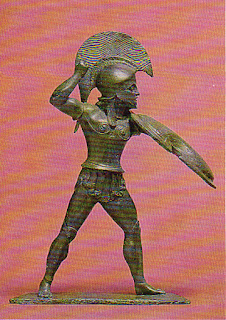
Sulpture found in Sparta dating from the early 5th century BC. Although spontaneously called "Leonidas" by the Greek workers on the site, the helmet is not the cross-crest of the Spartan kings and so probably depicts an ordinary Spartan hoplite of the period rather than the king himself.
What this means is that once Leonidas decided to stay and die – as he no doubt believed was his destiny based on the oracle from Delphi – his body guard had no option but to stay with him. There is anecdotal evidence recorded by Plutarch that Leonidas tried to save some of his companions by asking them to deliver dispatches, but the “older men” saw through him and refused. This is consistent with a king determined to face his destiny, but distressed by the knowledge that his decision will drag three hundred of Sparta’s finest with him.

The erection of two separate monuments and the epitaph makes sense in this context as well. Leonidas was the lion, who decided to go down fighting defiantly rather than live to fight a another day. After he had made that courageous decision, however, his bodyguard had no choice and for them, therefore, they lay buried in a foreign pass not as particular heroes but simply “in obedience to the laws.” 


Experience Spartan Society more closely in my  Leonidas' Trilogy:


Buy Now!                                         Buy Now!                                       Buy Now!

Saturday, December 1, 2012

How Do You Live At War?

The following review of "A Peerless Peer" was post posted on amazon.com by "Thomas E." October 28. Thank you, Thomas, wherever you are!
Amazon Verified Purchase
This review is from: Leonidas of Sparta: A Peerless Peer (Kindle Edition)
Doctor Helena P. Schrader is an accomplished historian and author of both non-fiction and fiction books. She also owns land in what was once known as Laceadeamon, or Sparta and writes about the place as if she can visualize it -- outside her front porch. In this, the second entry in her trilogy on Leonidas, she again hits the mark and builds even further upon what was a stellar entry in Leonidas of Sparta: A boy of the Agoge.

The first book took us through the early years in the life of Leonidas, focused as the title would indicate, largely on the agoge and the various rituals and training regimes that young men in Sparta underwent. It also let us know how romance and family relations in the city functioned, and how the perioiki and helots worked into this social system and structure. Now Leonidas is a grown man, a member of a mess, and a soldier in the army. He has taken it as his mission to become the "Peerless Peer" that the title aludes to, and we are given the opportunity to understand how a man could grow into one who would willingly sacrifice himself for his country.

We are given opportunity to see how the vaunted army functions, and how the kleros that maintains Spartan society actually works. For a city that strove towards an idyllic distribution of property that would make everyone equal, Schrader lays bare how one cannot legislate against greed and the machinations of the human spirit to protect ones family and build one’s own assets. There are villains and there are saints in Sparta, and Leonidas encounters them all.

The system of two kings is a recurring issue as well, in how it affects what is never more than a small city. The fact that Sparta was not always on a war footing comes up, and how families dealt with fathers, who basically were never around until they hit the age of thirty. It is a history book wrapped around a story that touches upon all the facets of the ancient world that one does not think about when envisioning such a place, but which make that place a real location that we visit through her writing. This is outstanding work, and we can all only hope that there is more to come.

Sunday, July 1, 2012

With it or Upon it -- Reassessing Spartan Mothers


Nothing has shaped the image of Spartan women in the popular imagination more than the alleged admonishment of Spartan mothers to their sons to return from war either with their shield or upon it. The image of brave mothers who would prefer to see their sons dead rather than disgraced has captured the imagination. Hollywood gave this supposed tradition a prominent place in the film “Three Hundred Spartans”, and Steven Pressfield eulogised Spartan mothers for this attitude in his blog on warriors. Yet there are a number of oddities about this stalwart feature of the popular view of Spartan society which suggest that it – like so many aspects of conventional wisdom about Sparta – may be a complete fabrication.

Let’s start by looking at the sources. Plutarch includes no less than seventeen “sayings” that he attributes to “Spartan women”, all of which appear to corroborate a widespread attitude among Spartan matrons consistent with the laconically expressed sentiment “with it or upon it”. In no less than three of these, fiercely patriotic mothers kill, with their own hands, cowardly sons who have failed to live up to their ideal. In others, the mothers revile their sons in insulting language – for example, suggesting they crawl back into the womb. In their mildest form, these sayings portray matrons who have lost sons in battle cheerfully going about their business rather than grieving. In two, when a mother learns of the death of a son from another male relative (in one case a second son and in the other her brother), she suggests that he (the relative) join the dead. In one, a woman is even portrayed losing five sons in battle but announcing she is glad because the battle itself was won.

Aside from the fact that undoubtedly many of these sayings are simply different versions derived from the same original source, almost all are anonymous. I am always suspicious of anonymous sources regardless of context, and this fact alone makes me question the veracity of the sayings. Admittedly, since it was considered dishonourable for a woman to be talked about, one might argue that Plutarch did not name names (or his sources didn’t) out of respect for the women involved; but that does not explain why the cowardly sons chastised or murdered by their mothers – much less the heroic sons whose deaths are not mourned – are not identified. Surely there was no reason not to name cowards and heroes, since this would shame the former and honour the latter in future generations?

In addition to the issue of anonymity, the sayings lack any kind of detail that would enable them to be dated or otherwise put into context. This likewise detracts from their authenticity. They are all vague and generic, as if they are at best apocryphal or at worst bad fiction.

But the sayings are implausible for two concrete reasons as well. First, given the fact that Sparta fought most of her battles far from home, one wonders how the sons of these patriotic matrons managed not only to break the Spartan line and flee the battle, but also to escape the wrath of their comrades and the discipline of their officers. Presumably the Spartan army had very little tolerance for cowards, so the sons had to desert from the army altogether and sneak back to Lacedaemon to seek the aid of their mothers. Here, others sources tell us, they would be treated as “tremblers” and suffer civic sanctions. This begs the question of why any Spartan who failed to do his duty in war would risk being seen in Sparta at all – and what they could possibly expect of their mothers!

Second, and even more telling against the probability that these sayings are genuine, is the simple fact that Spartans buried their dead near the field where they fell. This means that the last half of the famous saying “with it [your shield] or upon it” is utter nonsense in the context of Sparta. Sparta’s battle dead were not brought home on their shields, but as Nigel Kennel puts it in Spartans: A New History (p. 157), “served as tangible signs of their city’s ability to project power”. No Spartan mother would have been unaware of this custom.

Turning from the issue of authenticity, let’s reflect more closely on the content of the sayings. At their best, the sayings portray a soldierly ideal of “do or die” being reinforced and shared even by that one element of any society that would be most easily forgiven for not supporting it: the mothers of soldiers. Telling a son in the abstract to return victorious or not at all is certainly not unique to Sparta. Patriotic mothers have allegedly done that in every society caught up in what the women believed to be a just war.

Yet the sayings collected by Plutarch go considerably further. They portray women who are so patriotic that they rejoice at the death of their sons, or tell surviving sons to follow the example of their dead brothers. Worse, in three cases the mothers are so fanatical as to kill their sons with their own hands. Is there anything appealing, attractive, or admirable about such creatures?

The answer is no – and, I believe, that is exactly as it was intended to be. I believe these sayings did not originate in Sparta at all.

Why would the Spartans have had an interest in remembering and repeating incidents (five of Plutarch’s sayings) in which Spartan soldiers first failed to absorb the ethos of their society and then fled in the face of the enemy to run home to their mothers? These sayings, after all, don’t just portray ideologically radicalized mothers (who incidentally failed to raise their sons to share their values), but young men who singularly fail to live up to the ideal of their society as a whole. The young men who return alive have ostensibly all gone through the Spartan agoge and are members of Spartan dining clubs and soldiers in her army. And yet, according to these sayings, they still don’t live by the code. In short, these sayings imply, the entire Spartan upbringing was highly ineffective. It hardly seems reasonable that the Spartans would have an interest in recording and remembering such young men – no matter how patriotic their mothers were.

Furthermore, if the purpose was to reinforce the ethos of “victory or death”, then anonymous women and anonymous sons would have been blunt, indeed useless, instruments. How much more effective would it have been to tell how the survivors of Thermopylae (with name and patronymic) were reviled by their named mothers? If the Spartans wanted to make examples of patriotic mothers, they would have chosen real incidents from real wars and identified the brave women and their abhorrent sons by name. Nor would they have made the mistake of suggesting that Sparta’s victorious dead were brought home on their shields.

Sparta’s enemies, on the other hand, had no need for real names or real battles and no need to be particularly accurate about details (like where one buries one’s dead), because the intended audience was domestic. If the purpose of these sayings was to reinforce the “Feindbild” (the image of the enemy) – to make sure that even Sparta’s women were seen as enemies – then the more generic the stories were, the better. That way they became applicable to all times, to every battle, to every enemy soldier, to every Spartan mother.

I believe these sayings attributed to Spartan women were, in fact, enemy propaganda. They were intended to portray the women – even the “little old ladies” – of Sparta as repulsively different from normal (read: good) Athenian/Theban/Arcadian mothers, who naturally all adore their sons. The point is to depict Spartan women (always the object of horrified fascination on the part of other Greek males) as lacking even that most primeval of all instincts: the maternal instinct. Spartan mothers are shown to be unnatural, unfeminine creatures that deserve no sympathy even in their adversity. The sayings tell Sparta’s enemies that there is no need to pity Sparta’s women as one did, for example, the Trojan women. Go ahead, the sayings insinuate, kill their sons; because if we don’t kill them in battle, the abominations in female form who gave them life, the Spartan mothers themselves, will kill them when they get home.

As enemy propaganda against Sparta, these sayings had another even subtler message: namely, that Sparta’s legendary hoplites were really just a bunch of cowardly mama’s boys. Collectively these sayings suggest that Spartan soldiers, far from fighting to the death even in a hopeless situation, would run all the way home to their mothers, if only they got the chance. Why should any normal Athenian/Theban/Arcadian young man fear an army made up of a bunch of mama's boys?

As propaganda devised by Sparta’s enemies, these sayings served a dual purpose. First, they contributed to the overall image of Spartan women as repulsive, because they showed that in addition to being licentious as young women and adulterous as wives, Spartan women were heartless mothers. Second, they counteracted the legendary image of Sparta’s men as the spiritual descendants of Leonidas’ legendary band of 300, ready to fight tooth and nail even in a hopeless situation.

As propaganda intended for a domestic audience, these sayings diminished fear, bolstered courage, and undermined any sense of identification with the foe. And as such, they tell us something about Sparta’s enemies and their need to counter awe of Sparta’s young men and sympathy for Sparta’s mothers. What they do not do is tell us anything whatsoever about Spartan women.

What is tragic is that so many modern readers take them at face value.

The above essay first appeared in "Sparta: Journal of Ancient Spartan and Greek History," Vol. 7, Issue 4, 2011, pp.24-26. It is reprinted here with the permission of the editors of "Sparta."

Friday, June 1, 2012

Sparta's Self Confident Citizens


The Spartan Assembly is often portrayed as a body of dumb, possibly illiterate, automatons, a rubber stamp for the decisions of the Kings, Gerousia and ephors.  This view of the Spartan Assembly is based on constitutional provisions that appear to have restricted debate, the absence of secret ballots, and the assumption that Sparta’s notoriously obedient soldiers would “take orders” in the Assembly just as they did on the battlefield. 

However, as any officer can tell you, the best soldiers are not automatons who wait for orders, but thinking, self-confident men who take the initiative and act without – or even against – orders if necessary.  Furthermore, the famous case of Amompharetus refusing to obey Pausanias’ orders on the eve of the Battle of Plataea is a dramatic case in point demonstrating that Spartans didn’t always obey orders – not even on the battlefield.  It further highlights the fact that commanders in the Spartan army did not command obedience:  Amompharetus was not, after all, summarily executed or even relieved of his command. Instead, Pausanias tried to reason with him and finally ordered the rest of the army to move out. Last but not least, Sparta had sufficient confidence in the judgment of its individual commanders to repeatedly send men of “ordinary” status out act as advisors to foreign powers, such as Gylippus in Syracus.

Second, the Assembly had real powers, officially more than the kings.  The Assembly elected the ephors every year and members of the Gerousia whenever vacancies occurred due to death. Hence men with political ambitions had to lobby and ensure a majority of votes against rivals. Also, according to most interpretations of the Great Rhetra, the Assembly had “the final say” on legislation.  The Assembly forced more than one king into exile (e.g. Cleomenes I, Leotychidas, Pleistoanax) and could condemn commanders who exceeded instructions such as Pausanius and Phoebidas.  Thus, despite the inability to introduce legislation and the public nature of the vote, the Spartan Assembly did exercise real power.

Most important, however, the Spartan Assembly was made up of her soldiers and her soldiers knew that they represented the might and power of Sparta. A body in which a large minority was composed of virile young men, in peak physical condition, who have been raised to think of themselves as the elite is unlikely to have been docile. The men who were to be officers and admirals, magistrates, governors, ambassadors and military advisors around the world rose through the ranks of the army – and all had a voice (and probably a following) in the Assembly. Even if some citizens were indifferent to politics and willing to do what others advised, in every generation there would have been ambitious young men willing to challenge existing authority.  Certainly the Assembly as a whole could be quite rowdy as the example of the Assembly (“the Spartans” – not the ephors or Gerousia) throwing the Persian emissaries of Darius down a well demonstrates.

What the above suggests is that Spartan citizens were anything but mindless automatons manipulated by their officers and political leaders, but self-confident citizens with a highly developed sense of their own power and confidence in their own capabilities and judgment.  Sparta’s citizens were not docile or mindless pawns, but thinking and responsible citizens – every bit as confident that their voice in politics mattered as were the citizens of Athens.  The differences between Athenian and Spartan democracy were many, and both were imperfect from the modern standpoint, but the Spartan citizen’s individual status within his polity should not be denigrated.