Find Out More

Find out more about Helena P. Schrader's Sparta novels at: https://www.helenapschrader.com/ancient-sparta.html
Showing posts with label Spartan Society. Show all posts

Wednesday, June 5, 2024

Debunking Myths: A Nation of Thieves

Every scholar of Sparta knows Xenophon’s descriptions of how Spartan youths and boys were kept hungry so they would learn how to steal and were punished only for being caught rather than for theft itself.  Credible as Xenophon generally is, his commentary on this aspect of Spartan society is very questionable.
 
Admittedly, a nation of thieves may well fit Athenian views about their enemy.  The French referred to the English as “perfidious.” Americans and Soviets routinely attributed treachery to each other throughout the Cold War. The Israelis and Arabs have no end of adjectives to describe the deceitful character of the other side. Rather like calling your enemy’s men “fags” and their women “whores,” attributing sly dishonesty and immorality to the enemy is standard fare in propaganda wars regardless of culture or century.

A nation of thieves does not, however, fit well with a society that even her enemies considered remarkably stable and orderly. How do you keep a society orderly, if the entire male population between the ages of 7 and 20 are actively encouraged to steal? More important, how do you keep an economy functioning at the high levels of efficiency needed to finance a brutal, 30-year war if every farm, shop, house, workshop, and warehouse must be locked and guarded against hoards of desperate, half-starved youth? There are thieves in every society, but high levels of crime are one of the most destructive factors to social stability and political credibility. 

Admittedly, the theft of food alone might not be so devastating to an economy as the theft of all goods, but the accounts usually cited, supplemented with details such as the absurd story of a youth caught stealing a fox (which is not on anyone’s menu), suggest that theft as such was encouraged. It is this picture of Spartan youth which dominates modern portrayals of Sparta.

To his credit, Anton Powell, in his article “Dining Groups, Marriage, Homosexuality,” in Michael Whitby’s Sparta, notes that “theft offended against two ideals of Spartan society: obedience and respect for elders.” (Sparta, p. 102). However, rather than questioning if Xenophon’s account is accurate or complete, Powell tries to argue that the military benefits of teaching youth stealth and deceit outweighed the disadvantages of corrupting their morals.   

The problem with this argument is that such skills were conspicuously not necessary to the phalanx warfare at which Sparta excelled. Powell attempts to make a connection between guerrilla warfare and the custom of theft despite the fact that Thucydides states explicitly that prior to the Pylos campaign the Spartans had little experience of brigandage. Unable to square such a statement with his own image of Sparta, Powell hypothesizes a long history of (completely unrecorded!) helot revolts in which the Spartans learned guerrilla warfare – and so needed training in theft and stealth, but which Thucydides and Herodot knew absolutely nothing about.   

Admittedly, the kryptea was an organization in which the skills of deceit and theft would have been useful, but we are told that only selected Spartan youth ever served in it, not all of them. Furthermore, as Dr. Nic Fields so significantly pointed out, Sparta probably did not have that repulsive institution unit until after the helot revolt of 465.  There is, in fact, no credible indication whatsoever that Sparta had to deal with helot revolts of any kind prior to 465 – unless one counts the Second Messenian War as a major “helot” uprising. Taken all together, the evidence suggests that both helots and perioikoi prospered throughout the archaic period.

Rather than inventing unrecorded wars, I think it makes more sense to examine the presumption that Spartan youth were encouraged to steal.   It is far more likely, as Nigel Kennel argues in The Gymnasium of Virtue, that if Spartan youth were encouraged to learn stealth and theft at all, it was only in a very limited and restricted context, and/or only after the degeneration of Spartan society had set in in the mid-fifth century BC. 

The first book in my Leonidas Trilogy depicts the Spartan Agoge based on what we know about Spartan society as a whole and common sense. 

https://www.amazon.com/Leonidas-Sparta-Helena-P-Schrader/dp/1604944749/ref=sr_1_1?s=books&ie=UTF8&qid=1466242903&sr=1-1&keywords=a+boy+of+the+agoge


Wednesday, March 13, 2024

The Perioikoi

It is one of the ironies of recorded history that we generally know much more about the tiny, ruling elite in any society than about the masses that actually composed it. Thus we know about the lives and loves of medieval kings, but little about the peasants that represented more than 90% of their subjects. Likewise, Lacedaemonian history is dominated by the tiny class of Spartiates, albeit a great deal has also been written about the allegedly unjustly oppressed helots. The segment of Lacedaemonian society that has received the least scholarly attention is the “middle class” – the perioikoi. 

The lack of modern literature on the perioikoi is undoubtedly a result of the lack of historical and archeological information about this segment of Spartan society. The fact is, we know almost nothing about them -- not their origins, their history, the density of population, their laws or the nature of their relationship with the ruling Spartiates or their relationship to helots.

The lack of archaeological finds has led some historians to hypothesize that they were an essentially rural population, hardly better off than the helots themselves. Yet the very fact that they provided hoplites in at least equal numbers as the Spartiates casts serious doubt on this conclusion. I would also note that the archaeological finds in Sparta itself hardly reflect the might and wealth that we know Sparta enjoyed. For whatever reasons, the existing archaeological evidence from Lacedaemon is an incomplete, indeed inadequate, reflection of the society that inhabited the region in the 7th to 3rd Centuries BC.

John Chadwick in “The Mycenaean World" claims that the Mycenaeans found a native population on the Peloponnese, which they subjugated. When the Dorians invaded, they conquered the remnants of the Mycenaeans. This sequence of events might explain the three class system in Lacedaemon: the helots were the original inhabitants already reduced to serf-like status by the Mycenaeans, and the Mycenaeans became the perioikoi after the Dorian invasion. All three groups were essentially ethnically distinct and status depended on who had conquered whom. The situation appears to have been stable until the Spartans invaded Messenia and subdued another Dorian population. But all this is speculation.

Yet, while we know almost nothing about the perioikoi, we can infer a great deal. We know, for example, that in the later years of the Peloponnesian war, perioikoi hoplites were fully integrated with Spartan units – and that implies comparable levels of training, equipment and above all trust. While the enemies of Sparta (and modern commentators) make much of the hostility of the helots to Spartiate rule, the loyalty of the perioikoi is rarely questioned – or mentioned, despite its significance. 

We also know that Sparta had a fleet but that Spartiates had virtually no opportunity to gain the extremely complex knowledge necessary to build and sail ancient vessels. We know that Spartiates were prohibited from pursuing any profession other than that of arms and civic service, yet Lacedaemon had extensive international trade. We know further that Lacedaemon produced and exported timber, pottery, and bronze works. It had mines and quarries, and, of course, every kind of craft necessary to daily life in the ancient world from carpentry and metal working to tanning and basket-weaving. Who provided the manpower and the know-how for all these various industries, if the Spartiates were prohibited and the helots were working the land?

The logical answer is the perioikoi. Furthermore, by ascribing to the perioikoi these various urban professions generally held by citizens in other Greek cities, we quickly see a way in which the perioikoi could have been both integrated and co-opted into Spartan society despite their undeniable second-class political status. The Perioikoi had no voice in Spartan policy and yet were expected to risk their lives side-by-side with the Spartiates. It hardly seems credible that they would have accepted this situation for long – particularly in the bad years of the Peloponnesian War – if they had not enjoyed other benefits.

The financial benefits of a monopoly on industry and trade throughout the rich territory of Lacedaemon could be such an incentive. The very restrictive nature of Spartan citizenship, which confined Spartiates to the army and civic duties, opened immense opportunities for the perioikoi to enrich themselves. Even if completely excluded from land-holding (which to my knowledge they were not, but which might have been the case when the Spartiate population was expanding in the archaic era), there would still have been ample opportunities to not only earn a living but make a fortune as well. The experience of other societies shows that a manufacturing and trading middle-class can indeed prosper even when politically disenfranchised (see, for example, Medieval France). This, I believe, is the key to perioikoi loyalty and the essential character of the Spartiate-Perioikoi contract.

While Spartiates reserved political power to themselves and evolved a culture that disdained the public display of wealth; the perioikoi traded political enfranchisement for the dual benefits of economic freedom and security. Behind the shields of Sparta’s incomparable army, the perioikoi were free to enrich themselves for generations. Only after Sparta fell into decline and her citizen ranks grew too thin to guarantee the protection of Lacedaemon did the Spartiate-Perioikoi contract begin to unravel. The decline of Spartiate population forced an increasing dependence on perioikoi troops, which put perioikoi at ever greater risk. As long as Sparta was winning wars, that might have been acceptable, but once Sparta was defeated at Leuktra a perpetual disenfranchisement of the periokoi became untenable. Throughout the archaic period, however, the division of labor between Spartiate and perioikoi appears to have worked admirably.


Perioikoi play an important role in both A Peerless Peer and A Heroic King:


 BUY NOW!


                                                        BUY NOW! 

Wednesday, January 3, 2024

Time to Reconsider Sparta?

Ancient Sparta is widely perceived today as a militaristic and insular society. Most people believe it lacked intellectual, cultural and artistic achievements. Images of brutal discipline, pederasty and illiterate, brutish citizens ruthlessly oppressing their subject peoples dominate modern depictions of Sparta. Yet modern scholarship does not support these popular images or interpretation of Sparta society.
 

Plutarch argued that "devotion to the intellect is more characteristic of Sparta than love of physical exercise," and the evidence is that literacy was higher in Sparta than any other Greek city - if only because all Spartan women as well as their brothers and husbands enjoyed public education that included literacy. Pausanisus recorded hundreds of monuments, temples and public buildings worth visiting in Lacedaemon. Spartan sculpture and Spartan bronze works were admired throughout the ancient world, and Spartan pottery was an export commodity throughout the 6th century BC. Spartan festivals attracted large numbers of tourists because of the high quality of the musical performances and the dancing provided by both men and women's choruses.

In the archaic period, Sparta was also anything but insular. It was the city to which other Greek cities and even foreign powers turned for assistance. Its diplomats travelled to the courts of Persia and Egypt. Its goods were sold throughout the ancient world.

Furthermore, in no other city-state did women enjoy so much freedom and status. Not only did girls get fed the same food as their brothers (in contrast to girls in other Greek cities who were denied the same diet), they were allowed to exercise and go to school, unlike the girls elsewhere. More significant still, they were not married as frightened children to strangers, but rather married after they were sexually mature to men only slightly older than themselves, and who they would have known all their lives. Most important of all, they had control of the family estate from which their husbands derived citizenship. Economic power has always conferred status, and while Athenian women could own no property and inherit no land, Spartan women could do both in addition to managing their husband's estates, thereby excercising effective control over Sparta's agriculture.

The Spartan economy was also unique because it was the only economy in ancient Greece not dependent on chattel slaves. Instead of human chattels, the Spartan economy was in the hands of freemen called "perioikoi" and serfs called "helots." The perioikoi had their own cities, laws, customs and, except for being subordinate to Spartan foreign and military policy, lived without interference or restrictions on their freedom. Indeed, because Spartan law forbade its citizens from pursuing any profession except that of arms, the perioikoi had a monoply on all the lucrative manufacturing and trading sectors of the Lacedaemonan economy from the tin mines and quarries to timber, dye production, construction, bronze-working, pottery etc. They could accumulate fortunes and display their wealth without restriction. The helots, while less free than the perioikoi and Spartan citizens (Spartiates), were by no means as badly off as chattel slaves. They retained half of the production of the estates on which they worked. This they could dispose of as they wished, which enabled many helots to accumulate substantial wealth. More important, they could not be bought or sold, and they could marry and have families of their own. Chattel slaves were the sexual property of their owners, could not marry and their children were the property of their masters.

In short, Spartan society was far more complex than modern literature or films suggest. My website "Sparta Reconsidered" (https://spartareconsidered.com) provides a series of essays on different aspects of Spartan society. There is also a list of sources and recommended reading.

This blog is intended to be a supplement to that website, providing an opportunity for interaction with others interested in ancient Sparta and particularly those willing to set aside conventional stereotypes and look deeper into what Sparta really was.
 

Sunday, June 1, 2014

Spartan Fraternities and Spartan Families

Observers of ancient Sparta noted the peculiar Spartan custom of dinning clubs or syssitia at which adult Spartan citizens were required to share their evening meal.  These clubs were viewed as one of the key features of Spartan society that distinguished it from all other Greek cities. The Spartan dining clubs were considered peculiar in the ancient world because: 1) they had fixed membership (for life), and 2) they were a compulsory pre-condition for attaining citizenship and failure to make the designated fixed contributions to the mess could cost a man his citizenship.
Yet while the fact of these ancient fraternities is well established, the reason(s) the Spartans instituted and maintained this peculiar tradition is controversial. A large number of theories have been put forward over time including the desirability of men of different age cohorts dining together (so that young men would learn respect and benefit from the wisdom of older men) to the conscious desire of the Spartan state to weaken family ties.

This later thesis is put forward forcefully by Anton Powell, for example, in his contribution to Michael Whitby’s Sparta. Powell argues that totalitarian states, recognizing the influence of the family as inherently inimical to state control, have consistently tried to break down family ties. He cites examples from National Socialist Germany, although Soviet Russia and Communist China both provide much more compelling examples of anti-family policies designed to undermine family structures and influence.
The problem with the comparison between 20th Century totalitarian states and Sparta is two-fold. First, whether Nazi Germany or Communist China, these anti-family societies were consciously revolutionary. The reason they sought to undermine the family was because they recognized families as inherently conservative. Yet Powel himself stressed the fundamentally conservative nature of Sparta! If Sparta was essentially conservative, than no institution was better designed to reinforce conservative values than the family. The experience of 5,000 years of history supports this fact. It is when family structures break down that societies become most vulnerable to change – not the other way around.

The other problem with Powell’s thesis is that men eating one meal together at a club is hardly a good way to undermine family structure! It may be a modern truism that “families that eat together stay together,” but also a fact that most men in the Western world today also eat at least one meal away from their families. The most common pattern in Western industrialized societies is for men (and often women) to eat the mid-day meal away from home among their work colleagues rather than their family. Why should it be more destructive of family life to eat the evening meal away from home than the morning or mid-day meal? In many, particularly agricultural societies (such as ancient Sparta) it is the mid-day, not the evening meal, that is most important. 
I do not think there is any evidence to suggest that full Spartan citizens (31 years and older) did not eat the morning and mid-day meal with their families.  On the contrary, given the intimacy of Spartan society, I think it is very likely Spartans ate both breakfast and dinner (mid-day) with their families, and went to the syssitia in the evening for what was essentially a light supper. 

Certainly, as all accounts agree, Spartan men returned from the syssitia to their homes (or barracks) sober before it grew too late. Furthermore, syssitia were not noted for the entertainment of flute-girls and courtesans, unlike the tradition of Athenian symposia.  At the latter, men allegedly caroused together until the dawn and then staggered home drunk after indulging themselves with prostitutes both male and female. From a wife’s point of view, the Spartan custom of syssitia was infinitely preferable to the Athenian symposia, and in consequence it is arguable that the syssitia did far more to strengthen family life than to disrupt it.

Thursday, May 1, 2014

Missing Mothers -- The Cause of Sparta's Decline?

The dramatic decline in the Spartiate population between Thermopylae (480 BC) and Leuktra (371) has often been cited as the cause of Sparta’s political decline as well. At Thermopylae, a full call-up of all citizens over the age of 20 and under the age of 55, enabled Sparta to field an army of 6,000 citizens (Spartiates) – not counting perioikoi or helots. Yet at Leuktra, when again there was a full call-up of 35 age cohorts, the Spartan army consisted of only 700 citizens.

This dramatic decline in manpower was not only a serious disadvantage on the battlefield, where Sparta’s enemies could deploy (as they did at Leuktra) forces 50 deep to Sparta’s 12-man-deep line, it was also a disadvantage in economics and politics.  Because, evidently, the subject population of perioikoi and helots was not declining at the same rate, a shrinking ruling class of Spartiates was trying to dominate an ever larger body of disenfranchised inhabitants. Like apartheid, regimes dominated by too tiny elites generally collapse sooner or later. This is the reason Sparta’s population decline has long been a focus of scholars.

While some scholars (e.g. Chimes (1)) have questioned the magnitude of the decline, most accept the numbers and prefer to concentrate on blaming the Spartans for their problems.  Aristotle, of course, blamed Sparta’s women for everything since they could inherit property, and women are, according to him, inherently greedy, grasping and irrational. Hodkinson (2) ran demographic models to demonstrate how female inheritance leads to concentrations of wealth over seven generations. Other historians focus less on how wealth became concentrated in a few hands and more on the fact that as increasing numbers of Spartans lost their citizenship due to poverty, the Spartan state failed to respond adequately to the resulting crisis by opening the citizenship ranks. 


In short, the Spartans, due to their abnormal laws (female inheritance and polyandry) and their fanatical and irrational adherence to these laws, are to blame for their own decline. But as Figueira (3) has pointed out, Sparta’s population was growing or at least stable throughout the archaic period.  Either the laws on female inheritance and polyandry did not exist in the archaic period, or they cannot be made responsible for the decline in Sparta’s population in the classical.

The Great Earthquake of 464, on the other hand, is an event which allegedly took 20,000 lives in Sparta alone, and its role in Sparta’s decline needs to be re-examined. The accounts of the earthquake are nothing if not dramatic. Pliny claims only five houses were left standing, and there are less credible tales of youths surviving because they ran out of a gymnasium to chase a hare, while the army was saved by being marched out in time. While the details may be hard to credit, I think it is safe to say the earthquake was catastrophic without, notably, impacting the strength of the army. 


Meanwhile, while some historians dismiss the ancient accounts as incredible, Hodkinson goes to the other extreme of dismissing “modern guesswork” about women and children being more heavily impacted by the earthquake simply because it is not mentioned in ancient sources. Given the misogynous bias of our ancient sources and the focus of most ancient accounts on Sparta’s military strength, I have no problem using common sense in the absence of a specific reference. Ancient sources rarely mention women or children in any other context either!


Following Figueira’s overall thesis that the Great Earthquake was the catalyst that set off a chain reaction ending in Sparta’s decline, I’d like to suggest that the impact might have been even more dramatic than Figueira contends.  My thinking is as follows: If  – as is reasonable – women and young children were killed in disproportional numbers, then the size of the Spartan army would not been seen to decline for almost thirty years.  This is because the youth of the agoge were not disproportionately affected, so youths would have continued to graduate from the agoge and fill the ranks of the army for at least 14 years after the earthquake. Thereafter, for at least another 10 to 15 years, it would have been easy to maintain front-line strength by retaining men who would normally have gone off active service, i.e. by increasing the number of reserve age-cohorts on active duty.  Only when the age of the reservists made it unpractical to retain them, would the dramatically reduced numbers of graduates from the agoge become evident in the army.

The number of children entering the agoge, on the other hand, would have declined dramatically in the first seven years because of the children killed outright and thereafter because of the missing mothers -- or more acutely, the missing wives. The men already married, who marched to safety, would have lost their wives, while the youth in the agoge would have lost their future brides.  Obviously, some women survived, but if the number of surviving women was significantly disproportionate to the number of men, then the situation might have fostered the introduction of polyandry. It is significant that polyandry is not mentioned in Herodotus. The hypothesis of disproportionate casualties among women, maidens and girls would help explain not only the population decline of the second half of the 5th Century but also the evolution of such a peculiar custom for this part of the world at this period.

The shortage of Spartiate women would also explain the emergence of new-classes of quasi-citizens such as mothakes/mothones, nothoi, and neodameis. If there was a shortage of Spartiate female sexual partners following the earthquake, it would be only natural for the men, particularly the bachelors, to take perioikoi, helot or even foreign women – if not to wife – at least to their beds. They would then, particularly in face of the increasingly acute military manpower shortage, have had a strong interest in seeing the sons of these unions educated and at least partially integrated into the system. The fact that none of the above terms is found in reference to pre-earthquake individuals suggests to me that such classes of quasi-citizens either had not existed before or had not existed in sufficient numbers to be worthy of mention.

All in all, the thesis of “missing mothers” seems to explain more about Sparta’s decline in the later 5th Century BC than any other theory I have seen put forward.

(1)    K.M.T. Chimes, Ancient Sparta: A Re-Examinaton of the Evidence, Manchester University Press, Manchester, 1952.
(2)    Stephen Hodkinson, Property and Wealth in Classical Sparta, The Classical Press of Wales, London, 2000.
(3)    Thomas Figueira, “Population Patterns in Late Archaic and Classical Sparta,” Transactions of the American Philological Association 116 (1986), pp.165-213.


Wednesday, January 1, 2014

Sparta Lost and Found

Unlike Athens, that remained inhabited from the archaic period to the present day without interruption, Sparta was not only defeated and humiliated, it was destroyed by earthquakes, flooding and ultimately abandoned. When the Franks and the Ottomans came, there was not even a village to mark the site of Ancient Sparta.

Equally devastating was the lack of a Spartan literary tradition. A society that placed value on silence and brevity did not produce historians or play writes, and while Spartan philosophers were admired throughout the rest of the ancient world, they preferred an oral to a written tradition.

The combination of these factors, a lack of a written record, the dispersal of any inhabitants that might have kept an oral tradition alive and the physical destruction of the city, left subsequent generations with an image of Sparta that derives entirely from the accounts of outsiders. Many commentators on Sparta, even in ancient times, had never been there – or at most visited briefly. Some, like Xenophon, knew Sparta relatively well, but remained fundamentally Athenian. Trying to understand Sparta on the basis of the accounts of Athenians and Romans is like trying to understand Africa from the reports of Victorian explorers.  It won’t get you very far.

Our images of Sparta, the city, are dominated to this day by what we have been told about Sparta and Spartans by these visitors from a different culture. Even someone who has never studied Sparta or read a single book about it has images of Sparta that have been transmitted through our language alone.  “Spartan” is an adjective used to denote “severe,” “plain,” and “austere.” Laconic speech is “terse,” “concise” and “economical.” The most rudimentary and fleeting brush with Sparta in literature will not be without reference to rigid discipline, disdain for luxury, self-sacrifice and endurance of hardship.

The more a novice looks into Spartan society, the quicker he/she is confronted by references to a childhood of deprivation in which one had to steal to get enough to eat and was allowed only one garment per year. The boys, we learn, had to cut down the river reeds with their bare hands or the help of a tool which is dismissed as practically worthless, and then sleep upon these instead of real beds. Worse, they had to live practically in the wild, exposed to the elements without shelter or proper clothes.  Books like Gates of Fire describe horrendous beatings to which Spartan boys were apparently subjected for any tiny infraction of the rigid rules of acceptable behavior.

Nor are youths the only Spartans whom, we are led to believe, suffered deprivation. This was a society, according to most sources, where women were prohibited from wearing jewelry or even taking pride in their weaving. Indeed, all gold and silver was banned, and so could adorn nothing - not even the temples of the Gods.  The houses, we are told, were not painted (as else where in the Ancient world), and if one believes the oft quoted “sayings of Spartan kings” they did not even hew their house beams into regular square posts, but left them raw and untreated – one imagines crude timber as in a log cabin. Meanwhile, the young men lived in barracks (notoriously grim places in any society!) and for their entire lives ate their meals at men’s clubs where the cuisine, we soon learn, was infamous throughout the ancient world for its lack of sophistication and variety.

Such a society is most readily imagined in an austere, plain, indeed barren, landscape.  After all, a society characterized by deprivation of food, clothes, decoration and fine cuisine sounds like a desperately poor society, a society barely surviving in a hostile environment, a society which has made a virtue out of necessity. It is logical to assume that the underlying – if unspoken – root cause of Sparta’s obsession with self-discipline and self-denial for the good of the community, the City, was a fundamental lack of resources that required such a rigid regime.

This assumption is reflected in modern literature about Sparta. In his best-selling novel Gates of Fire Stephen Pressfield calls Sparta “a village” adding: “The whole stinking place would fit, with room to spare, within His Majesty’s [Xerxes of Persia’s] strolling garden at Persepolis. It is … a pile of stones. It contains no temples or treasures of note, no gold; it is a barnyard of leeks and onions, with soil so thin a man may kick through it with one strike of the foot.”[i]

But there is a problem here.

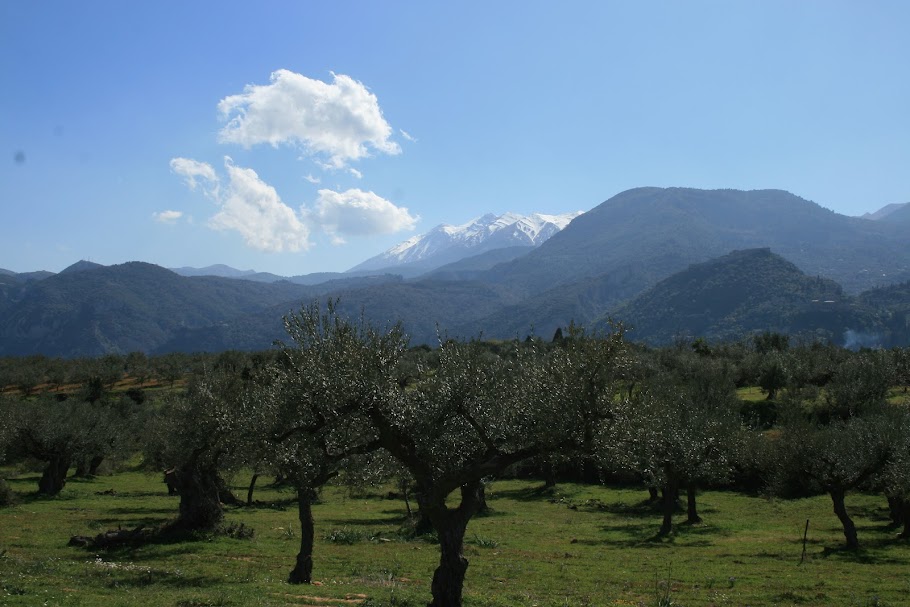
If you drive down the modern road from Tripoli (or Tegea as I prefer to think of it) toward Sparti (Sparta) there is a moment when coming around a bend you catch the first glimpse of Taygetos. I will never forget the first time I encountered that view: it took my breath away.  I could hardly concentrate on the winding road for straining to get another glimpse of those spectacular, snow-capped mountains. And when the valley of the Eurotas was spread out before me it was like revelation. My image of Sparta – Ancient Sparta and all that Sparta implied – was transformed in a single instant.

The valley of the Eurotas is anything but barren! It is quite the reverse. It is green and fertile and stunningly beautiful - like riches cupped in the hands of the gods. From the blooming oleander to the wild iris, the valley is a garden. The orange orchards stretch as far as the eye can see, brazenly advertising not only the abundance of soil and sun but water as well. Most spectacular of all, the Eurotas valley is one of those few places on earth that offers the sensually stimulating sight of palm trees waving against a back-drop of snow-capped mountains.

Has Laconia perhaps changed dramatically in the last 2,500 years? Was it poor when the harsh, economical, self-disciplined Spartan society took root in its – then – sparse and almost barren soil?  Does it bloom now artificially because of modern fertilizers and irrigation?

If we are to believe the ancient historians, no. Herodotus speaks of Sparta’s “good soil”[ii] or Thucydides describes the entire Peloponnese (with the exception of Arcadia) as the “richest part of Hellas.”[iii] It is when speaking of Athens, that Thucydides draws attention to “the poverty of her soil.”[iv]

So the fertility and abundance of the valley has not changed since Ancient times any more than the shape of Taygetos beyond. But if this rich valley was the seat of Sparta, then Spartan austerity and deprivation did not come from necessity! Sparta’s land was rich, fertile and productive enough to enable the highest standard of living available in the ancient world – at least to the always modest number of elite Spartiates. In short, if Sparta was as austere a society as it is depicted in modern times, then that austerity was self-imposed.

But is it reasonable to imagine that a people raised in the midst of wealth and beauty had no appreciation for either? Or is the very austerity of Spartan society as mythical as the thin soil of Pressfield’s Sparta?
Maybe our images of a rigid, harsh and brutally disciplined society is also a distortion? A fractured image? A misunderstanding based on ignorant, or prejudiced foreign reporting? Imagine what American society looks like through the eyes of the Taliban!

It's because I firmly believe that modern images of Sparta a largely based on inadequate, hostile and sometimes purely fanciful source material that I have dedicated this blog and my website “Sparta Reconsidered” to questioning common assumptions and misconceptions about Sparta.


[i] Pressfield, p. 188
[ii] Herodotus, Book I.66, p.26.
[iii] Thucydides, Book I.2, p.36.
[iv] Ibid.
[v] Nicastro, p. 67
[vi] Pausanias, III.10. p. 37.

Saturday, August 3, 2013

Spartan Dress and Spartan Dandies

Spartan dress and decoration differed from that of the rest of the Greek world sufficiently to provoke comment among ancient observers.  At the same time, Spartan dress remained essentially Hellenic.  The Spartans did not wear clothing fundamentally different from other Greeks, they were simply more conservative in the adoption of new styles, meaning that they retained archaic fashions, such as the peplos and long hair for men, long after Greeks from other cities had adopted new fashions.  When one considers the fact that new fashions were introduced primarily from Persia and Macedonia, than it is fair to say that Spartan dress was more purely “Greek” or “Doric” than the fashions of Athens.


The most obvious example of the conservative character of Spartan dress was the preference of Spartan women for the old-fashioned peplos, even after Greek women elsewhere had adopted the long chiton.  The peplos is the robe worn by almost all archaic kore, and these archeological models refute modern allegations that Spartan women went around in short skirts like Amazons. The ancient complaint that Spartan women were “thigh-throwers” did not refer to skirts or chitons so short they revealed a woman’s thigh, but rather to the fact that a woman wearing a peplos was very restricted in her movements – unless the side seam was opened to above the knee. Thus, while Athenian women in their looser cut long chitons could walk vigorously without revealing their legs, their Spartan sisters always showed some leg when they walked.  The characteristic Spartan bronzes that show a girl in a short skirt running or dancing do not depict mature Spartan women but rather girls; the most likely interpretation is that they depict girls in the agoge, and as such girls before puberty.


Another typical Spartan fashion that dated back to at least the archaic age was for men to wear their hair long. However, modern depictions of Spartans as shaggy, unkempt men with scrawny, chest-long beards and wild, tangled hair hanging to their shoulders (alà Richard Hook’s illustrations in Osprey’s The Spartan Army) are not supported by ancient sources. A statue fragment found in the heart of Sparta and dating from the early fifth century (commonly – or affectionately – referred to as Leonidas) shows a man with a clipped beard and neat hair. Earlier archaic artwork unanimously shows men with short beards and long, but very neat, “locks” of hair. (Note, for example the hoplites on the magnificent frieze of the Siphnian Treasure at Delphi dating from Leonidas’ lifetime, the Krater of Vix and other figures of known Laconian origin displayed now in the Museum of Ancient History in Berlin or pictured in Conrad Stibbe’s Das Andere Sparta.)


Likewise, I reject emphatically descriptions such as those of Otto Lendle, who describes Spartans as stinking, filthy and slovenly. These images likewise contradict the historical record and existing archeological evidence. Herodotus makes a great point of how the Spartans groomed themselves before Thermopylae, for example, and no one would be tempted to stress the beauty of Spartans  -- as Plutarch explicitly does -- if they had been repugnant for their lack of grooming and cleaning. Plutarch also claims Spartan men took particular care of their hair especially in the face of danger, and refers to an alleged quote from Lycurgus that long hair was preferred because it rendered a handsome man better looking, and an ugly one more frightening. 
The later quote suggests, of course, that while a handsome man might have groomed his hair assiduously, an ugly man might have consciously ratted his, but this hardly makes sense if one considers the need for a man to wear a helmet, as all Spartans did until they had reached the age of 61.  It is more likely to refer to the fact that hair braided back from the forehead tends to give the face greater prominence than a crown of curls such as other Greeks wore in the classical period.  Thus, while both a handsome and an ugly Spartan wore their hair neatly braided from the forehead, the effect was to highlight the good features of the former and the bad features of the latter. I would note further, that anyone familiar with African hair braiding knows that a great deal of variety, and so different effects, can be achieved without breaking the fundamental concept of long hair, neatly braided from the forehead. I like to imagine that Spartan dandies shocked and irritated their conservative elders by obeying the letter of the law (long, neatly groomed hair) while nevertheless developing individual styles.


I would also like to note that no ancient source claims that Spartan women did not adorn themselves.  On the contrary, in Euripides’ plays and Aristotle’s political commentary both, Spartan women are despised and castigated for being exceptionally vain, luxury loving and self-indulgent. Thus, while Spartan men are portrayed as (stupidly) restrained and austere, Spartan women are loathed for being even more fond of self-adornment than Athenian women, who are themselves viewed as excessively fond of cosmetics, perfumes and jewels.
This suggests that even if, as some argue, Spartan laws prohibited not only the use of gold and silver currency but also gold and silver objects d’art, than Spartan women found other means of adorning themselves. One option would have been to make jewelry from other materials – ivory, copper, bronze, lapis lazuli, jade, coral, amber etc. etc.  In addition, the garments could have been decorated with bright colored embroidery or borders with beads of bronze, copper, ivory etc. Alternatively, the peplos themselves might have been made of brightly colored fabrics.  The most precious purple dye was produced from muscles found in the Gulf of Laconia, and Lacedaemon undoubtedly exported this dye and or fabric stained with it.  Other important dyes, such as indigo, were also produced in Lacedaemon. 


Anthropology, archeology and art history show us that there is almost nothing as universal as human vanity. Throughout history and throughout the world, men and women have been astonishingly inventive in developing ways to adorn themselves and make themselves appealing to one another.  Sparta, a society far closer to our own than many others the world has known, was certainly no exception.

Wednesday, May 1, 2013

The Spartan Economy: The Role of the Perioikoi


It is one of the ironies of recorded history that we generally know much more about the tiny, ruling elite in any society than about the masses that actually composed it. Thus we know about the lives and loves of medieval kings, but little about the peasants that represented more than 90% of their subjects. Likewise, Lacedaemonian history is dominated by the tiny class of Spartiates, albeit a great deal has also been written about the (allegedly unjustly) oppressed helots.  The segment of Lacedaemonian society that has received the least scholarly attention is the “middle class” – the perioikoi. 

The lack of modern literature on the perioikoi is undoubtedly due to the lack of historical and archeological information about this segment of Spartan society. The fact is, we know almost nothing about them -- not their origins, their history, their laws, or their legal relationship with the ruling Spartiates and subordinate helots. 

The lack of archeological finds has led some historians to hypothesize that they were an essentially rural population, hardly better off than the helots themselves.  Yet the very fact that they provided hoplites in at least equal numbers as the Spartans casts serious doubt on this thesis.  I would also note that the archeological finds in Sparta itself hardly reflect the might and wealth that we know Sparta enjoyed. For whatever reasons, the existing archeological evidence from Lacedaemon is an incomplete, indeed woefully inadequate, reflection of the society that inhabited the region in the 7th to 3rd Centuries BC.


John Chadwick in “The Mycenaean World" claims that the Mycenaeans found a native population on the Peloponnese, which they subjugated.  When the Dorians invaded, they conquered the remnants of the Mycenaeans.  This sequence of events might explain the three class system in Lacedaemon: the helots were the original inhabitants already reduced to serf-like status by the Mycenaeans, and the Mycenaeans became the perioikoi after the Dorian invasion.  All three groups were essentially ethnically distinct and status depended on who had conquered whom.  The situation appears to have been stable until the Spartans invaded Messenia and subdued another Dorian population. But all this is speculation.

Yet, while we know almost nothing about the perioikoi, we can infer a great deal. We know, for example, that in the later years of the Peloponnesian war, perioikoi hoplites were fully integrated with Spartan units – and that implies comparable levels of training, equipment and above all trust.  While the enemies of Sparta (and modern commentators) make much of the hostility of the helots to Spartiate rule, the loyalty of the perioikoi is rarely questioned – or mentioned, despite its significance. 

Furthermore, we know that Sparta had a fleet but that Spartiates had virtually no opportunity to gain the extremely complex knowledge necessary to build and sail ancient vessels. We know that Spartiates were prohibited from pursuing any profession other than that of arms (and civic administration – see my earlier entry "Not Just Soldiers"), but Lacedaemon had extensive international trade. We know further that Lacedaemon produced and exported timber, pottery, and bronze works. It had mines and quarries, and, of course, every kind of handcraft necessary to daily life in the ancient world from carpentry and metal working to tanning and basket-weaving. If the Spartiates were prohibited from performing these tasks and the helots were working the land, who provided the manpower and the know-how for all these various industries?


The logical answer is the perioikoi. Furthermore, by ascribing to the perioikoi these various urban professions generally held by citizens in other Greek cities, we quickly see a way in which the perioikoi could have been both integrated and co-opted into Spartan society despite their undeniable second-class political status.  The Perioikoi had no voice in Spartan politics and yet they were expected to risk their lives side-by-side with the Spartiates. It hardly seems credible that they would have accepted this situation for long – particularly in the bad years of the Peloponnesian War – if they had not enjoyed other benefits. 

The financial benefits of a monopoly on industry and trade throughout the rich territory of Lacedaemon would have been such an incentive. The very restrictive nature of Spartan citizenship, which confined Spartiates to the army and civic duties, opened immense opportunities for the perioikoi to enrich themselves.  Even if completely excluded from land-holding (which to my knowledge they were not, but which might have been the case when the Spartiate population was expanding in the archaic era), there would still have been ample opportunities to not only earn a living but make a fortune with industry and trade. The experience of other societies shows that a manufacturing and trading middle-class can indeed prosper even when politically disenfranchised (see, for example, Medieval France).  This, I believe, is the key to perioikoi loyalty and the essential character of the Spartiate-Perioikoi contract. 

While Spartiates reserved political power to themselves and evolved a culture that disdained the public display of wealth; the perioikoi traded political enfranchisement for the dual benefits of economic freedom and security.  Behind the shields of Sparta’s incomparable army, the perioikoi were free to enrich themselves for generations.  Only after Sparta fell into decline and her citizen ranks grew too thin to guarantee the protection of Lacedaemon did the Spartiate-Perioikoi contract begin to unravel. The decline of Spartiate population forced an increasing dependence on perioikoi troops, which put perioikoi at ever greater risk. As long as Sparta was winning wars, that might have been acceptable, but once Sparta was defeated at Leuktra the perpetual disenfranchisement of the periokoi became untenable.  Throughout the archaic period, however, the division of labor between Spartiate and perioikoi appears to have worked admirably.

Perioikoi play an important role in my  Leonidas' Trilogy:


Saturday, November 17, 2012

Spartan Gifts

Did the Spartans give gifts? 

Obviously, gifts were an important feature of most ancient societies. Gifts were an important component of diplomacy, with monarchs or cities exchanging gifts as gestures of good will. Gifts were given to the gods, and to victorious athletes. Gifts were a feature of the cult of hospitality and friendship, and gifts were given to favored prostitutes and slaves. Gifts played a much more significant role in ancient Greek society as a whole than they do in ours today. 

But what about Sparta? In Sparta, after all, conspicuous consumption was disdained. Spartan laws prohibited the minting of gold and silver coins, and in the 5th Century BC, even the wearing of gold and silver was allegedly proscribed.  While there is good reason to think that descriptions of Spartan austerity are greatly exaggerated, there is no reason to think that Sparta was not comparatively less extravagant in the use of luxuries and display of wealth. 

In a society which frowned upon the display of wealth, gifts would necessarily have a different character than in a society, like Athens, where flaunting wealth was an essential component of social status and political power. For example, an Athenian Olympic victor was fed for the rest of his life at civic expense, was granted a front-row seat at all public festivals including the plays, and received other material rewards as well. Sparta's Olympic victors received only one reward: the privilege to "stand in front of their Kings in the line of battle" -- i.e. automatic membership in the elite unit, the Hippeis, or royal guard. 

In short, Spartans had the same cultural traditions of gift-giving, but very likely gave gifts that were more immaterial and practical. Personally, I picture public gifts being mostly "honors" -- prominence of place in processions or at festivals, or election to positions of prestige (committees judging the singing and dancing contests, for example) or ceremonial functions -- the Kings' cup bearer, the Kings' marshal, etc. Personal gifts were more likely to be practical things, game, honey, and other products from a man's kleros, or possibly a hunting dog or livestock. 

Gifts to women, on the other hand, were probably more conventional, things like jewelry, expensive fabrics, perfumes etc.  We know Athenians viewed Spartan women as particularly extravagant and luxury loving, and Aristotle blamed their love of wealth for the downfall of Spartan society. 

For those of us living today, however, gift-giving is a traditional aspect of the "Holiday Season," and our gift-giving is more materialistic than symbolic. So for any of you who would like to give a gift with a Spartan theme, I have created a few products. I'm just getting started, actually, but I hope you'll like one or the other of my t-shirts and mugs. You can look, select and buy online at: http://HPSDesign.spreadshirt.com or http://HPSDesign.spreadshirt.de.


Thursday, May 24, 2012

At last the real Sparta emerges!


Under the above title, Peter Spencer published the following review of "Leonidas of Sparta: A Boy of the Agoge." 

Helena Schrader has finally revealed Sparta and Spartan society as it most probably would have been. This is not the Sparta of many modern European writers, but Helena shows a society where literacy was an essential tool of all citizens (Spartan soldiers also travelled regularly as envoys and on diplomatic missions - makes it a bit hard if you are an ignorant illiterate doesn't it? Also Spartan women managed property - I wonder how they did the books and kept the good management they were famous for?), and the Agoge was more in line with a boarding school education now. Indeed even now, many Army officers I know went from an elite GPS boarding school to Royal Military College Duntroon, and then to their Regiments in a very similar progression to Spartan youth.


Now a retired Australian Army Officer, my military special study was Sparta, and it constantly annoyed me that many writers espoused a society that could not have produced either the successful and prosperous culture, or the military supremacy that Sparta had for hundreds of years. It should be remembered that for Spartan citizens, this was a genuine democracy, who the rest of Greece looked to for defence from tyrannical governments. Even Athens had sought their help here. Helena explores what the real Sparta probably was, through the eyes of a fairly modest kid, who proves to be very real and very 'normal' but who will become the only Spartan King to ever undergo the Agoge. Helena's portrayal of Leonidas as a developing personality fits perfectly with the man who will become one of the iconic 'heroes' of history.


Thank you Helena for the real Sparta, and the real Leonidas.


I can barely wait to begin book 2.


Thank you, Peter! I hope you have enjoyed "A Peerless Peer." Meanwhile, the final book in the trilogy has gone to the publisher. We're still on track to release it in September of this year.