Find Out More

Find out more about Helena P. Schrader's Sparta novels at: https://www.helenapschrader.com/ancient-sparta.html
Showing posts with label Spartans. Show all posts

Saturday, August 3, 2013

Spartan Dress and Spartan Dandies

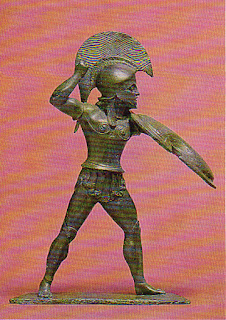
Spartan dress and decoration differed from that of the rest of the Greek world sufficiently to provoke comment among ancient observers.  At the same time, Spartan dress remained essentially Hellenic.  The Spartans did not wear clothing fundamentally different from other Greeks, they were simply more conservative in the adoption of new styles, meaning that they retained archaic fashions, such as the peplos and long hair for men, long after Greeks from other cities had adopted new fashions.  When one considers the fact that new fashions were introduced primarily from Persia and Macedonia, than it is fair to say that Spartan dress was more purely “Greek” or “Doric” than the fashions of Athens.


The most obvious example of the conservative character of Spartan dress was the preference of Spartan women for the old-fashioned peplos, even after Greek women elsewhere had adopted the long chiton.  The peplos is the robe worn by almost all archaic kore, and these archeological models refute modern allegations that Spartan women went around in short skirts like Amazons. The ancient complaint that Spartan women were “thigh-throwers” did not refer to skirts or chitons so short they revealed a woman’s thigh, but rather to the fact that a woman wearing a peplos was very restricted in her movements – unless the side seam was opened to above the knee. Thus, while Athenian women in their looser cut long chitons could walk vigorously without revealing their legs, their Spartan sisters always showed some leg when they walked.  The characteristic Spartan bronzes that show a girl in a short skirt running or dancing do not depict mature Spartan women but rather girls; the most likely interpretation is that they depict girls in the agoge, and as such girls before puberty.


Another typical Spartan fashion that dated back to at least the archaic age was for men to wear their hair long. However, modern depictions of Spartans as shaggy, unkempt men with scrawny, chest-long beards and wild, tangled hair hanging to their shoulders (alà Richard Hook’s illustrations in Osprey’s The Spartan Army) are not supported by ancient sources. A statue fragment found in the heart of Sparta and dating from the early fifth century (commonly – or affectionately – referred to as Leonidas) shows a man with a clipped beard and neat hair. Earlier archaic artwork unanimously shows men with short beards and long, but very neat, “locks” of hair. (Note, for example the hoplites on the magnificent frieze of the Siphnian Treasure at Delphi dating from Leonidas’ lifetime, the Krater of Vix and other figures of known Laconian origin displayed now in the Museum of Ancient History in Berlin or pictured in Conrad Stibbe’s Das Andere Sparta.)


Likewise, I reject emphatically descriptions such as those of Otto Lendle, who describes Spartans as stinking, filthy and slovenly. These images likewise contradict the historical record and existing archeological evidence. Herodotus makes a great point of how the Spartans groomed themselves before Thermopylae, for example, and no one would be tempted to stress the beauty of Spartans  -- as Plutarch explicitly does -- if they had been repugnant for their lack of grooming and cleaning. Plutarch also claims Spartan men took particular care of their hair especially in the face of danger, and refers to an alleged quote from Lycurgus that long hair was preferred because it rendered a handsome man better looking, and an ugly one more frightening. 
The later quote suggests, of course, that while a handsome man might have groomed his hair assiduously, an ugly man might have consciously ratted his, but this hardly makes sense if one considers the need for a man to wear a helmet, as all Spartans did until they had reached the age of 61.  It is more likely to refer to the fact that hair braided back from the forehead tends to give the face greater prominence than a crown of curls such as other Greeks wore in the classical period.  Thus, while both a handsome and an ugly Spartan wore their hair neatly braided from the forehead, the effect was to highlight the good features of the former and the bad features of the latter. I would note further, that anyone familiar with African hair braiding knows that a great deal of variety, and so different effects, can be achieved without breaking the fundamental concept of long hair, neatly braided from the forehead. I like to imagine that Spartan dandies shocked and irritated their conservative elders by obeying the letter of the law (long, neatly groomed hair) while nevertheless developing individual styles.


I would also like to note that no ancient source claims that Spartan women did not adorn themselves.  On the contrary, in Euripides’ plays and Aristotle’s political commentary both, Spartan women are despised and castigated for being exceptionally vain, luxury loving and self-indulgent. Thus, while Spartan men are portrayed as (stupidly) restrained and austere, Spartan women are loathed for being even more fond of self-adornment than Athenian women, who are themselves viewed as excessively fond of cosmetics, perfumes and jewels.
This suggests that even if, as some argue, Spartan laws prohibited not only the use of gold and silver currency but also gold and silver objects d’art, than Spartan women found other means of adorning themselves. One option would have been to make jewelry from other materials – ivory, copper, bronze, lapis lazuli, jade, coral, amber etc. etc.  In addition, the garments could have been decorated with bright colored embroidery or borders with beads of bronze, copper, ivory etc. Alternatively, the peplos themselves might have been made of brightly colored fabrics.  The most precious purple dye was produced from muscles found in the Gulf of Laconia, and Lacedaemon undoubtedly exported this dye and or fabric stained with it.  Other important dyes, such as indigo, were also produced in Lacedaemon. 


Anthropology, archeology and art history show us that there is almost nothing as universal as human vanity. Throughout history and throughout the world, men and women have been astonishingly inventive in developing ways to adorn themselves and make themselves appealing to one another.  Sparta, a society far closer to our own than many others the world has known, was certainly no exception.

Sunday, October 16, 2011

New Reviews of Leonidas of Sparta: A Peerless Peer

Excellent description of difficult period
by Brenda Miller (North Carolina), Sept. 30, 2011


Helena Schrader has done it again, amazingly. In this, her second volume in the Leonidas trilogy, she has brought an admittedly difficult period in Leonidas' life to a level of sustained reader interest. The earlier volume covering the agoge period had an easily identifiable theme and historical framework, and the last volume, which will emphasize Thermopylae, also has an identifiable historical framework to build on. It is this interim period, about which very little is actually known, where Ms Schrader shows her skills as an historical novelist. It bears repeating here that Ms Schrader does and has done, her "homework" on ancient Sparta in this period. Her research is beyond reproach and although she embellishes (as she must),she does not make up her own facts. Although my own field of Greek historical interest is a much earlier period, I know enough about 5th Century Sparta to recognize the accuracy of her descriptions. I can also state that based on my 23 years as an Infantry officer in the US Army, Ms Schrader has clearly done a significant amount of research on armies, soldiers, and what motivates them and makes them cohesive winners.

As she states in her prefaces, Ms Schrader aims to correct general opinion of Sparta as being some sort of brutal producer of robot-like ironmen. She succeeds, to the point where I and I suspect other, at least male, readers, might say that she has gone a bit too far in describing Sparta as a "touchy-feely", sensitive, place where a straight-arrow, incorruptible, nice guy, like Leonidas could even survive, much less become a King and army commander. But there is no arguing with Ms Schrader's research and if such is the Sparta she has uncovered, then so be it.My only disappointment is that I have to wait now for a seemingly interminable period for the final volume of this trilogy!

Ms Schrader has done a superb job here putting flesh on the few historical bones that we have of Leonidas. She has written an absolutely excellent historical novel which should have widespread appeal and which, with the other two volumes, would make a fascinating movie. I would not hesitate to buy the completed trilogy as a gift for members of my own family of very different ages.

An extremely readable historical/biography
by M. Lignor (New York, NY), Oct. 7, 2011


A good start for a review concerning Sparta might be for the layman to know just where Sparta is located. Sparta is on a plain, completely surrounded by mountain ranges. It was a Greek city/state but not fortified as most of the cities of Greece were at that time. Sparta was a collection of small villages built over a large rural area and six very low hills. The highest served as the acropolis and location of the Temple of Athena. Sadly, there's not much of it left to see.

Now on to Leonidas of Sparta: A Peerless Peer. The Administrators of the Spartan government tried to get the King of Sparta to set aside his wife and take another as she had not produced a child. The King refused and in an attempt to get an heir, the Administrators agreed to allow the King to take a second wife without putting aside his first. The new wife soon had a son, Cleomenes.

A year after the birth of Cleomenes, the King's first wife gave birth to a son, Dorieus, followed by twin sons, Leonidas and Cleombrotus. As Leonidas was considered to be her third son, he didn't have a chance to become King so he had to go to the agoge (a public school that all Spartan sons had to complete in order to qualify for citizenship).

King Cleomenes has to deal with a co-monarch, King Demaratus, and this King is a fighter while Cleomenes is more interested in sticking his nose into the affairs of Athens. Demaratus is against this move and soon the kings are at odds. Trading on this conflict, the Corinthians are challenging the Spartan's control of the area. At the same time, other Greek cities are asking for aid from Sparta in a rebellion against Persia.

Leonidas, if you remember, is the youngest half-brother of Cleomenes and is not really interested in politics. He has just obtained his citizenship from the school and doesn't think that this revolt by his countrymen will affect him in the slightest. He is an ordinary soldier in the Spartan army and a lot more interested in taking care of his own life. His biggest concerns are to find people to take care of his ruined estate and looking around for a suitable woman to become his bride.

He sets his cap for Gorgo; she is intelligent and tough - qualities that were not the norm for marriageable women in Ancient Sparta. They get married, and they are a good team. Gorgo is extremely clever and this helps Leonidas to take care of his people and the pair become very well thought of monarchs. But, that is for the next book in this very readable series to cover. This book is book two in the Leonidas saga. The first volume: Leonidas of Sparta, A Boy of the Agoge, deals with Leonidas' birth, growing up in Sparta and his schooling at the Agoge. This second volume is about his citizenship before he became ruler, his marriage, the battles (which were frequent) that he fought, and the politics that he learned to handle.

Readers will enjoy this book even if they have not read the first in the series. A Peerless Peer will definitely stand alone and is also a good lead-in to the final book in the series. When readers finish this story they will be anxious to see what happens to Leonidas and Gorgo when his fortunes change for the better.

The author is a superb writer of Historical/Fiction/Biography. The story was very readable and Ancient History buffs will be able to put themselves in the middle of these great battles and the politics that brought them to the attention of the author.


4.0 out of 5 stars


4.0 out of 5 stars

Saturday, October 1, 2011

Helen of Sparta - What Homer's Helen Tells Us About Sparta

Raphael Sealey in his study Women and Law in Classical Greece (Chapel Hill: 1990) makes a strong case that the marriage customs and status of women as portrayed in the works of Homer are incompatible with customs in classical Athens. He argues that: “The Athenian and Homeric concepts of marriage are so markedly different that one cannot have developed from the other.” (p. 126)
 
Sealey furthermore argues that the depiction of Helen in both the Iliad and the Odyssey is not the evil, vain, greedy and sex-crazed Helen of Athenian theater but a dignified princess/queen and a wise woman. In the Iliad, Priam honors her, calling her “dear child,” while Hektor, the paragon of Homeric virtue, shows her courtesy and respect. Most important, Menelaos takes her back to be his Queen. In the Odyssey, Helen is depicted in Sparta apparently enjoying the respect of the entire population and providing wise advice to her husband. It is striking that such a portrayal of Helen is consistent with Spartan tradition, where Helen was honored alongside Menelaos, temples were built to her and an annual holiday was celebrated in her honor.
 
One particularly intriguing aspect of the Helen portrayed by Homer in the Odyssey is that she, like Gorgo, is shown to be cleverer than the men around her! She is the first to recognize Telemachos (Odyssey 4:138:32), and it is Helen who deciphers the significance of an eagle carrying a goose (Odyssey 15:160:78).
 
This begs the question if Homeric traditions with respect to women had a stronger influence on Sparta, particularly Archaic and pre-revolutionary Sparta, than they did on Athens. Is it possible that Doric traditions generally owed more to the world described in the works of Homer than did Ionian traditions? Admittedly, we do not know just what society the Iliad and Odyssey actually describe and many argue that the world of Homer, like Homer himself, is completely fictional. Yet repeatedly, archeological evidence has come to light that verifies elements of the great epics previously dismissed as “fiction” (e.g. helmets with boars tusks).
 
We know that women in Sparta enjoyed exceptional freedom and status compared, particularly, to women in Athens. While this difference is traditionally attributed to the laws of Lycurgus, it is unreasonable to presume that something as fundamental as attitudes toward women would change over night. It is far more likely that women in Sparta already enjoyed higher status and that the revolution in Sparta that followed the First Messenian War only codified, institutionalized and developed to new levels pre-existing tendencies. The fact that Cretan women, Achaian women and women in Gortyn also had notably more freedom and status than women in classical Athens is further evidence that at least in Doric societies there was a wider, pre-classical tradition which contrasted sharply to the misogynous practices and laws of classical Athens.
 
It would be interesting to know if Doric traditions differed markedly to Ionic traditions in other spheres as well – and equally intriguing to investigate to what extent (if any) Ionic traditions were influenced by Asiatic customs. Is it possible that Athenian misogyny had more to do with the influence of the East – of Babylon and Persia – than with the roots of Greek civilization? Was Sparta’s comparatively greater respect for women perhaps more genuinely “Greek/Hellenic”?

Saturday, September 24, 2011

Sparta’s Happy Helots: A Closer Look at Helot Society

The common view of Sparta is of a society divided between the wealthy, politically privileged (albeit underfed, cowed yet brutal etc. etc.) Spartiates, and the oppressed, helpless, despised helots. As I have noted in earlier entries, this ignores the vitally important role of perioikoi, but today I wish focus on helot society, particularly the fact that it too was highly differentiated. Not all helots were equal – nor equally miserable.

Historical sources make reference to helots in a variety of positions. First and foremost, of course, the helots worked the land. But helots also played a – singularly undefined – role in the Spartan army. Helots accompanied the Spartan army to Plataea, for example, and they were ordered to set fire to the sacred wood after the battle of Sepeia. These army helots appear to be a collective body under the command of the king, not the individual attendants of Spartan rankers. But each Spartan hoplite did, apparently, also have a helot body servant to look after his kit and help him arm. We hear too of “Lacedaemonian” wet-nurses being highly valued, and finding service as far away as Athens, where such a nurse allegedly breast-fed the ultimate Athenian aristocrat Alcibiades. While not explicitly a helot, it is hard to imagine a Spartiate or even perioikoi woman taking a position that was usually held by a chattel slave. The same is true of hereditary “town-criers, flute-players and cooks” listed by Herodotus (The Histories:6:60). Because all these functions were important to the army, I have argued elsewhere that they were not despised professions, but it is unclear whether the jobs were filled by perioikoi or helots; either interpretation is possible. Last but not least, although not explicitly mentioned, implicit in a highly civilized society with a very tiny elite such as Sparta, were people doing all the menial tasks necessary to keep a developed but still non-mechanized society functioning. In short, helots most likely did all those tasks done by chattel slaves in the rest of the ancient world. Someone in Lacedaemon built roads, dug ditches, cleaned latrines, quarried stones and extracted ore from mines etc., and I think it is safe to assume that these jobs were done by helots.

As we look closer at helot society, let’s remember that rural helots retained a substantial fixed portion (probably 50%) of the produce of that land they worked. Allegedly, at the time of Lycurgus’ Great Reforms, there was one adult male helot on each kleros, who tilled the land for the benefit of himself and the Spartiate “master.” Officially, neither the Spartiate nor the helot actually owned the land, which belonged to the state. Both were hereditary “tenants.” As long as there is only one male heir to each tenant, such a system is more or less sustainable indefinitely. Unfortunately, however, human demographics do not produce perfect replacement and even in countries with primogeniture (such as medieval England) families die out in the male line on average every three generations. Without primogeniture, however, an excess of heirs can rapidly reduce a family to penury. To avoid these consequences, societies evolve inheritance and marriage laws to regulate the distribution of wealth over generations.

Stephen Hodkiinson in his excellent study Property and Wealth in Classical Sparta (London, 2000) traces the impact of inherence laws on the concentration of wealth in Spartiate society, but helots were not land-owners and could not buy or sell land. Rather, they were transferred with the land from one Spartiate owner to another. Still, the ancient historians tell us that some helots were wealthy enough by the end of the 5th century to buy their freedom. In short, the accumulation of wealth – albeit not land – was clearly possible even in helot society. Some helots were definitely richer than others. But how?

The key to understanding this is again demographics. Unlike chattel slaves in the rest of Greece, helots had family units. In consequence, the sexual relations and off-spring of helots were not controlled by their masters for their own purposes, but developed more naturally.

In Athens and elsewhere, the off-spring of slaves were unwanted extra mouths to feed (that also reduced the concentration and working life of a female slave) and so intercourse between slaves was prevented to the extent possible. The fact that it was not always possible to prevent slave women from getting pregnant would not have worried slave-owners unduly because in the ancient Greek world it was common to expose unwanted children – even of citizen children. The unwanted children of chattel slaves would therefore simply have been left to die. Athens did not suffer from a growing slave population because it could keep the slave population under control effectively by these methods and by selling off slaves who were superfluous on the international market. Unwanted Athenians slaves, therefore, could end up in Persia, Egypt or Italy.

In Lacedaemon, in contrast, Spartiates could not sell helots outside of Lacedaemon, and helots lived in family units. As everywhere else on earth where families exist, fathers would have taken pride in at least their male off-spring. Male children would have been nourished and raised to adulthood to the extent possible. Females would have received less attention, food and affection (if the evidence of societies across the globe is any guide), but enough girls would have survived to adulthood to ensure survival of the family. Barring catastrophes, populations grow over time. Thus we can hypothesize a growing helot population from the age of Lycurgus (whenever that was) to the classical period – that fateful age when the helot population outnumbered the Spartiate population many times over (though probably not more than serfs outnumbered noblemen in Medieval Europe, by the way.) This is an important dynamic that explains why the imbalance between Spartiate and helot populations was so much greater than the imbalance between the Athenian citizen and slave populations.

This simple demographic fact might also explain why helots, who could not acquire land as their Spartiate masters clearly did, would have effectively become poorer over the generations. After all, if all the descendants of the original helot tenant of a kleros were tied to the same plot of land, then a finite plot of land would have been required to sustain entire clans rather than just one nuclear family by the time two hundred years had passed. In short, each individual would have been much poorer than his ancestor. And while there may have been a general tendency toward impoverishment, it was clearly not the fate of all helots or there would have been no wealthy helots able to buy their freedom, and no one doing all the other jobs noted above.

Instead it appears that some form of voluntary or involuntary primogeniture evolved over timte that ensured that only one helot had the status of “tenant-in-chief” on each kleros. He might have many children and many sons, but he had only one “heir.” If there were no sons, then very likely a son-in-law became the “tenant-in-chief,” and if there were no surviving children at all, the kleros was “vacant” and the Spartan state had to find new tenants from a pool of available helots.

In the more common case of a man having more than one son, the non-heirs (most likely the younger sons) would have been forced to earn a living off the family farm. As the property of the Lacedaemonian state, of course, helots could not leave Lacedaemon, but to my knowledge there is no reason to think they could not hire themselves out within the boundaries of Lacedaemon.

Some younger sons would have been apprenticed to learn crafts scorned by the perioikoi and prohibited to the Spartiates. Through apprenticeship to those that had taken this path before them, they would have become tanners and tinkers, cobblers and coopers, masons and dyers. As a master craftsman, able to retain 100% of their earnings, these helots would have been in a position to found families, build houses and accumulate wealth.

Other young men unable or unwilling to embark on such a slow, hard career, would have sought employment as laborers for the Spartan army or state, or to individuals. Thus they could have become the personal attendants to Spartan hoplites or agricultural day-laborers, going from estate to estate.  Others would have worked for wages as teamsters and mule-drivers for the Spartan army or as construction workers, bath attendants, gardeners and repairmen for the Lacedaemonian government. Still other could have found employment in perioikoi factories and business - as miners, quarry workers, rowers, etc. etc..

Meanwhile, helot girls unable to find husbands would, like the daughters of the poor in every society across the globe over the last three thousand years, have found work as nursemaids and housemaids. They would have waited on the women and children of those better off than themselves, and made up the bulk of the household labor on Spartiate and perioikoi estates and homes.

In other words, helot society was more complex than Spartiate society. On the land there would have been at least three classes of helots. There would have been “tenants-in-chief” on the prosperous estates of wealthy (even royal) Spartiates, who retained a large portion of significant revenues from the fertile land. Such helots would probably have been able to build substantial dwellings and to hire household help and additional labor when necessary (harvest etc.) without dividing up the inheritance and so keeping it in tact. They would probably have lived better than many free men in other societies. (A good example of this pattern is the wealthy serfs of southwest England who built houses hardly distinguishable from the manors of the gentry.) At the same time there would have been helots on poor, run-down or marginal estates that -- like their Spartiate masters -- were constantly on the brink of failure. Conceivably, Spartiate masters living in fear of losing their citizenship or barely able to make agoge fees were harsh masters, constantly trying to squeeze more from the kleros or looking for ways to cheat the helots out of their share. Finally, at the bottom of rural society would have been the itinerant agricultural workers without homes of their own, who sold their labor by the day or hour,

But, as I pointed out above, helot society was not exclusively rural. Urban helots too would have been divided into different strata living very different life-styles. Those helots working hired laborers for the Spartan state and army, would have lived in barracks or in small rented rooms, and would have formed a kind of urban proletariat similar to poor craftsmen in Athens and elsewhere. However, there would also have been skilled craftsmen with workshops and stores. While some of these might have barely scraped by, living in miserable slums or dark attic rooms rented from their more prosperous neighbors, others – as anywhere on earth – would have had a talent for business and sales. Exceptional craftsmen would have been able to charge more for their goods or found other ways to make money. These would have been able to afford apprentices and even slaves of their own. The more succuessful they became, the easier it would be for them to accumulate wealth by investing and lending. Such men, like the privileged “tenants-in-chief” on the land, would have lived in comparative luxury and would later be in the position to buy their freedom.

In short, in addition to the oppressed, abused and miserable helots familiar to every student of Sparta, there were also large numbers of comparatively well-off helots, who enjoyed considerable freedom, a reasonable standard of living for their age, and were far from discontented with their lot in life. These helots were what enabled the Spartan state to function so well throughout the archaic period.

Saturday, September 17, 2011

Leonidas of Sparta: A Peerless Peer -- The First Reviews

Just ten days after the release of Leonidas of Sparta: A Peerless Peer two reviews have already been posted on amazon.com. That's exciting -- especially when both are from people I do not know and to whom I did not send review copies. I hope this is a good omen and the book will continue to attract positive attention.


5.0 out of 5 stars
So Good It Will Make You Stay Up Past Your Bedtime..., September 8, 2011
By
Kathleen Ann Langley "Lucky 7 Tattoo Kings Beach" (Lake Tahoe, California)
(REAL NAME), Amazon Verified Purchase

This review is for: Leonidas of Sparta: A Peerless Peer (Paperback)

Yes, once again Ms Schrader has kept me up WAY past my bedtime for "just one more chapter." Rarely in historical fiction does this happen for me. I will hit a boring spot in a book and easily put it down until next time. Not so with the second book of this Leonidas trilogy "Leonidas of Sparta: A Peerless Peer." She had a tough job to outshine herself after the first part of this 3 part series, " A Boy of the Agoge" yet the author met the challenge with gusto.

All the main players of ancient Sparta are back, and some new ones add to the story without becoming confusing. Gorgo comes into her teenage years with timeless problems we can relate to. Leonidas becomes a man we would all desire to have in our lives as the ultimate compassionate alpha male. And the folks who surround these 2 ancient royal players have their own stories told too. Not a boring one in the bunch either. It's like a soap opera set in antiquity!

Now that I have plowed my way through this second book I once again cannot wait until the 3rd and final book comes out next year! If you even have a vague interest in what life may have been like for Leonidas, or the Spartan people at this time and place in history, you will dig this book.

AND

5.0 out of 5 stars
Thin rations, September 4, 2011,
BY
Jessica Allan Schmidt (People's Republic of Cambridge, Massachusetts, United States)
(REAL NAME)

This review is for: Leonidas of Sparta: A Peerless Peer (Paperback)

William Styron, author of The Confessions of Nat Turner once commented that a historical novelist did best when given "thin rations". This book takes those scant rations available from the historical record and extrapolates them, using common sense as well as classical sources, to construct what life may have been like for Leonidas I. There are some interesting inconsistencies with the historical records -- for instance, it is not known if Cleombrotus was Leonidas' twin or younger brother, yet the series paints him quite convincingly as Leonidas' elder twin -- but on the whole, it provides a very interesting look at the dynamics of an unusual society.

Sparta is often treated by modern scholars as a nation of simple brutes, but records do not hold with this -- if the training of youths was simply a matter of testing them until they broke, Greek leaders from all over the peninsula would not have competed to send their sons to the agoge for whatever periods they could. Like military schools of today, Sparta's educational programme was much more clearly devoted to military *and* practical learning, but the relative dearth of universal military training during this period means that its military nature is over-emphasised. Moreover, the fact that attendance at the Spartan agoge meant for some préstige among other Greeks strongly implies that it was seen as a specialist school that was a great honour for youths inclined to eventually rise to rôles of command in their own city-state's military.

The examination of what Spartan adult life was like is an interesting view of comparison and contrast. In the era before supertankers and jet aircraft, military engagements were by necessity no more than half the year, before mud and rain made it impossible to manoeuvre effectively, and, even more importantly, avoid disease decimating the ranks (a killer that was more likely than death by battle wound up through the Second World War), and therefore, even though Spartans were certainly careful to keep themselves in training year round and maintain constant operational readiness, they also had personal, civilian lives that were just as important to them, if not more so. As any tactician can tell you, the most motivated fighter is one who fights to defend a society he feels is integral to his life. Were Sparta a brutal place dedicated to warfare and only warfare, there would be no society to defend.

In this book, it is interesting to see the evolution of Queen Gorgo from girlhood to womanhood, even though most of it is conjecture based on what *is* known of the training of Spartan women. This book is also surprisingly engaging for the middle part of a trilogy, traditionally a time when *any* storytelling lags. The agoge is notorious, and Leonidas' death is equally well-known, but this period could have been fairly dull, yet it is as engaging as the first book in this series. I recommend it strongly.


Saturday, September 10, 2011

The Physical Appearance of Spartans


As a novelist, I have given considerable thought to what the Spartans in the Age of Leonidas might have looked like, as well as how they would have groomed themselves and dressed. From comments and correspondence, I gather that this is a topic of interest to many of my readers as well, so I thought it might be worth some joint speculation.


In terms of physical build, I have not heard of any archeological evidence based on skeletons, but would welcome any information you may have heard or read about. In the absence of such forensic evidence, I am dependent on a mixture of ancient sources, modern experience, and common sense.

Both Plutarch and – more importantly - Xenophon stress that Spartan youth (i.e. during the critical years of physical development and growth) were not allowed to eat “too much.” Xenophon speaks of “just the right amount for them never to become sluggish through being too full, while also giving them a taste of what it is not to have enough. [Lycurgus'] view was that boys under this kind of regime would be better able, when required, to work hard without eating, as well as to make the same rations last longer, when so ordered; they would be satisfied with a plain diet, would adapt better to accepting any type of food, and would be in a healthier condition. [Lycurgus] also considered that a diet which produced slim bodies did more to make them grow tall than one in which the food filled them out.” (Spartan Society:2)


Plutarch, the less reliable source, writes: “The aim of providing [Spartan boys in the agoge] with only sparse fare is that they should be driven to make up its deficiencies by resort to daring and villainy. While this is the main purpose of their scanty diet, a subsidiary one is claimed to be the development of their physique, helping them, in particular, to grow tall. When people over-eat, their breathing is labored, thus producing a broad, squat frame. In contrast, if breath suffers from only slight delay and difficulty and has an easy ascent, the body is enabled to develop freely and comfortably. Good looks are produced in the same way. For where lean, spare features respond to articulation, the sheer weight of obese, over-fed ones makes them resist it.” (Lycurgus:17).

It is startling the way Xenophon’s explanation of why the Spartans restricted the diet of youth to the necessary is focused on virtues very useful to an effective army in the field, while Plutarch’s speculation is more about cheating and “villainy.” Indeed, if one follows Plutarch’s reasoning, Spartan youth didn’t suffer any deprivation at all because they simply stole what they didn’t get in their official rations and the clever and better they were at theft, the fatter they would have become, defeating any “secondary” aim of improving the physique.

Notable, however, is despite the different explanations of why the Spartans instituted a regime of sparse rations for youth, both authors suggest that it produced “tall” and (in Plutarch’s case) handsome men. To my knowledge, however, too little food in fact stunts growth, not the reverse. Clearly, the ancient commentators postulated a causal effect where there was none, but such a thesis would presumably have been based on two known facts: that Spartan youth ate less than their Athenian etc. equivalents and Spartans were, on average, taller than their enemies. 


(The modern observer should take careful note of the fact that if Spartans were apparently on average taller than other Greeks, they probably did not suffer any real deprivation as children. Whatever “short” rations were common in the agoge, they were not so short that growth was in any way stunted since even if some youth may have been adept at theft, most would not have been.)

Returning to the theme of physical appearance, however, we clearly have a reasonable indication that Spartans were on average notably taller than most of their contemporaries. Since the ancient explanation (they received too little to eat as children) is implausible, we need to look for other possible explanations that would make the thesis (Spartans were generally taller) credible. Here the experience of modern Japan might be a useful corollary. As long as the Japanese diet was dependent almost exclusively on fish for protein, the Japanese were notoriously short; the introduction of meat led to the average height in Japan skyrocketing by roughly a foot in just two generations. If we remember that fish was the preferred food in Athens and the most readily available protein for all the island Greeks, while Spartans were envied for their rich pastures and game-filled forests, I think it is fair to postulate that the Spartan diet was more meat-heavy than that of their major rivals. It is reasonable, therefore, to picture Spartans as unusually tall by contemporary standards.


It would be wrong to conclude, however, that they were broader as well as taller than their contemporaries. On the contrary, the ancient commentators stress that Spartans were slim, something they attributed to the fixed rations at the syssitia. Yet men who are too tall and too thin would have been incapable of marching long distances or fighting exceptionally well in a phalanx. So we are talking about lean, not skinny, men.

While it might be tempting to picture a Spartan in his prime looking something like a linebacker, I would caution that Sparta’s military successes were not solely a function of Spartan troops being able to push harder, but also march more rapidly (and move at night) and cover difficult terrain. Likewise, the emphasis on hunting, particularly for men in the reserves, suggests to me that Spartans were not excessively “top heavy,” but rather lithe and fleet of foot as well as broad-shouldered and strong-armed. In conclusion, I postulate that Spartans had an all-around athletic build developed over decades of physical activity from sports and hunting to military drill and combined with a healthy, but a protein-heavy diet that made them tough and lean but not stocky.


Turning to grooming, let me start by dismissing modern artistic depictions of Spartans that show them as shaggy, unkempt men with scrawny, chest-long beards and wild, tangled hair hanging to their shoulders alà Richard Hook’s illustrations in Osprey’s The Spartan Army. Likewise, I reject descriptions such as those of Otto Lendle, who describes Spartans as stinking, filthy and slovenly. These images contradict the historical record and existing archeological evidence.

Herodotus, for example, makes a great point of how the Spartans groomed themselves before Thermopylae, and no one would be tempted to stress the beauty of Spartans as Plutarch does if they had been repugnant for their lack of grooming and hygiene. More important, a statue fragment found in the heart of Sparta and dating from the early fifth century (commonly – or affectionately – referred to as Leonidas) shows a man with a clipped beard and neat hair. Earlier archaic artwork unanimously shows men with short beards and long, but very neat, “locks” of hair. (Note, for example, the hoplites on the magnificent frieze of the Siphnian Treasure at Delphi dating from Leonidas’ lifetime, the Krater of Vix also from this period, and the figurines of known Laconian origin now displayed in the Museum of Ancient History in Berlin or pictured in Conrad Stibbe’s Das Andere Sparta.)


In addition to these sources, the admittedly dubious Plutarch claims Spartan men took particular care of their hair especially in the face of danger and refers to an alleged quote from Lycurgus that long hair was preferred because it rendered a handsome man better looking, and an ugly one more frightening.


Whether the locks depicted in ancient sculpture were in fact braided or plaited is not possible to tell from the stylized nature of the evidence. However, it is physically impossible to keep long hair in neat, orderly strands when engaged in sports and other strenuous activities unless it is carefully confined in some way. Thus, practical modern experience suggests that Spartan men did braid their hair, something that is consistent with – though not definitely proved -- by the archeological evidence. 


Braiding has the added advantage of being something that can be done quickly and alone if necessary or done elaborately with help. Thus it could have been a means for men to express individual taste and personality within the rigid limits of the Spartan prohibitions against displaying wealth in dress or personal ornament. I personally like to think of conservative, “old-fashioned” men just braiding their hair to keep it out of their faces, while the “dandies” of Spartan society inventively braided their hair at diagonals or in crossing patterns etc. – as in Africa today. This gave a man a great deal of freedom for individual expression – all without breaking any taboos about the use of jewelry or other ornaments.

Spartans and their unique culture are depicted as realistically as possible in all my Spartan novels:


       Buy Now!                                         Buy Now!                                     Buy Now!